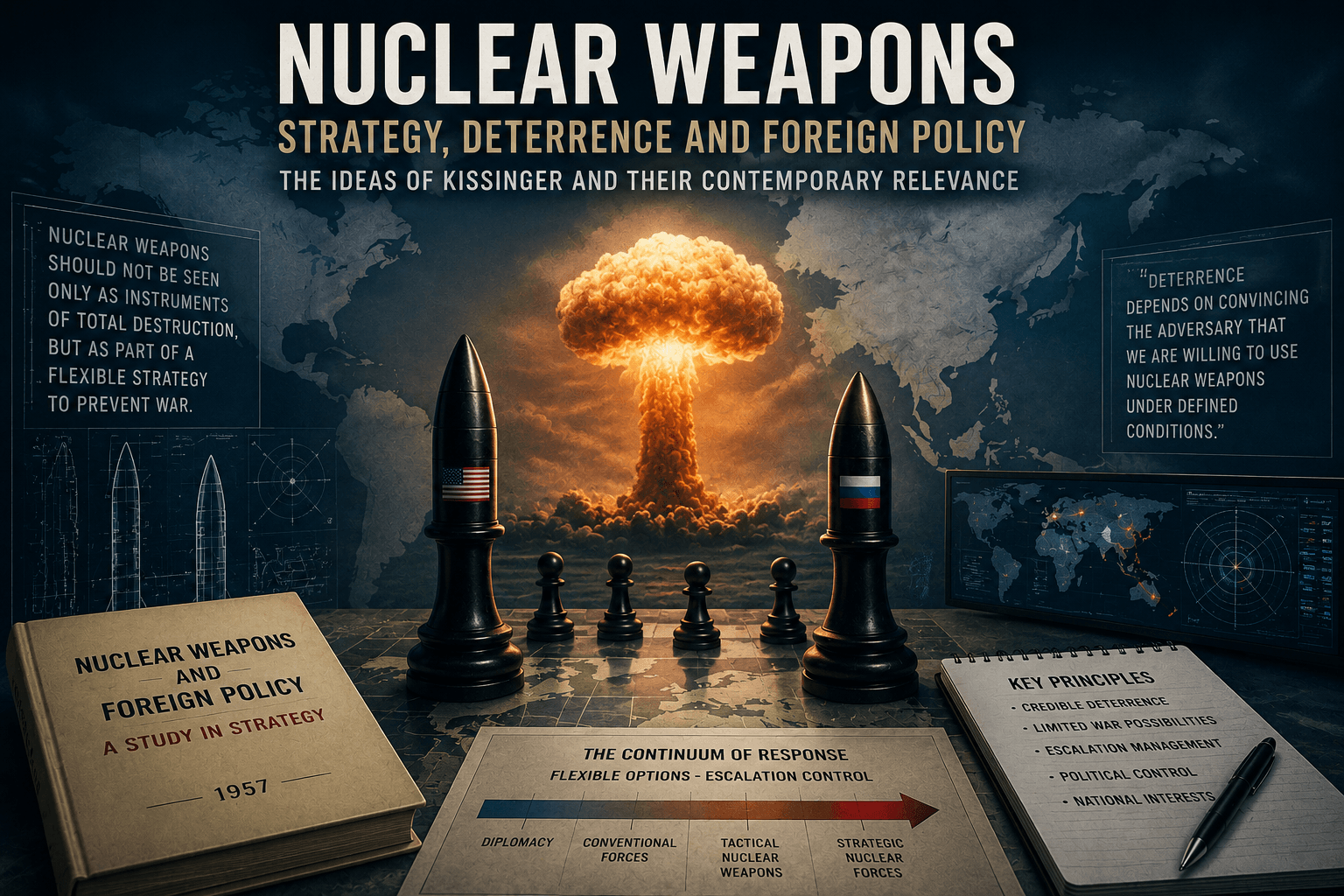
In the tense atmosphere of the early Cold War, few strategic thinkers influenced Western nuclear doctrine as profoundly as Henry Kissinger. Before becoming a famous diplomat and U.S. Secretary of State, Kissinger established himself as a controversial intellectual voice through his 1957 book Nuclear Weapons and Foreign Policy. Written during a period marked by fear of atomic annihilation and growing rivalry between the United States and the Soviet Union, the work challenged dominant assumptions regarding nuclear war. Instead of treating nuclear conflict as an unthinkable apocalypse that could only end in total destruction, Kissinger argued that limited nuclear war might be strategically possible and, under certain circumstances, politically necessary. His ideas reshaped debates on deterrence, military planning, and Cold War diplomacy, while also generating intense criticism from scholars, military leaders, and peace advocates.
Stay ahead of global events.
Get clear geopolitical analysis in your inbox.
Kissinger’s central argument emerged from dissatisfaction with the doctrine of “massive retaliation” promoted during the administration of President Dwight D. Eisenhower. According to this doctrine, any major Soviet aggression would trigger overwhelming nuclear retaliation by the United States. Kissinger believed this strategy lacked credibility because it offered policymakers only two extreme options: surrender or total nuclear war. In practice, he argued, American leaders would hesitate to unleash civilization-ending destruction in response to limited aggression, especially in contested regions such as Europe. As a result, the Soviet Union might exploit this strategic rigidity by conducting smaller conventional or tactical operations under the assumption that Washington would avoid escalation.
To address this problem, Kissinger proposed a more flexible nuclear strategy centered on limited war. He argued that nuclear weapons should not automatically be viewed solely as instruments of total annihilation but also as military tools that could be integrated into broader strategic calculations. Tactical nuclear weapons, in particular, could theoretically be used on battlefields to halt enemy advances without necessarily provoking unrestricted global catastrophe. Kissinger believed that by developing credible limited nuclear options, the United States could strengthen deterrence and maintain strategic stability. In his view, deterrence depended not merely on possessing nuclear weapons but on convincing adversaries that political leaders were genuinely willing to use them under defined conditions.
This argument represented a dramatic departure from the dominant public perception of nuclear conflict during the 1950s. Only a decade after the atomic bombings of Atomic bombings of Hiroshima and Nagasaki, much of the world associated nuclear weapons with absolute devastation. Kissinger did not deny their destructive capacity, yet he insisted that policymakers had to think beyond moral shock and confront strategic realities. The Soviet Union’s growing nuclear capabilities made some form of nuclear confrontation conceivable, and therefore Western planners needed practical doctrines rather than abstract fears. His analysis reflected the broader evolution of Cold War strategic thought, in which military theorists increasingly sought methods of controlling escalation rather than merely preventing war altogether.
Kissinger’s ideas significantly influenced later strategic doctrines associated with “flexible response,” particularly during the administration of President John F. Kennedy. Flexible response aimed to provide the United States and NATO with a spectrum of military options ranging from conventional warfare to tactical nuclear deployment and, ultimately, strategic nuclear exchange. The goal was to make deterrence more credible by ensuring proportional responses to varying levels of aggression. Although Kissinger was not solely responsible for this doctrinal transformation, his writings helped legitimize the intellectual framework behind it. His emphasis on adaptability, escalation management, and political realism became central themes in Cold War strategic planning.
At the same time, critics fiercely attacked Kissinger’s conception of limited nuclear war. Many argued that his theories dangerously underestimated the unpredictability of escalation. Once nuclear weapons were used, even on a limited scale, there could be no guarantee that conflict would remain controlled. Opponents maintained that battlefield nuclear exchanges could rapidly spiral into full-scale thermonuclear war, especially given the speed of military decision-making and the enormous pressures placed upon political leaders during crises. Critics also emphasized the humanitarian consequences of any nuclear use, pointing out that even tactical nuclear weapons could cause catastrophic civilian casualties, environmental devastation, and long-term radioactive contamination.
Prominent strategists such as Bernard Brodie questioned whether nuclear war could ever remain politically rational once initiated. Others argued that Kissinger’s framework normalized the idea of nuclear conflict and lowered the psychological barriers against atomic warfare. Peace activists and disarmament advocates viewed his theories as morally troubling because they transformed weapons of mass destruction into instruments of ordinary military calculation. From this perspective, the very attempt to theorize “manageable” nuclear war risked making catastrophe more likely.
Despite these criticisms, many of Kissinger’s ideas retain considerable relevance in contemporary international relations. Modern nuclear powers continue to grapple with the problem of credible deterrence in an increasingly complex strategic environment. The emergence of smaller nuclear arsenals, precision-guided systems, cyber warfare, and tactical nuclear modernization has revived debates about escalation control and limited conflict. Countries such as Russia have incorporated concepts resembling limited nuclear use into their military doctrines, particularly through discussions of “escalate to de-escalate” strategies. These approaches suggest that limited nuclear strikes could theoretically compel adversaries to back down during conventional conflicts.
The war in Ukraine has further renewed global attention toward nuclear deterrence theory. Russian nuclear rhetoric, combined with fears of escalation between NATO and Moscow, has demonstrated that the questions raised by Kissinger in the 1950s remain unresolved. Policymakers continue to debate how nuclear threats can be managed without provoking uncontrollable escalation. Similarly, tensions involving China, North Korea, and regional nuclear rivalries in South Asia have reinforced the importance of strategic flexibility and deterrence credibility in modern defense planning.
Kissinger’s broader intellectual legacy also remains visible in contemporary realism within international relations theory. He believed that states operate primarily according to calculations of power, survival, and strategic interest rather than moral idealism alone. This perspective continues to influence debates over nuclear modernization, alliance systems, and great-power competition in the twenty-first century. Supporters argue that realism offers a sober framework for understanding how states behave under conditions of existential insecurity. Critics, however, contend that excessive reliance on strategic realism can marginalize ethical concerns and normalize permanent geopolitical confrontation.
The enduring controversy surrounding Kissinger’s nuclear theories reflects a deeper tension within modern strategic thought. On one side lies the belief that policymakers must prepare for every conceivable scenario, including limited nuclear conflict, in order to maintain credible deterrence and prevent adversaries from exploiting strategic weaknesses. On the other side stands the conviction that any attempt to rationalize nuclear warfare fundamentally misunderstands the catastrophic humanitarian and political consequences such weapons entail. This debate has never truly disappeared because nuclear weapons themselves continue to exist as central instruments of global power.
Ultimately, Nuclear Weapons and Foreign Policy remains one of the most influential and contentious strategic works of the Cold War era. Kissinger challenged simplistic assumptions about deterrence and forced policymakers to confront difficult questions regarding escalation, credibility, and military flexibility. Although many of his conclusions remain deeply controversial, his ideas shaped decades of nuclear strategy and continue to resonate in contemporary discussions about international security. In a world where nuclear arsenals persist and geopolitical tensions endure, the dilemmas explored by Kissinger during the 1950s remain disturbingly relevant.
You May Also Like
A Brief History of Greenland: Key Dates and Events
BRICS: What It Is and What It Wants to Become
Soft Power vs Hard Power: What’s the Difference and Why It Matters
What Is Geopolitics? Meaning, Examples, and Why It Matters Today
Hybrid Warfare: A Misleading Label for an Enduring Reality
Naval Blockade: History and Strategic Utility