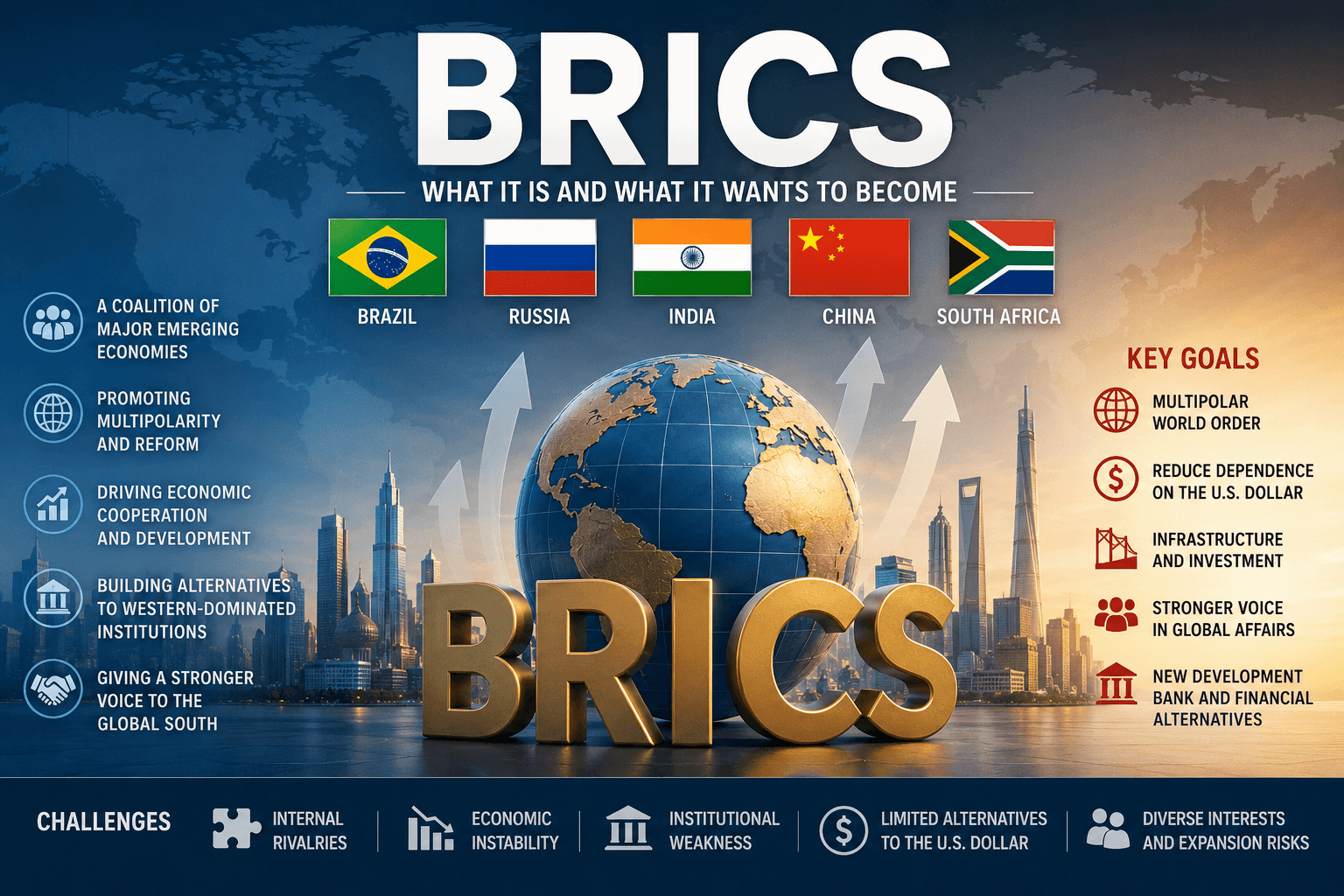
In recent years, BRICS has evolved from a loose economic concept into one of the most discussed geopolitical blocs in the world. Originally formed by Brazil, Russia, India, China, and South Africa, the organization now seeks to present itself as a major alternative voice to the Western-led international order. Supporters see BRICS as a platform for multipolarity, economic cooperation, and reform of global institutions. Critics, however, argue that the bloc suffers from deep internal contradictions, limited cohesion, and unrealistic ambitions.
As global tensions intensify and emerging powers gain influence, BRICS has become increasingly relevant in debates surrounding international trade, global governance, energy, and the future balance of power. Understanding what BRICS is — and what it hopes to become — is essential for analyzing twenty-first-century geopolitics.
Stay ahead of global events.
Get clear geopolitical analysis in your inbox.
What Is BRICS?
BRICS is an intergovernmental grouping that initially brought together five major emerging economies: Brazil, Russia, India, China, and South Africa. The term “BRIC” was first coined in 2001 by economist Jim O’Neill of Goldman Sachs, who predicted that these rapidly developing economies would become increasingly influential in global affairs. South Africa joined the group in 2010, transforming BRIC into BRICS.
The organization was created to promote cooperation among emerging economies and to increase their influence within international institutions dominated by Western powers, particularly the United States and Europe. Over time, BRICS expanded its agenda from economics into diplomacy, energy, technology, finance, and security issues.
In 2024, BRICS entered a new phase of expansion by inviting additional countries into the bloc. This enlargement reflected growing interest from states seeking alternatives to Western-led institutions and financial systems. Countries in the Global South increasingly view BRICS as a platform through which they can gain greater political and economic autonomy.
Despite this growing visibility, BRICS is not a military alliance like NATO, nor is it a deeply integrated economic union like the European Union. Instead, it operates as a flexible political and economic forum with broad goals but limited institutional integration.
The Main Goals of BRICS
One of the central objectives of BRICS is the promotion of a “multipolar world order.” In practical terms, this means reducing the dominance of Western powers — especially the United States — in international politics and economics.
BRICS countries frequently criticize institutions such as the International Monetary Fund and the World Bank for reflecting Western priorities and power structures established after the Second World War. The bloc argues that emerging economies deserve greater representation within these institutions.
Another major objective involves reducing dependence on the U.S. dollar in international trade. Several BRICS leaders have openly discussed conducting trade in national currencies or creating alternative payment systems. This effort accelerated after Western sanctions against Russia following the war in Ukraine highlighted the strategic importance of the dollar-based financial system.
BRICS also seeks stronger economic cooperation among member states. Areas of collaboration include infrastructure investment, energy partnerships, agricultural trade, technological development, and digital finance. One of the organization’s most significant achievements has been the creation of the New Development Bank, often described as an alternative to Western-dominated financial institutions.
Supporters of BRICS argue that the organization gives developing nations a stronger voice in global affairs. Many countries in Africa, Latin America, Asia, and the Middle East believe the current international system does not adequately represent their interests. BRICS attempts to position itself as a champion of the Global South.
Why BRICS Attracts Attention
Several factors explain the growing global attention surrounding BRICS.
First, the combined demographic and economic weight of its members is enormous. BRICS countries account for a significant percentage of the world’s population, natural resources, and economic output. China and India alone represent more than one-third of humanity.
Second, dissatisfaction with the Western-led international order has increased in many regions. Some governments believe that Western powers apply international rules selectively, particularly regarding sanctions, military interventions, and trade policies. BRICS benefits politically from this perception.
Third, global geopolitical tensions have accelerated the search for alternative partnerships. The growing rivalry between the United States and China, combined with the consequences of the war in Ukraine, has encouraged many states to diversify their diplomatic and economic relationships.
For some countries, closer ties with BRICS provide strategic flexibility. Rather than fully aligning with either Washington or Beijing, they seek to maintain multiple partnerships simultaneously.
The Influence of China Within BRICS
Although BRICS officially promotes equality among members, China clearly plays the dominant role within the organization. China possesses the world’s second-largest economy and contributes enormous financial resources to BRICS initiatives.
This imbalance creates both opportunities and tensions. On one hand, Chinese economic power gives BRICS credibility and financial capacity. On the other hand, some members worry that the bloc could become excessively dependent on Beijing.
India, in particular, maintains a cautious approach toward Chinese influence. Despite participating in BRICS, India and China remain geopolitical rivals with unresolved border disputes and competing strategic ambitions in Asia. This rivalry highlights one of the central contradictions inside the organization.
Russia also views BRICS as strategically important, especially as tensions with the West continue. For Moscow, the bloc provides diplomatic legitimacy and access to non-Western economic partnerships. However, Russia’s growing dependence on China has altered internal power dynamics within BRICS.
Criticism of BRICS
Despite ambitious rhetoric, BRICS faces substantial criticism from analysts, economists, and policymakers.
One common criticism is that the organization lacks unity. The member states possess different political systems, economic structures, strategic interests, and foreign policy priorities. Democratic India, authoritarian China, energy-exporting Russia, and economically troubled South Africa often have divergent objectives.
Unlike the European Union, BRICS lacks strong institutions capable of enforcing collective decisions. Most agreements remain symbolic or loosely coordinated. Critics argue that the bloc frequently produces declarations rather than concrete action.
Economic disparities among members also create difficulties. China’s economy is vastly larger than those of the other BRICS countries, creating fears of imbalance and dependency. Some observers argue that BRICS is less a partnership of equals and more a platform increasingly shaped by Chinese interests.
Another criticism concerns the bloc’s anti-Western image. Although BRICS officially claims to support international cooperation rather than confrontation, many Western analysts see it as a geopolitical tool designed to challenge U.S. influence. Critics warn that increasing global polarization could deepen divisions between competing blocs.
Human rights issues also generate controversy. Some BRICS members face criticism regarding political freedoms, censorship, corruption, or democratic backsliding. Opponents argue that the organization rarely addresses these concerns because its members prioritize sovereignty and non-interference over liberal democratic principles.
Obstacles to BRICS Expansion and Development
While BRICS has expanded its global visibility, several major obstacles could limit its long-term development.
The first challenge is internal rivalry. China and India compete for influence in Asia, while Brazil often prioritizes regional concerns in Latin America. These strategic differences complicate efforts to develop a unified geopolitical vision.
The second obstacle involves economic instability. Several BRICS countries face serious domestic problems, including inflation, debt, corruption, slow growth, or political instability. South Africa, for example, has struggled with energy shortages and economic stagnation. Brazil has experienced repeated political crises and fluctuating economic performance.
A third challenge concerns institutional weakness. BRICS lacks the legal and political integration necessary for rapid collective action. Decisions are generally based on consensus, which slows implementation and limits effectiveness.
Currency ambitions represent another major difficulty. While BRICS leaders often discuss reducing dependence on the U.S. dollar, replacing the dollar in global trade is extremely difficult. The American financial system remains deeply integrated into the global economy, and investors continue to trust U.S. financial markets more than most alternatives.
In addition, many BRICS members still maintain strong economic ties with Western countries. India, for example, cooperates closely with the United States in several strategic sectors despite participating in BRICS. This dual positioning limits the bloc’s ability to act as a fully unified geopolitical force.
Finally, expansion itself could create new problems. Adding more countries increases diversity but may also weaken cohesion. The larger BRICS becomes, the more difficult it may be to reach consensus on sensitive issues.
Can BRICS Reshape the Global Order?
The future of BRICS remains uncertain. The organization clearly reflects important global trends: the rise of emerging powers, dissatisfaction with Western dominance, and the growing demand for multipolarity.
However, transforming these ambitions into a coherent alternative world order is far more complicated.
BRICS possesses considerable demographic, economic, and geopolitical weight. Its influence will likely continue to grow, especially among developing nations seeking greater independence in international affairs. The organization has already succeeded in increasing pressure for reform within global institutions.
At the same time, internal contradictions remain substantial. Strategic rivalries, uneven economic development, and institutional limitations reduce the bloc’s effectiveness. BRICS may become an increasingly influential diplomatic platform without ever achieving the cohesion of alliances such as the European Union or NATO.
Ultimately, BRICS represents both opportunity and ambiguity. To supporters, it symbolizes a more balanced and representative international system. To critics, it remains a fragmented coalition united more by dissatisfaction with the West than by a truly shared vision for the future.
The coming decade will determine whether BRICS evolves into a transformative geopolitical force or remains primarily a symbolic expression of the changing global balance of power.
You May Also Like
Soft Power vs Hard Power: What’s the Difference and Why It Matters
What Is Geopolitics? Meaning, Examples, and Why It Matters Today
Why a Palestinian State May Pose Strategic Risks for Israel
Geography Does Not Disappear: How Maps Still Shape Global Politics
The Case Against a Nuclear-Armed Iran