Introduction: The Power and the Problem of a Concept
In recent years, “hybrid warfare” has become one of the most frequently invoked terms in strategic analysis. It is used to describe conflicts that combine conventional military force with irregular tactics, cyber operations, disinformation, economic coercion, and political manipulation. The term gained particular prominence after 2014, when it was widely applied to explain Russia’s actions in Ukraine.
Yet the rapid adoption of the concept raises an important question: does hybrid warfare actually describe a new type of conflict, or does it merely repackage familiar practices under a modern label? This article does not deny the existence of multi-domain conflict. Rather, it questions whether the concept of hybrid warfare adds analytical clarity or instead contributes to conceptual confusion.
The central argument advanced here is that hybrid warfare is not a new form of war. It is a modern description of the long-standing integration of military and non-military instruments, intensified by technological change and executed at greater speed.
Stay ahead of global events.
Get clear geopolitical analysis in your inbox.
The Illusion of Novelty
The appeal of the concept lies in its apparent ability to explain the complexity of contemporary conflict. However, this appeal rests on a questionable assumption: that earlier forms of war were simpler, more “pure,” and confined to clearly defined battlefields.
Historical evidence contradicts this assumption. War has always involved a mixture of methods and instruments. The Trojan War, often cited as one of the earliest recorded conflicts, already demonstrates the integration of deception, psychology, and military action. The Trojan Horse was not a conventional assault but a carefully designed stratagem aimed at manipulating perception.
This logic was explicitly articulated by Sun Tzu, who argued that deception is the essence of warfare. His insight—that one must shape the enemy’s perception rather than merely confront their forces—remains fully applicable today. Modern information warfare, often presented as a novel development, is fundamentally an extension of this ancient principle.
Deception as a Permanent Feature of War
Throughout history, deception has been central to military success. It has taken many forms, from simple misdirection to complex strategic operations.
During the Second World War (1939-1945), Operation Bodyguard exemplified the systematic use of deception at a grand scale. The Allied effort to mislead Nazi Germany about the location of the D-Day landings involved fake armies, controlled leaks, false radio transmissions, and coordinated misinformation. The objective was to shape enemy expectations and delay response, thereby ensuring the success of the actual invasion.
Such operations are often described today as elements of hybrid warfare. Yet they demonstrate that the integration of military planning with information manipulation is not new. What has changed is the speed and reach of communication technologies, which allow similar strategies to be executed more rapidly and on a global scale.
Indirect Action and Proxy Conflict
Another defining feature attributed to hybrid warfare is the use of indirect methods, particularly the exploitation of internal divisions within a target state.
This approach has a long history. In 1938, Germany destabilized Czechoslovakia by mobilizing political movements among ethnic Germans in the Sudetenland. The resulting unrest provided both a justification and a mechanism for external intervention. The strategy combined political agitation, propaganda, and the threat of military force—an integrated approach that closely resembles what is now labeled hybrid warfare.
During the Cold War, indirect action became a central instrument of great power competition. The Iranian coup d’état (1953) and the Chilean coup d’état (1973) illustrate how external actors could shape internal political outcomes without direct military confrontation.
The Vietnam War further demonstrates the integration of conventional and irregular warfare. North Vietnam combined regular military operations with guerrilla tactics carried out by the Viet Cong, creating a multi-layered conflict that blurred the line between internal and external war. Such combinations are often described as hybrid today, yet they were already well established decades ago.
Manufactured Pretexts and Narrative Control
The manipulation of events to justify military action is another recurring feature of warfare. States have frequently used real or fabricated incidents to construct legitimacy and frame themselves as defenders rather than aggressors.
The Mukden Incident provided Japan with a justification for expansion into China (1931). Similarly, the Gleiwitz Incident (1939) was used to legitimize the invasion of Poland. The USS Maine explosion played a comparable role in mobilizing support for war between the United States and Spain (1898).
These examples highlight the enduring importance of narrative control in warfare. Modern disinformation campaigns operate within the same strategic logic, albeit with more advanced tools and broader reach. The informational dimension of conflict has expanded, but it has not fundamentally changed in nature.
Technology: Transformation of Means, Not Essence
Technological innovation is often cited as the primary reason why hybrid warfare represents a new form of conflict. Cyber operations, digital surveillance, and social media manipulation have undoubtedly expanded the range of available tools.
However, history suggests that technological change does not necessarily produce conceptual rupture. The introduction of gunpowder, the development of mechanized warfare, and the advent of nuclear weapons all transformed the conduct of war without redefining its essence.
Cyber capabilities follow the same pattern. They enhance the ability to disrupt, influence, and gather intelligence, but they do not alter the fundamental nature of conflict. They are best understood as new instruments serving familiar strategic purposes.
Non-State Actors and the Persistence of Complexity
The growing role of non-state actors is another argument used to support the novelty of hybrid warfare. Yet such actors have been present throughout history.
Partisan movements during the Second World War, for example, played a crucial role in resisting occupation and supporting conventional military operations. Their activities—sabotage, intelligence gathering, and guerrilla warfare—were integrated into broader strategic frameworks.
The presence of non-state actors therefore does not represent a new phenomenon. What has changed is their ability to coordinate and communicate, facilitated by modern technologies.
Integration and Speed: The Real Transformation
If the elements associated with hybrid warfare are not new, what explains the perception of novelty? The answer lies in the degree of integration and the speed of execution.
Modern conflicts are characterized by the simultaneous use of multiple instruments of power. Military operations, cyber attacks, economic measures, and information campaigns can be coordinated to achieve cumulative effects. This synchronization creates challenges for decision-makers, who must respond to multiple, overlapping pressures. Ambiguity and speed can delay reaction and complicate attribution.
This represents a significant operational shift. However, it does not constitute a new type of war. It reflects the intensification of existing practices under conditions of technological acceleration.
The Problem of Conceptual Inflation
The concept of hybrid warfare suffers from a fundamental weakness: it is too broad. If any conflict involving multiple methods is labeled hybrid, then the term loses its ability to distinguish between different types of warfare.
Calling modern conflict “hybrid warfare” because it combines multiple methods is conceptually similar to calling modern economies “hybrid economies” simply because they integrate different sectors. The label adds little analytical value.
This conceptual inflation has practical consequences. It can obscure the specific mechanisms at work in a given conflict and lead to imprecise strategic thinking. A concept that explains everything ultimately explains nothing.
Toward a More Precise Analytical Framework
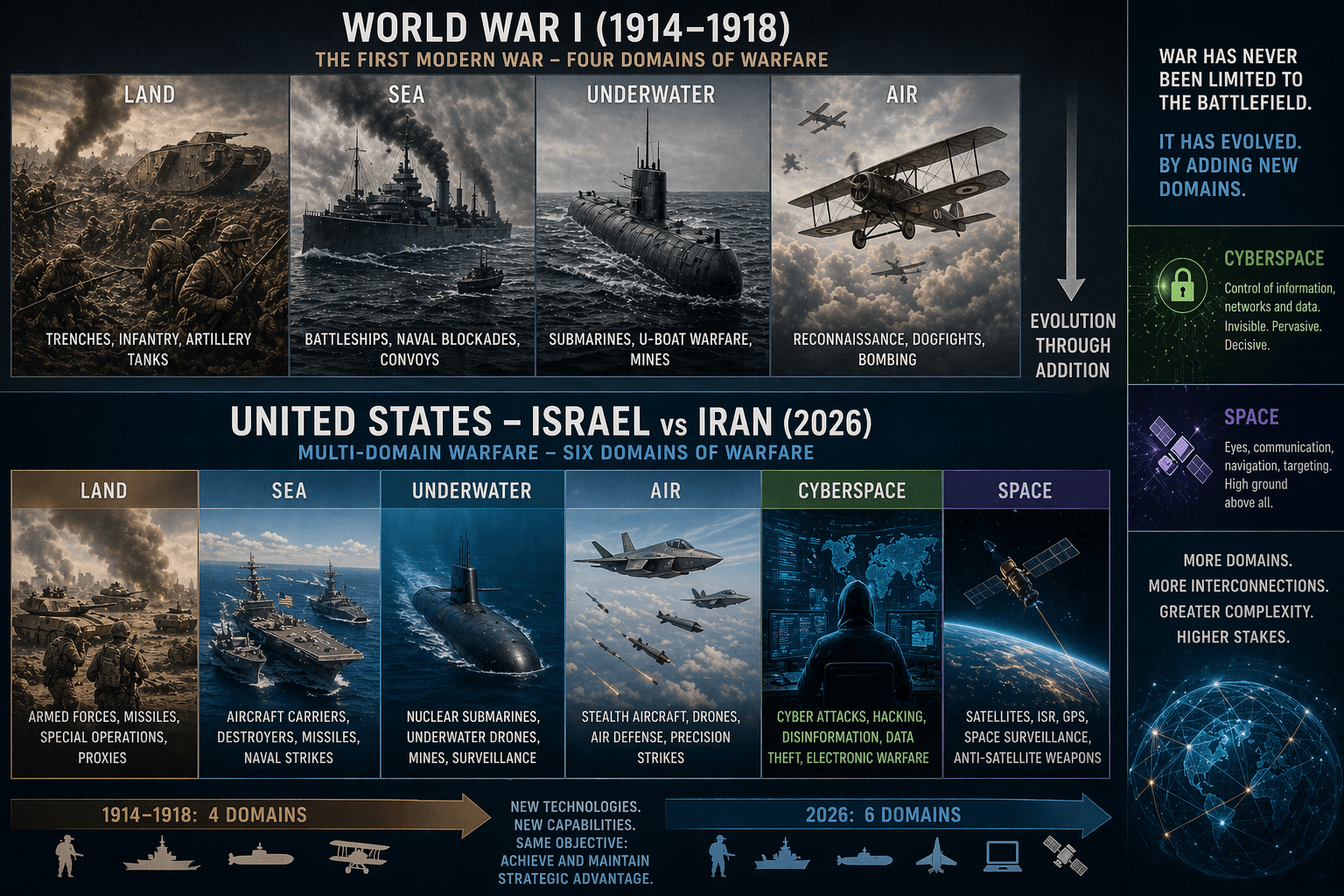
A more rigorous analytical framework disaggregates conflict into a set of interacting mechanisms: deception and perception management, designed to distort adversary cognition, fragment situational awareness, and impose decision-making delays; indirect action and proxy utilization, which extend strategic reach while preserving deniability, diffusing responsibility, and raising the political threshold for retaliation; the strategic deployment of technological instruments, from precision strike systems to cyber capabilities, which compress time, expand battlespace, and increase the speed, scale, and reversibility of effects; narrative construction and legitimacy management, through which actors frame events, mobilize support, and shape both domestic consent and international tolerance; and, finally, the synchronization of these elements across multiple domains—land, sea, air, underwater, space, and cyberspace—in order to generate cumulative, mutually reinforcing effects that exceed the impact of any single instrument employed in isolation.
Crucially, these mechanisms do not operate independently. Their effectiveness derives from interaction: deception amplifies the impact of proxy action by obscuring attribution; technological tools accelerate narrative dissemination and entrench competing interpretations; indirect methods exploit informational ambiguity to delay coherent responses; and cross-domain coordination multiplies pressure by forcing adversaries to allocate attention and resources simultaneously across disparate arenas. The result is not a new type of war, but a more tightly integrated application of familiar practices, executed at a tempo that challenges traditional decision cycles and institutional responses.
By isolating these mechanisms and examining their interplay, analysis can move beyond broad and imprecise labels toward a more granular understanding of how contemporary conflicts are structured and conducted. This approach preserves conceptual clarity, allows for meaningful comparison across historical cases, and avoids the analytical dilution that arises when heterogeneous phenomena are subsumed under a single, elastic category. In this sense, abandoning the catch-all notion of “hybrid warfare” in favor of mechanism-based analysis does not diminish our understanding of modern conflict—it refines it, grounding interpretation in observable processes rather than in conceptual generalization.
Conclusion: Continuity Behind Change
The concept of hybrid warfare captures an important intuition: modern conflict is complex, multi-dimensional, and fast-moving. However, this complexity does not represent a fundamental break with the past.
Historical examples—from the Trojan Horse to Cold War proxy wars—demonstrate that the practices associated with hybrid warfare have long been part of strategic behavior. What has changed is their integration, scale, and speed, not their essence.
As Carl von Clausewitz famously argued, war is a continuation of politics by other means. This insight remains valid regardless of the tools employed.
Hybrid warfare, therefore, does not describe a new reality. It reflects a modern tendency to reinterpret enduring patterns as novel. The challenge for analysis is not to multiply labels, but to understand how continuity operates within change.
You May Also Like
Naval Blockade: History and Strategic Utility
The Case for a Unified European Army: Strategic Autonomy, Security, and the Future of EU Power