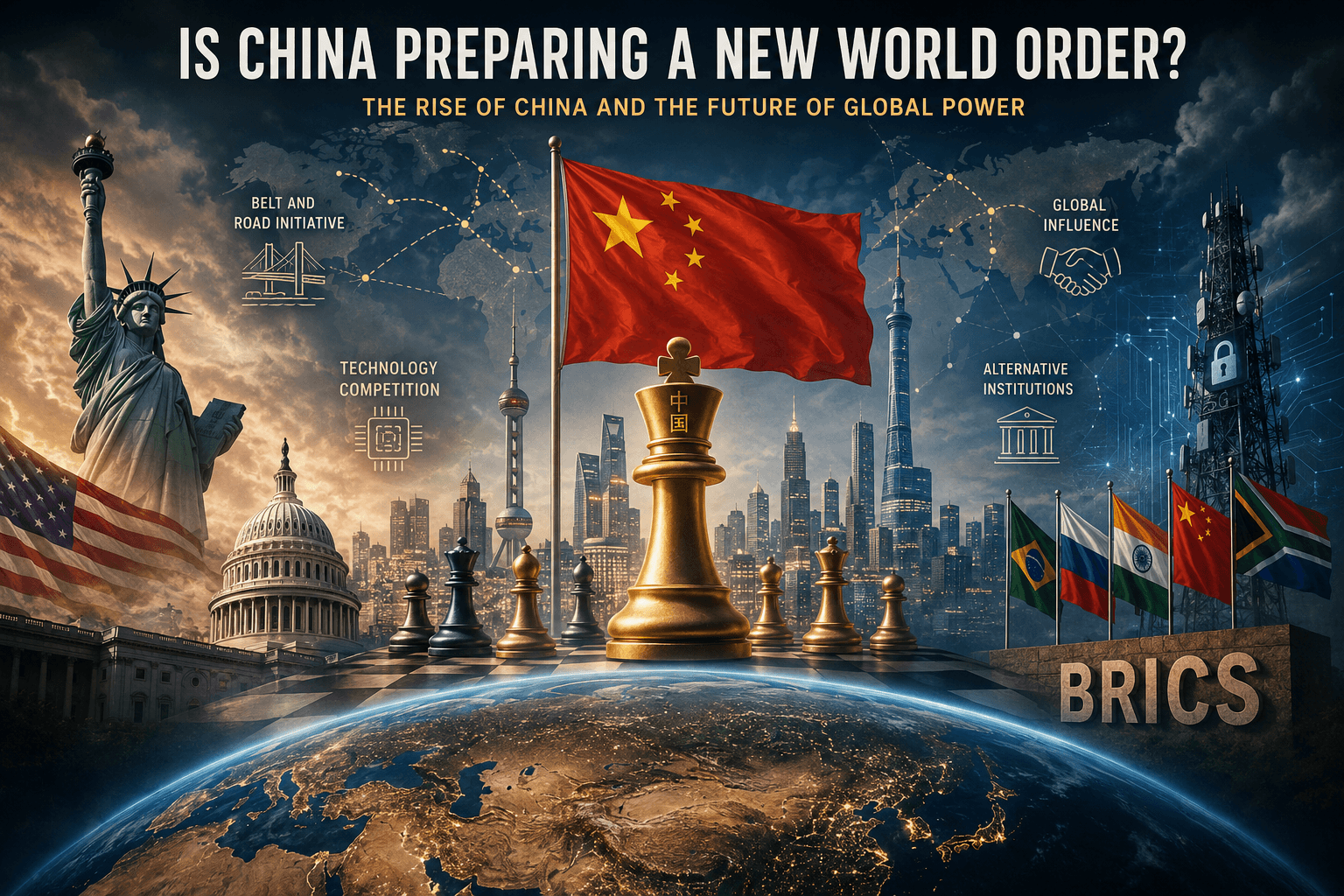
For most of the post-Cold War era, the international system revolved around a single dominant power: the United States. American military superiority, the dominance of the dollar, Western technological leadership, and institutions created after the Second World War shaped what many described as a “rules-based international order.” Yet in the early twenty-first century, another power has emerged with the ambition, economic strength, and geopolitical patience necessary to challenge that system: China.
The central geopolitical question of our time is no longer whether China will become influential. That phase has already passed. The real question is whether Beijing seeks merely a larger role within the existing international order—or whether it is quietly constructing an entirely new one.
From trade routes and infrastructure investments to technological competition, military expansion, and diplomatic outreach across the Global South, China increasingly behaves not as a rising regional power, but as a state preparing for systemic leadership. While Chinese officials reject accusations that they seek global dominance, many of Beijing’s actions suggest an attempt to reshape the political and economic architecture of the twenty-first century.
Stay ahead of global events.
Get clear geopolitical analysis in your inbox.
The End of the Unipolar Moment
The collapse of the Soviet Union in 1991 left the United States as the world’s sole superpower. For decades, this “unipolar moment” appeared unshakable. American military alliances stretched across Europe and Asia, the dollar became the backbone of global finance, and Western institutions such as the IMF and World Bank exerted enormous influence over developing countries.
China initially benefited from this order. After economic reforms initiated by Deng Xiaoping in the late twentieth century, Beijing integrated itself into global markets and became the manufacturing center of the world. Western corporations invested heavily in Chinese industry, believing economic liberalization would eventually lead to political liberalization.
That assumption proved deeply flawed.
Instead of becoming more politically Western, China used globalization to strengthen its own authoritarian-capitalist model. Under Xi Jinping, the Chinese state has become more centralized, more nationalistic, and more ambitious internationally. Beijing no longer appears content merely participating in a system designed by others. Increasingly, it seeks to influence the rules themselves.
The Belt and Road Initiative: Infrastructure as Geopolitics
Perhaps the clearest symbol of China’s global ambitions is the Belt and Road Initiative (BRI), launched in 2013. Officially presented as an infrastructure and connectivity project, the BRI aims to link Asia, Europe, Africa, and parts of Latin America through ports, railways, highways, pipelines, and digital networks.
To supporters, the initiative represents an unprecedented development opportunity for poorer nations neglected by Western investment. Chinese loans have financed ports in Pakistan, railways in East Africa, highways in Central Asia, and industrial projects across the developing world.
Critics, however, see something far more strategic.
By funding critical infrastructure abroad, China gains political leverage, economic influence, and long-term access to strategic regions. Ports built with Chinese financing can potentially support Chinese naval operations in the future. Nations deeply indebted to Beijing may become more politically aligned with Chinese interests in international forums.
The BRI is therefore not simply about economics. It is about creating a China-centered network of global connectivity capable of rivaling traditional Western influence.
Importantly, China presents this strategy differently from the interventionist approaches historically associated with Western powers. Beijing emphasizes sovereignty, non-interference, and pragmatic cooperation. Many governments in Africa, the Middle East, and Southeast Asia find this approach attractive because it avoids lectures about democracy or human rights.
As a result, China has steadily expanded its diplomatic influence across regions once considered firmly within the Western sphere.
The Global South and China’s Diplomatic Offensive
One of the most significant geopolitical developments of recent years has been China’s growing popularity in the Global South. Across Africa, Latin America, and parts of Asia, many political leaders increasingly view Beijing as a viable alternative to Western dominance.
This trend is partly rooted in history. Many post-colonial states retain deep suspicions toward Western powers due to the legacies of imperialism, military intervention, and economic dependency. China, by contrast, portrays itself as a fellow victim of historical humiliation and foreign exploitation.
Beijing has carefully cultivated this narrative.
Chinese diplomacy emphasizes multipolarity—the idea that the world should not be dominated by a single superpower. This message resonates strongly among states seeking greater autonomy from Washington. Chinese investment, infrastructure projects, vaccine diplomacy during the COVID-19 pandemic, and expanding trade relationships have strengthened these perceptions.
Organizations such as BRICS further illustrate this shift. Originally composed of Brazil, Russia, India, China, and South Africa, BRICS has expanded and increasingly positions itself as a counterweight to Western-dominated institutions. China plays a central role within this framework, advocating financial reforms that reduce dependence on the US dollar and Western-controlled institutions.
The geopolitical significance of this trend cannot be overstated. If enough countries begin orienting themselves economically and diplomatically toward China, the foundations of the post-1945 international system could gradually erode.
The Technology War Between China and the United States
No struggle better captures the emerging rivalry between China and the United States than the battle over technology.
In previous centuries, global power depended largely on territorial conquest or industrial production. In the twenty-first century, technological supremacy may prove even more decisive. Artificial intelligence, semiconductors, quantum computing, telecommunications, and cyber capabilities now represent the strategic high ground of international politics.
China understands this reality clearly.
Through initiatives such as “Made in China 2025,” Beijing has sought to reduce dependence on foreign technology while establishing leadership in advanced industries. Chinese firms such as Huawei and BYD have become global competitors in telecommunications and electric vehicles.
The United States views these developments with growing alarm. Washington increasingly fears that Chinese technological dominance could undermine American military superiority, economic leadership, and intelligence capabilities. As a result, the US has imposed export controls on advanced semiconductor technology and pressured allies to limit cooperation with Chinese tech companies.
This technological confrontation resembles a new form of Cold War—one fought not primarily through ideology, but through innovation, supply chains, and data control.
China’s long-term objective appears clear: technological self-sufficiency combined with global influence over emerging industries. If achieved, such dominance would fundamentally reshape international power structures.
Taiwan: The Most Dangerous Flashpoint in the World
No issue is more central to China’s geopolitical ambitions than Taiwan.
The Chinese Communist Party considers Taiwan a breakaway province that must eventually be reunified with mainland China. Beijing insists this reunification is inevitable and refuses to renounce the possibility of using force.
For the United States and many of its allies, however, Taiwan represents far more than a territorial dispute. The island occupies a strategically crucial location in the Western Pacific and produces a massive share of the world’s advanced semiconductors. A Chinese takeover of Taiwan would dramatically alter the balance of power in Asia.
The danger lies not only in military escalation, but in symbolism.
If China successfully absorbed Taiwan despite American opposition, many states around the world might conclude that the era of US dominance had ended. American alliances in Asia could weaken, while China’s prestige would soar.
For this reason, Taiwan has become one of the most dangerous geopolitical flashpoints on Earth. A conflict there could involve not only China and the United States, but potentially Japan, Australia, and other regional actors.
The stakes are therefore global, not merely regional.
China and Russia: A Strategic Partnership Against Western Dominance
China’s relationship with Russia also plays a critical role in the emerging geopolitical landscape. Although the two countries do not form a formal military alliance, they share a common interest in reducing American global influence.
Both governments oppose what they perceive as Western interventionism and support a more multipolar international system. Economic cooperation between Beijing and Moscow has expanded significantly, particularly after Western sanctions against Russia intensified following the war in Ukraine.
China benefits from discounted Russian energy exports, while Russia increasingly relies on Chinese markets and technology. Militarily, the two powers conduct joint exercises and coordinate diplomatically in international forums.
However, the relationship is not entirely equal.
China’s economy vastly surpasses Russia’s, and Beijing appears careful not to become too closely tied to Moscow’s geopolitical risks. Nevertheless, the partnership reflects a broader trend: the gradual formation of networks resistant to Western pressure.
This does not necessarily mean a new Cold War identical to the twentieth-century version. The modern world is far more economically interconnected. Yet the geopolitical logic of bloc formation is becoming increasingly visible.
The Dollar and the Future of Global Finance
One of the pillars of American global influence has long been the dominance of the US dollar. International trade, energy markets, and global reserves rely heavily on the American currency, granting Washington enormous financial leverage.
China increasingly seeks to reduce that dependence.
Beijing has promoted international use of the yuan, developed alternative financial systems, and encouraged trade agreements conducted in non-dollar currencies. Some countries, especially those wary of US sanctions, view these alternatives favorably.
Although the dollar remains dominant, even gradual diversification could weaken American influence over time. China does not necessarily need to replace the dollar entirely. It merely needs to create a parallel system resilient enough to limit US coercive power.
This strategy reflects a broader Chinese approach: rather than openly destroying the existing order, Beijing often seeks to slowly build alternatives alongside it.
Is China Exporting an Ideology?
Unlike the Soviet Union during the Cold War, China does not aggressively promote a universal ideological revolution. Beijing rarely attempts to export communism in the traditional sense.
Instead, China promotes a model of governance centered on state authority, economic modernization, technological surveillance, and political stability. Some authoritarian governments view this model as highly attractive because it promises economic growth without democratic liberalization.
Chinese surveillance technology, digital infrastructure, and governance methods have already influenced several states around the world.
In this sense, China may not be exporting ideology directly, but it is normalizing an alternative vision of modernity—one less dependent on liberal democratic values.
That may ultimately prove one of the most transformative aspects of China’s rise.
Conclusion: A New World Order in Slow Motion
Is China preparing a new world order?
The evidence increasingly suggests that it is—not through sudden military conquest, but through gradual structural transformation. Beijing is building infrastructure networks, expanding diplomatic influence, challenging technological supremacy, strengthening alternative institutions, and promoting a multipolar vision of global politics.
China’s strategy differs fundamentally from the revolutionary models of past empires. Rather than seeking immediate domination, Beijing appears focused on patient accumulation of influence. Economic interdependence, technological leadership, and strategic partnerships form the core of this approach.
Whether China succeeds remains uncertain. The country faces serious challenges, including demographic decline, economic pressures, regional tensions, and resistance from the United States and its allies. Yet it would be a mistake to underestimate the scale of Beijing’s ambitions.
The world is entering an era defined not by the disappearance of American power, but by the emergence of genuine geopolitical competition for the first time since the Cold War.
The international order that shaped the late twentieth century is no longer uncontested. A new era is emerging—one in which China seeks not merely a seat at the table, but a decisive role in redesigning the table itself.
You May Also Like
BRICS: What It Is and What It Wants to Become
Soft Power vs Hard Power: What’s the Difference and Why It Matters
What Is Geopolitics? Meaning, Examples, and Why It Matters Today
The Thucydides Trap Is a Myth: What Athens, Sparta, and History Actually Reveal
Geography Does Not Disappear: How Maps Still Shape Global Politics