Introduction
Among the major geopolitical theories of the twentieth century, Rimland Theory remains one of the most influential in understanding global power politics, maritime strategy, and international relations. Developed primarily by Dutch-American political scientist Nicholas John Spykman during the Second World War, the theory challenged earlier assumptions about land power and argued that control over the coastal fringes of Eurasia — the “Rimland” — would determine the balance of power in the modern world.
Rimland Theory became a major intellectual foundation of American Cold War strategy, influencing policies such as containment, alliance-building, and military presence across Europe, the Middle East, and Asia. Even today, analysts often use the concept to explain geopolitical competition involving the United States, China, Russia, and emerging regional powers.
This article explores the origins of Rimland Theory, its core principles, historical applications, criticisms, and its continuing relevance in twenty-first-century geopolitics.
Stay ahead of global events.
Get clear geopolitical analysis in your inbox.
What Is Rimland Theory?
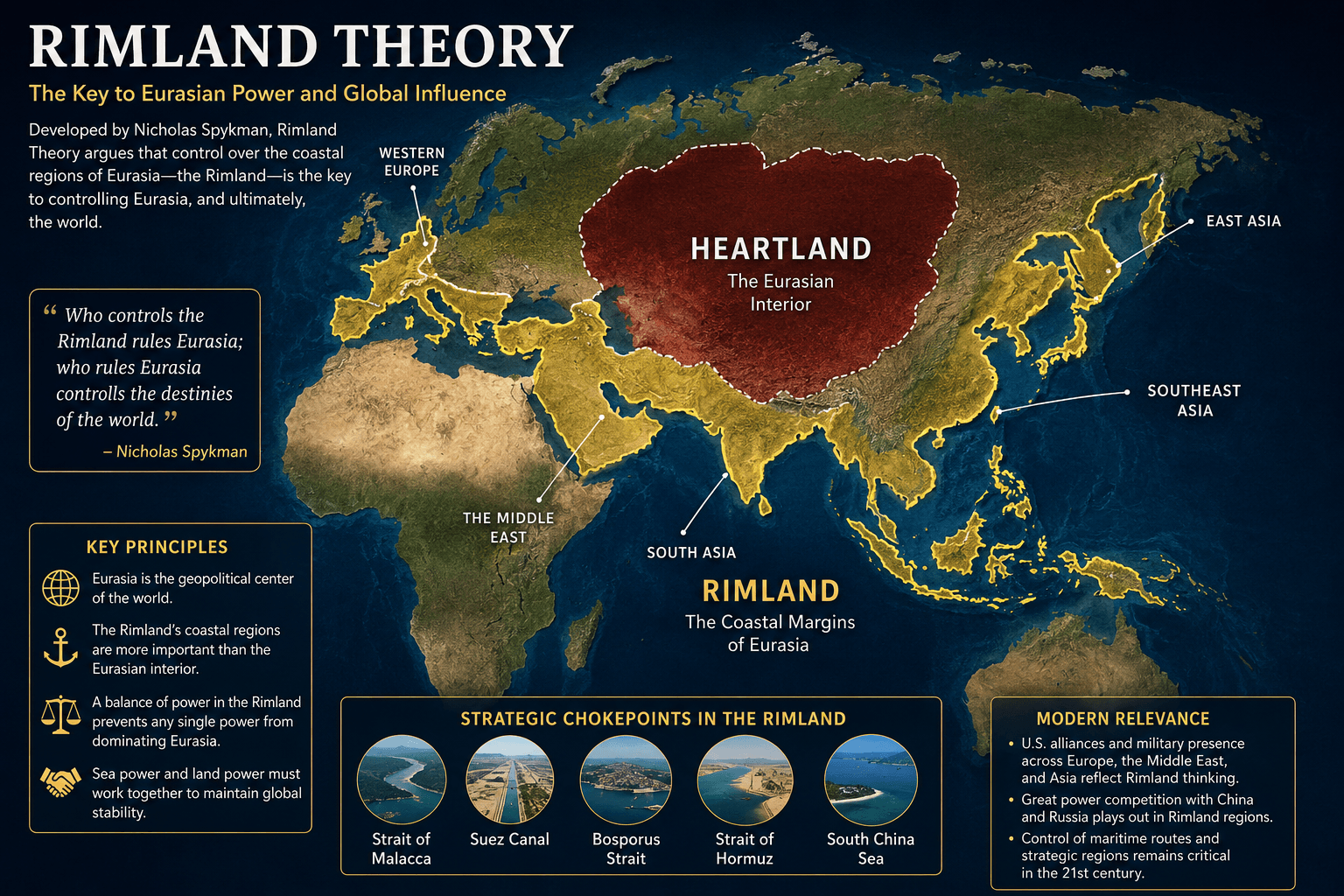
Rimland Theory is a geopolitical concept stating that the coastal regions surrounding Eurasia are the key to global dominance. According to Spykman, whoever controls the Rimland controls Eurasia, and whoever controls Eurasia holds the greatest potential to influence world affairs.
The theory emerged as a response to the earlier Heartland Theory developed by British geographer Halford Mackinder. Mackinder argued that control over the Eurasian interior — the “Heartland” — would ultimately lead to global supremacy. Spykman disagreed, believing that the coastal margins of Eurasia were more important because they contained the majority of the world’s population, economic resources, industrial capacity, and access to maritime trade routes.
Spykman summarized his argument in a famous phrase:
“Who controls the Rimland rules Eurasia; who rules Eurasia controls the destinies of the world.”
The Rimland includes Western Europe, the Middle East, South Asia, East Asia, and the coastal regions surrounding the Eurasian landmass. These areas form a strategic belt between maritime powers and continental powers.
The Origins of Rimland Theory
Rimland Theory was developed during a period of global instability marked by the rise of fascism, imperial rivalry, and world war. Spykman published his ideas in works such as America’s Strategy in World Politics (1942) and The Geography of the Peace (1944).
He believed geography remained a permanent factor in international politics, despite technological progress. In his view, states continued to compete for security and influence, and geographic position strongly affected national strategy.
Spykman criticized excessive isolationism in American foreign policy. He argued that the United States could not remain secure if a hostile power dominated Eurasia. Therefore, Washington needed to maintain a balance of power across the Rimland regions.
This perspective later became central to American grand strategy during the Cold War.
Core Principles of Rimland Theory
Several major ideas define Rimland Theory.
1. Eurasia Is the Strategic Center of the World
Spykman considered Eurasia the most important geopolitical space because it combined population, industry, resources, and military potential. Any power dominating Eurasia would possess enormous strategic advantages.
2. Coastal Regions Matter More Than the Interior
Unlike Mackinder’s focus on continental power, Spykman emphasized the importance of coastal territories. The Rimland connected land and sea power, making it economically dynamic and militarily strategic.
The region included many major ports, trade hubs, industrial zones, and densely populated areas.
3. Balance of Power Is Essential
Spykman believed no single state should dominate the Rimland. If one power gained control over these regions, it could potentially threaten global stability and American security.
This logic later justified alliance systems and military deployments designed to contain rival powers.
4. Sea Power and Land Power Must Be Combined
Rimland Theory recognized the importance of maritime power but did not dismiss land power. Instead, it argued that successful global influence required a combination of naval capabilities, alliances, and continental access.
Rimland Theory and the Cold War
Rimland Theory heavily influenced the foreign policy of the United States during the Cold War.
After the Second World War, American leaders feared the expansion of the Soviet Union into Europe, the Middle East, and Asia. Many Cold War policies reflected Spykman’s belief that controlling the Rimland was essential to maintaining global balance.
Containment Strategy
The American strategy of containment sought to prevent Soviet expansion into key Rimland regions. This approach shaped military alliances, economic assistance programs, and diplomatic initiatives.
Examples included:
- The creation of NATO in Europe
- American involvement in the Korean War
- Military alliances in Asia such as SEATO
- Strategic partnerships in the Middle East
These efforts aimed to stop Soviet influence from spreading across Eurasia’s coastal belt.
Military Presence
The United States established military bases throughout the Rimland, including in Germany, Japan, South Korea, Turkey, and the Persian Gulf. This global network reflected Spykman’s argument that strategic presence in Eurasia was necessary for long-term security.
Economic Integration
Programs such as the Marshall Plan also aligned with Rimland thinking. Economic stability in Western Europe reduced the risk of Soviet influence while strengthening American alliances.
The Importance of Maritime Chokepoints
Rimland Theory also highlighted the strategic significance of maritime routes and chokepoints.
Several critical areas lie within the Rimland:
- The Strait of Malacca
- The Suez Canal
- The Bosporus
- The Strait of Hormuz
- The South China Sea
These regions are vital for global commerce, energy transportation, and naval movement. Control or influence over these chokepoints can provide enormous geopolitical leverage.
Modern geopolitical tensions often focus on precisely these areas, demonstrating the continuing relevance of Spykman’s ideas.
Rimland Theory and China
In recent years, Rimland Theory has regained attention because of the rise of China.
China’s economic growth, military modernization, and maritime ambitions have transformed Asian geopolitics. Some analysts argue that Beijing seeks greater influence across the Indo-Pacific Rimland through infrastructure projects, naval expansion, and regional diplomacy.
The Belt and Road Initiative
China’s Belt and Road Initiative aims to improve connectivity across Eurasia through ports, railways, and trade corridors. Critics sometimes interpret the initiative as an attempt to increase strategic influence across key Rimland territories.
South China Sea Disputes
Territorial disputes in the South China Sea illustrate the strategic logic of Rimland competition. The region contains major shipping lanes, natural resources, and military importance.
The United States and its allies maintain a strong naval presence in the Indo-Pacific partly to preserve freedom of navigation and regional balance.
Indo-Pacific Strategy
American partnerships with countries such as Japan, India, Australia, and South Korea reflect modern attempts to maintain influence across the Asian Rimland.
Organizations like the Quad have become increasingly important in this context.
Rimland Theory and Russia
The geopolitical behavior of Russia is also frequently analyzed through Rimland Theory.
Russia historically sought access to warm-water ports and influence over neighboring buffer zones. Conflicts involving Eastern Europe, the Black Sea, and the Caucasus reveal the importance of strategic frontier regions.
The expansion of NATO into Eastern Europe after the Cold War can also be interpreted as a contest for influence within parts of the European Rimland.
The Russian invasion of Ukraine intensified debates over Eurasian balance of power and the strategic significance of border regions connecting Europe and Russia.
Criticisms of Rimland Theory
Despite its influence, Rimland Theory has faced substantial criticism.
Geographic Determinism
Critics argue that the theory places excessive emphasis on geography while underestimating ideology, economics, culture, and technological change.
Modern warfare, cyber capabilities, and nuclear deterrence have altered traditional geographic assumptions.
Oversimplification
Some scholars believe the theory reduces global politics to a simple struggle for territorial control. International relations are often more complex, involving diplomacy, institutions, domestic politics, and economic interdependence.
Colonial and Imperial Perspectives
Others criticize classical geopolitical theories for reflecting imperial-era thinking. Rimland Theory emerged during a period when major powers frequently competed for strategic dominance over weaker regions.
As a result, critics argue that such theories may encourage interventionism and power politics.
Technological Change
Advances in air power, missiles, satellites, and cyberwarfare have reduced some traditional geographic barriers. Critics question whether physical control of territory remains as decisive as Spykman believed.
Nevertheless, many strategic analysts argue geography still matters deeply, especially regarding trade routes, military logistics, and resource access.
Is Rimland Theory Still Relevant Today?
Although developed more than eighty years ago, Rimland Theory continues to influence strategic thinking.
Modern geopolitical competition increasingly centers on regions Spykman considered critical:
- Eastern Europe
- The Middle East
- The Indo-Pacific
- The South China Sea
- Maritime trade corridors
The rivalry between the United States and China, NATO expansion, Arctic competition, and disputes over global shipping routes all demonstrate the enduring importance of strategic geography.
The concept has also evolved. Contemporary analysts often combine classical geopolitics with economic networks, technological competition, energy security, and global supply chains.
Instead of direct territorial conquest, influence today may involve infrastructure investment, naval presence, digital systems, trade agreements, and economic dependency.
Even so, the central logic of Rimland Theory — that control over Eurasia’s coastal regions shapes global power — remains influential in academic and strategic discussions.
Conclusion
Rimland Theory occupies a central place in modern geopolitical thought. Developed by Nicholas Spykman during the turbulent years of the Second World War, the theory argued that the coastal fringes of Eurasia represented the true strategic heart of global politics.
Its influence shaped Cold War containment strategy, alliance systems, and American military deployments across Europe and Asia. In the twenty-first century, renewed competition involving China, Russia, and the United States has revived interest in the theory.
Although critics point to its limitations and deterministic tendencies, Rimland Theory still provides a powerful framework for understanding international rivalry, maritime strategy, and the global balance of power.
In an era marked by strategic competition in the Indo-Pacific, energy security concerns, and contested trade routes, Spykman’s vision of the Rimland continues to resonate in world affairs.
You May Also Like
OPEC’s Rise and Decline: How the Oil Cartel Shaped the Modern World
The Thucydides Trap Is a Myth: What Athens, Sparta, and History Actually Reveal
Geography Does Not Disappear: How Maps Still Shape Global Politics
The 10 Maritime Chokepoints That Control the Global Economy
The World’s Nuclear Powers: Capabilities, History, and Risks to Humanity