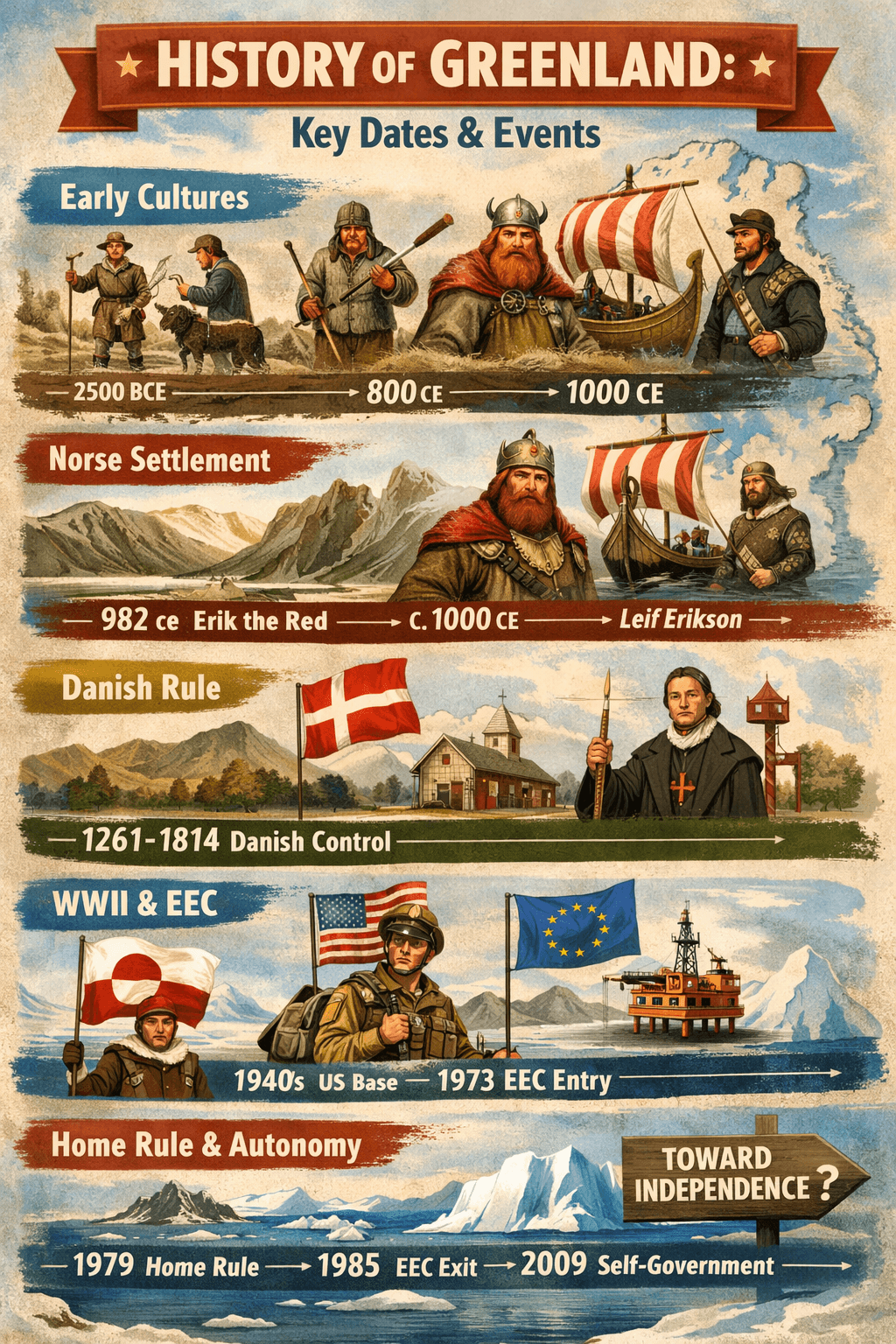
Early Human Settlement (c. 2500 BCE – 1000 CE)
- c. 2500 BCE – The first known humans arrive in Greenland: the Independence I culture, originating from Arctic Canada.
- c. 800 BCE – 1 CE – The Dorset culture inhabits parts of Greenland, known for advanced Arctic survival techniques.
- c. 1000 CE – The Thule people, ancestors of modern Inuit, migrate from Alaska across Arctic Canada into Greenland, bringing dog sleds and whale-hunting technology.
Stay ahead of global events.
Get clear geopolitical analysis in your inbox.
Norse Exploration and Settlement (982–1450)
- 982 CE – Erik the Red, exiled from Iceland, explores Greenland and names it “Greenland” to attract settlers (early marketing genius).
- 986 CE – Norse settlers establish the Eastern and Western Settlements.
- c. 1000 CE – Leif Erikson, son of Erik the Red, sails from Greenland to North America (Vinland).
- 1350–1450 – The Norse settlements gradually disappear, likely due to climate cooling (Little Ice Age), economic isolation, and conflicts.
Greenland under Scandinavian Rule (1261–1814)
- 1261 – Greenland formally becomes part of the Kingdom of Norway.
- 1380 – Norway enters a union with Denmark; Greenland comes under Danish-Norwegian control.
- 1721 – Danish missionary Hans Egede begins the modern Danish colonization of Greenland.
- 1814 – After the Treaty of Kiel, Greenland officially becomes a Danish colony, remaining Danish while Norway is separated.
From Colony to Autonomous Territory (1900–1979)
- 1917 – Denmark sells the Danish West Indies to the United States; U.S. recognition of Danish sovereignty over Greenland follows.
- 1941–1945 – During World War II, Greenland is occupied by the United States to prevent German control.
- 1953 – Greenland’s colonial status ends; it becomes an integral part of the Kingdom of Denmark.
- 1973 – Greenland enters the European Economic Community (EEC) with Denmark.
Home Rule and Self-Government (1979–Present)
- 1979 – Greenland is granted Home Rule, gaining control over many internal affairs.
- 1985 – Greenland withdraws from the EEC following a 1982 referendum.
- 2009 – The Self-Government Act comes into force, recognizing Greenlanders as a people with the right to self-determination under international law.
- 21st century – Greenland increasingly asserts political autonomy, while debates over independence, natural resources, and climate change shape its future.
Conclusion
From prehistoric Arctic cultures to modern self-government, Greenland’s history is defined by adaptation, survival, and strategic importance. Today, it remains part of the Kingdom of Denmark, while steadily moving toward greater autonomy in a rapidly changing Arctic world.
You May Also Like
Greenland, the Gordian Knot of the Transatlantic Relationship
Europe’s Realistic Options if the United States Attempts to Annex Greenland
What Would a NATO Without the United States Look Like?