What Is ANZUS?
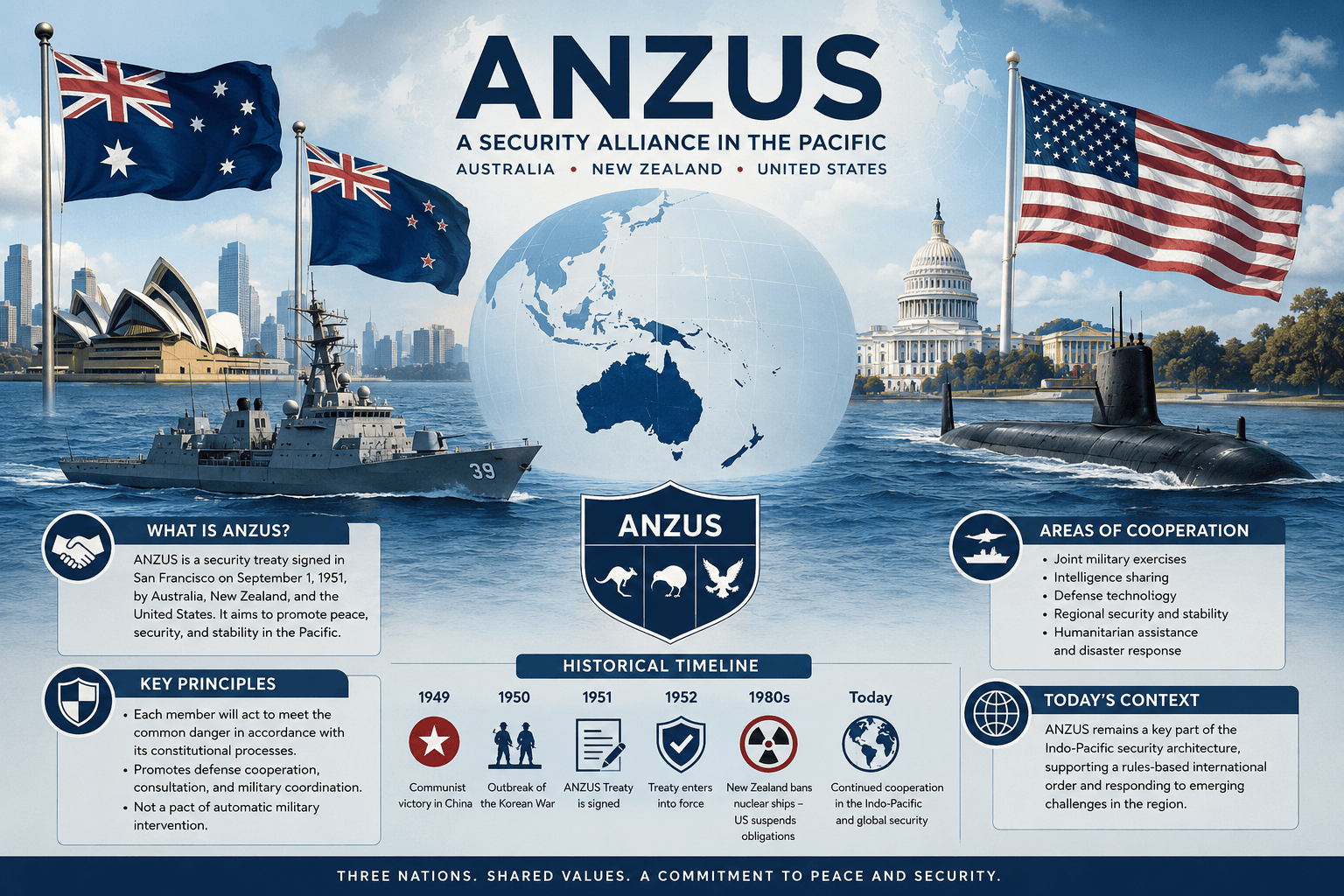
ANZUS is a trilateral security treaty signed in 1951 by Australia, New Zealand, and United States. Officially known as the ANZUS Treaty, the agreement was created during the early years of the Cold War to strengthen security cooperation in the Pacific region.
The treaty was signed in San Francisco on September 1, 1951, and entered into force in 1952. Its primary objective was to establish a collective defense framework capable of responding to security threats in the Asia-Pacific area.
More than seven decades later, ANZUS remains an important element of Indo-Pacific geopolitics and continues to influence military strategy, intelligence cooperation, and regional diplomacy.
Stay ahead of global events.
Get clear geopolitical analysis in your inbox.
Why Was ANZUS Created?
The alliance emerged in a period of growing uncertainty following the end of the Al Doilea Război Mondial. Several developments contributed to the creation of ANZUS:
- the communist victory in China in 1949;
- the outbreak of the Războiul din Coreea in 1950;
- fears of Soviet expansion in Asia and the Pacific.
Australia and New Zealand sought stronger security guarantees from the United States, especially after witnessing the rapid expansion of communist influence in East Asia. Washington, meanwhile, wanted reliable allies in the Pacific as part of its broader Cold War containment strategy.
The ANZUS Treaty was therefore designed to ensure closer military consultation and cooperation among the three nations.
Main Principles of the ANZUS Treaty
Unlike NATO, ANZUS does not automatically require collective military intervention if one member is attacked. Instead, the treaty states that each member would “act to meet the common danger” in accordance with its constitutional processes.
This wording gives governments significant flexibility in how they respond to crises.
The treaty promotes:
- defense cooperation;
- intelligence sharing;
- military coordination;
- consultation during regional security emergencies.
Over time, ANZUS also contributed to closer intelligence integration through networks associated with the broader Western alliance system, including cooperation within the “Five Eyes” intelligence framework.
ANZUS During the Cold War
During the Cold War, ANZUS members frequently cooperated militarily. Australia and New Zealand supported the United States during conflicts such as:
- the Războiul din Vietnam;
- the Korean War;
- broader anti-communist security initiatives in Asia.
For Australia, the alliance became a cornerstone of national defense policy. Many Australian leaders viewed the partnership with the United States as essential for long-term security in the Pacific.
The New Zealand Nuclear Dispute
One of the most important crises in ANZUS history occurred during the 1980s. New Zealand adopted an anti-nuclear policy and banned nuclear-powered or nuclear-armed ships from entering its ports.
Because the United States maintained a policy of neither confirming nor denying the presence of nuclear weapons on its vessels, tensions quickly escalated. In 1986, Washington suspended its security obligations toward New Zealand under ANZUS.
As a result, the alliance effectively became a closer bilateral partnership between Australia and the United States, although the treaty itself remained formally in place.
Relations between the United States and New Zealand gradually improved in the following decades, especially after the end of the Cold War.
ANZUS in the 21st Century
Today, ANZUS operates in a very different geopolitical environment. The rise of China as a global power, growing tensions in the South China Sea, and concerns about Indo-Pacific stability have increased the strategic importance of regional alliances.
Australia and the United States maintain particularly close military cooperation through:
- joint military exercises;
- intelligence sharing;
- defense technology partnerships;
- regional deterrence initiatives.
ANZUS is also connected indirectly to newer strategic frameworks such as AUKUS, which focuses on advanced military technologies and nuclear-powered submarines.
Supporters argue that ANZUS helps maintain stability and balance in the Indo-Pacific region. Critics, however, claim the alliance can contribute to geopolitical polarization and increase tensions between major powers.
Conclusion
ANZUS remains one of the most enduring security alliances in the Pacific. Although its structure differs from NATO, the treaty continues to shape defense cooperation among Australia, New Zealand, and the United States.
As geopolitical competition intensifies in the Indo-Pacific, ANZUS is likely to remain a key component of Western strategic planning in the region. Its future importance will depend on how member states respond to emerging challenges, including military modernization, regional rivalries, and shifting global power dynamics.
You May Also Like
BRICS: What It Is and What It Wants to Become
Soft Power vs Hard Power: What’s the Difference and Why It Matters
What Would a NATO Without the United States Look Like?
The World’s Nuclear Powers: Capabilities, History, and Risks to Humanity