The war between Russia and Ukraine has revived one of the most dangerous questions in modern geopolitics: what happens when a nuclear power risks losing a conventional war against a non-nuclear state?
For decades, nuclear strategy was built around the assumption that nuclear-armed states would rarely face existential military defeat. Nuclear weapons themselves were supposed to prevent such scenarios by deterring foreign intervention and discouraging escalation. Yet the war in Ukraine challenged many of these assumptions. A state possessing the world’s largest nuclear arsenal failed to achieve a rapid victory over a neighboring country without nuclear weapons, while Western military aid significantly strengthened Ukrainian resistance.
This reality has forced analysts, policymakers, and military strategists to confront a deeply uncomfortable issue: how far might a nuclear state go to avoid defeat?
Stay ahead of global events.
Get clear geopolitical analysis in your inbox.
Nuclear Weapons and the Logic of Deterrence
Since the beginning of the Cold War, nuclear weapons have primarily served as instruments of deterrence rather than battlefield tools. The central logic has remained relatively simple: if two nuclear powers can destroy each other, neither side has an incentive to initiate total war.
This concept, commonly associated with mutually assured destruction, shaped global security for decades. Nuclear arsenals became political weapons designed to prevent catastrophic conflict rather than wage it directly.
However, deterrence becomes far more complicated when a nuclear state faces serious conventional setbacks. Military losses can create pressure not only on armies, but also on political leadership, domestic legitimacy, and international credibility.
In the case of Russia, the invasion of Ukraine was initially expected by many observers to end quickly. Instead, Ukrainian resistance, combined with Western intelligence, financial support, and advanced weapons systems, transformed the conflict into a prolonged and costly war.
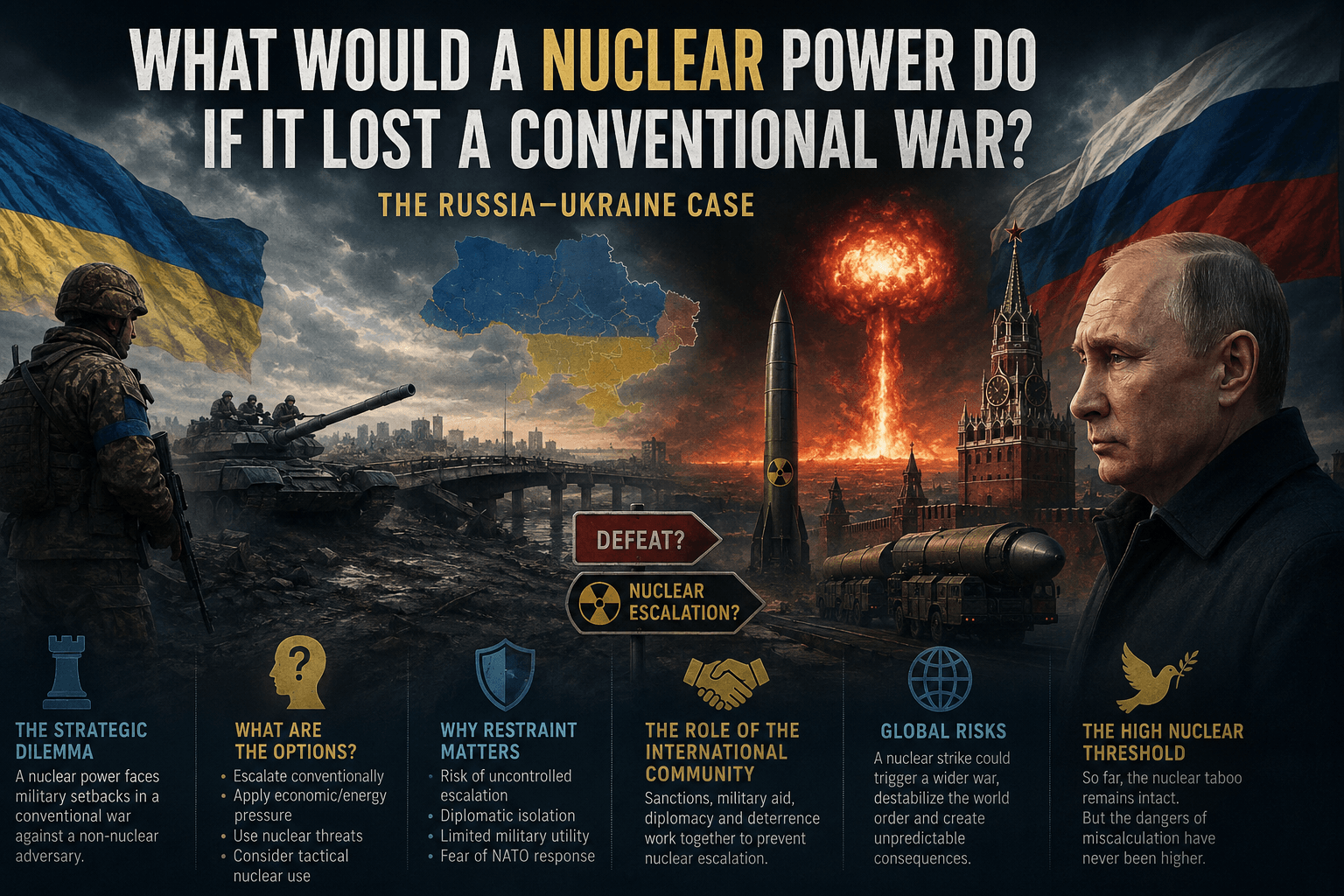
This created a strategic dilemma rarely seen in modern history: how does a nuclear power react when conventional military superiority no longer guarantees success?
The Ukrainian Battlefield and Russian Escalation
As the war evolved, Russia responded to battlefield difficulties through several forms of escalation that stopped short of nuclear use.
These included:
- partial military mobilization;
- intensified missile strikes;
- attacks on Ukrainian energy infrastructure;
- expanded drone warfare;
- increasingly aggressive nuclear rhetoric.
Russian officials repeatedly reminded the world of the country’s nuclear capabilities. Statements from political and military figures suggested that Moscow viewed the conflict not merely as a regional war, but as part of a broader confrontation with the West and NATO.
This rhetoric raised fears that Russia might eventually consider using tactical nuclear weapons if it perceived the survival of the state—or the survival of the regime itself—to be at risk.
The distinction between tactical and strategic nuclear weapons is important. Strategic weapons are designed for large-scale destruction against major cities or military infrastructure across continents. Tactical nuclear weapons are smaller and intended for battlefield use or limited military objectives.
Some analysts argued that Russia might theoretically employ a tactical nuclear strike to shock Ukraine and its Western supporters into negotiations. This concept is often linked to the controversial idea of “escalate to de-escalate,” a strategy allegedly involving limited nuclear use to force an opponent to back down.
Yet despite repeated speculation, Russia has not crossed the nuclear threshold.
Why Russia Has Not Used Nuclear Weapons
The fact that nuclear weapons have not been used in Ukraine remains one of the most significant aspects of the conflict.
There are several major reasons for this restraint.
The Risk of Uncontrolled Escalation
Once a nuclear weapon is used, even on a limited scale, escalation becomes extremely difficult to control. A single tactical strike could trigger massive political and military responses from NATO states, even if those responses remained conventional.
No government can fully predict how other nuclear powers would react after the first use of nuclear weapons in a major war.
For this reason, the nuclear taboo established after World War II remains extraordinarily powerful. Since the bombings of Atomic bombings of Hiroshima and Nagasaki, nuclear weapons have never again been used in combat.
Breaking that taboo would fundamentally transform global security.
Diplomatic Isolation
Even states that maintained relatively neutral positions toward Russia, including China and India, signaled discomfort with nuclear threats during the war.
A Russian nuclear strike could severely damage Moscow’s international relationships, undermine remaining diplomatic support, and intensify economic isolation.
For any major power, geopolitical influence depends not only on military strength but also on global partnerships. Nuclear use would carry enormous political costs.
Limited Military Utility
Many military experts question whether a tactical nuclear strike would even produce decisive battlefield advantages.
Modern warfare is dispersed, mobile, and technologically sophisticated. Ukrainian forces are not concentrated in massive Cold War-style formations that could easily be destroyed with a single strike.
A limited nuclear attack might therefore create enormous political consequences without fundamentally changing the military balance.
In some scenarios, it could even strengthen Ukrainian resistance and increase Western involvement.
Fear of NATO Response
Although NATO repeatedly stated that it would not directly enter the war, Western officials also warned of “catastrophic consequences” if Russia used nuclear weapons.
Importantly, those consequences did not necessarily imply nuclear retaliation. NATO possesses overwhelming conventional military capabilities that could devastate Russian forces in Ukraine or the Black Sea region without initiating global nuclear war.
This ambiguity may itself have strengthened deterrence.
Could a Nuclear Power Accept Defeat?
The Ukraine war has reopened a broader strategic debate: can nuclear powers psychologically and politically accept conventional defeat?
Historically, nuclear weapons were often viewed as ultimate insurance policies against regime collapse or national destruction. But modern conflicts are more ambiguous than total wars of the twentieth century.
Russia’s leadership may define victory and defeat differently over time. Territorial losses, stalled offensives, or negotiated settlements do not automatically equal existential collapse.
This distinction matters enormously because nuclear doctrine in most states is connected to survival threats rather than ordinary military setbacks.
At the same time, authoritarian systems may face additional internal pressures during wartime. National prestige, elite stability, and personal political survival can become intertwined with military outcomes. This creates uncertainty about decision-making during crises.
The danger is not necessarily irrationality, but miscalculation.
A leadership under pressure might interpret foreign actions as attempts at regime change even when opponents intend only limited objectives. In nuclear strategy, perception can become as important as reality.
The Limits of Nuclear Deterrence
Another major lesson from Ukraine concerns the limits of nuclear deterrence itself.
Possessing nuclear weapons did not:
- guarantee rapid victory;
- prevent Western support for Ukraine;
- eliminate economic sanctions;
- stop long-term military attrition.
This does not mean nuclear weapons are irrelevant. On the contrary, they almost certainly prevented direct NATO intervention and shaped Western caution throughout the conflict.
However, the war demonstrated that nuclear arsenals cannot automatically solve political, logistical, or conventional military problems.
This may influence future strategic thinking worldwide. Countries observing the conflict are studying both the strengths and limitations of nuclear power in modern warfare.
For smaller states, Ukraine demonstrated that determined resistance combined with external support can challenge even major military powers.
For nuclear states, the war highlighted the risks of escalation, overconfidence, and prolonged attritional conflict.
A Dangerous Precedent for the Future
The Russia–Ukraine war may become one of the defining strategic case studies of the twenty-first century.
It has tested assumptions about deterrence, escalation, alliance politics, sanctions, information warfare, and the relationship between conventional and nuclear power.
Most importantly, it revealed that nuclear-armed states are not immune to military frustration or strategic failure.
At the same time, the conflict also demonstrated that the nuclear threshold remains extraordinarily high. Despite repeated tensions and nuclear signaling, all major actors have so far avoided direct escalation into nuclear conflict.
That restraint reflects a grim reality understood by leaders across the world: once nuclear weapons are used, controlling the consequences may become impossible.
The central question raised by the Ukraine war is therefore not simply whether a nuclear power would use atomic weapons to avoid defeat. The deeper question is whether modern international systems can continue managing such crises without eventually crossing the line that has remained uncrossed since 1945.
So far, the answer remains uncertain.
You May Also Like
BRICS: What It Is and What It Wants to Become
What Is Geopolitics? Meaning, Examples, and Why It Matters Today
Why a Palestinian State May Pose Strategic Risks for Israel
The Case Against a Nuclear-Armed Iran
From “America First” to “America Alone”: What the Strait of Hormuz Reveals