Introduction
Triangular diplomacy has shaped global politics for more than seven decades. The concept refers to the strategic interaction between three major powers, each attempting to balance, manipulate, or cooperate with the others in order to maximize its own geopolitical advantage. During the Cold War, the triangle formed by the United States, the Soviet Union, and Communist China fundamentally transformed the international system. Today, a new version of triangular diplomacy is emerging, one with profound implications for the European Union.
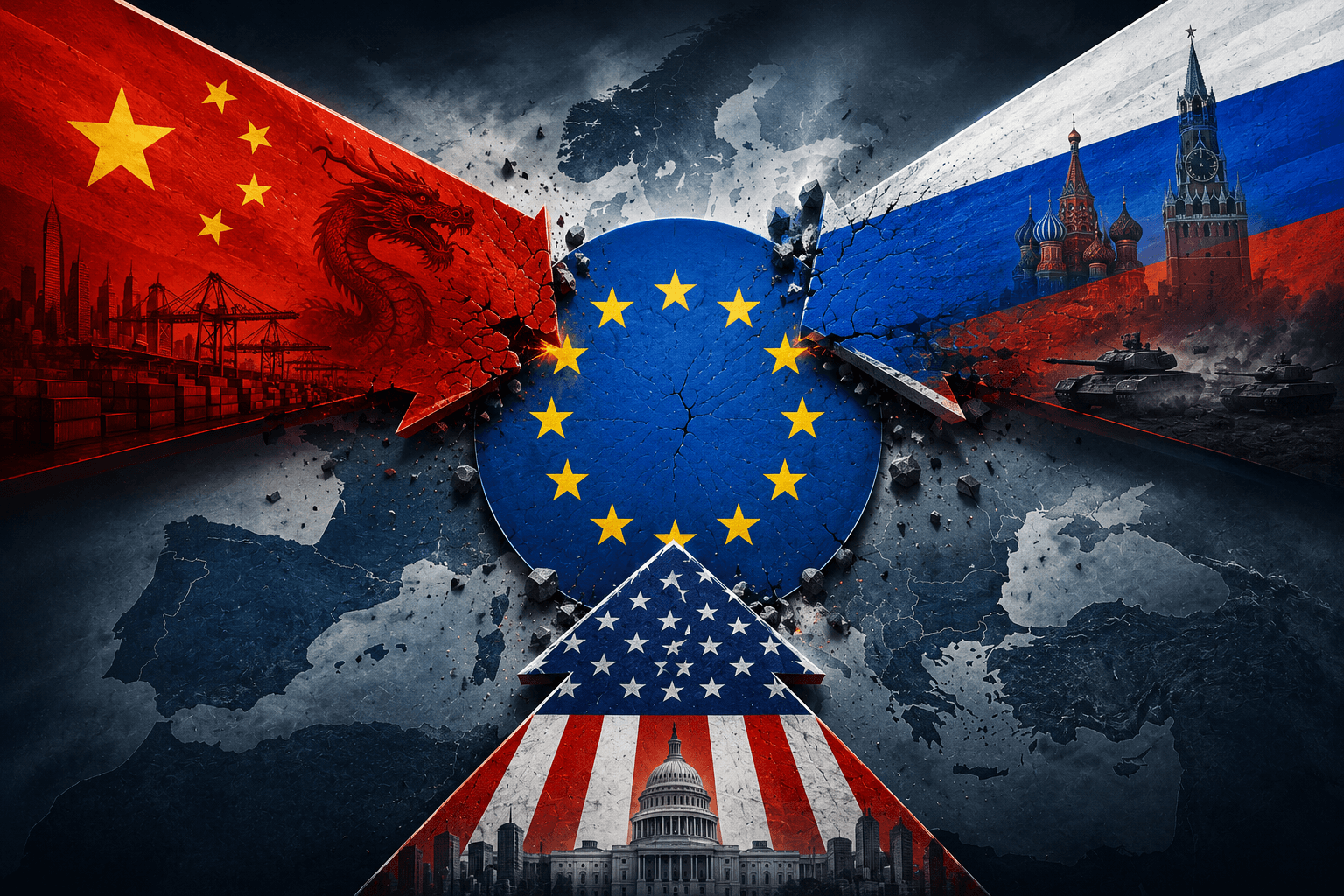
The evolution of triangular diplomacy can be divided into several major phases: the initial alliance between the Soviet Union and Communist China during the Korean War; the Sino-Soviet split and the violent rivalry that followed; the strategic rapprochement between the United States and China against the Soviet Union; the post-Cold War partnership between Russia and China against American global dominance; and finally, the emerging geopolitical reality in which China, Russia, and even parts of the American political establishment increasingly converge against the European Union’s economic and political influence.
For Europe, this transformation represents more than a diplomatic challenge. It may constitute an existential geopolitical test. The European Union now faces a world in which traditional assumptions about Western solidarity can no longer be taken for granted.
Stay ahead of global events.
Get clear geopolitical analysis in your inbox.
The First Phase: The Soviet-Chinese Alliance and the Korean War
After the Communist victory in the Chinese Civil War in 1949, the newly established People’s Republic of China aligned itself closely with the Soviet Union. People’s Republic of China and the Soviet Union appeared united by communist ideology, anti-Western sentiment, and a shared desire to challenge American global influence.
The alliance was formalized through the 1950 Sino-Soviet Treaty of Friendship, Alliance, and Mutual Assistance. Soviet economic aid, industrial expertise, and military support helped China consolidate communist rule. In return, China became a major strategic partner in Asia.
The Korean War became the first major test of this alliance. When North Korean forces invaded South Korea in 1950, the conflict rapidly escalated into a global confrontation involving the United States, the United Nations coalition, China, and the Soviet Union. China intervened massively after American-led forces approached the Yalu River, fearing a hostile Western presence on its border.
Although Soviet forces largely avoided direct combat, Moscow provided military equipment, pilots, and strategic coordination. The Korean War demonstrated that the communist bloc could act in concert against the West. For Washington, the war confirmed fears of a monolithic communist alliance stretching from Eastern Europe to East Asia.
However, beneath the appearance of unity, tensions already existed. Mao Zedong believed that Stalin treated China as a junior partner rather than an equal. These frustrations would eventually explode into one of the greatest geopolitical ruptures of the twentieth century.
The Sino-Soviet Split and Border Confrontations
The death of Joseph Stalin in 1953 accelerated divisions within the communist world. Mao strongly opposed Nikita Khrushchev’s policy of de-Stalinization and peaceful coexistence with the West. Ideological disagreements became increasingly severe, but geopolitical competition mattered even more.
China sought recognition as the leading revolutionary power in the communist world, while the Soviet Union viewed Beijing as unpredictable and dangerously radical. Disputes emerged over nuclear strategy, relations with the developing world, and leadership within global communism.
By the 1960s, the Sino-Soviet alliance had effectively collapsed. Propaganda wars intensified, economic cooperation ceased, and both countries began preparing for military confrontation.
The rivalry culminated in armed clashes along the Ussuri River in 1969. Soviet and Chinese troops engaged in deadly border battles, raising fears of a larger war between two nuclear powers. At one point, Soviet leaders reportedly considered the possibility of a preemptive strike against Chinese nuclear facilities.
The Sino-Soviet split transformed global geopolitics. Instead of confronting a unified communist bloc, the United States now faced two hostile powers deeply suspicious of each other. Washington recognized an extraordinary strategic opportunity.
The Second Phase: The United States and China Against the Soviet Union
American President Richard Nixon and his National Security Adviser Henry Kissinger fundamentally reshaped global diplomacy during the early 1970s. Rather than treating China and the Soviet Union as a single adversarial bloc, the United States exploited the rivalry between them.
Nixon’s historic 1972 visit to China represented one of the most significant diplomatic realignments in modern history. The United States and China did not become formal allies, but both recognized the strategic value of balancing Soviet power.
This triangular diplomacy gave Washington enormous leverage. The Soviet Union now faced the possibility of strategic encirclement, while China gained protection against Soviet military pressure and access to Western technology and markets.
The policy proved highly successful for the United States. Throughout the 1970s and 1980s, the Soviet Union was forced to divide its military resources between Europe and Asia. China gradually opened its economy and integrated into global trade networks dominated by the West.
From an American perspective, triangular diplomacy contributed significantly to the eventual exhaustion and collapse of the Soviet Union. It was a classic example of balance-of-power politics executed with remarkable strategic discipline.
The Third Phase: Russia and China Against the United States
After the collapse of the Soviet Union in 1991, many Western leaders believed that Russia and China would eventually integrate into a U.S.-led international order. Instead, the opposite occurred.
Russia viewed NATO expansion and Western interventions as evidence of American encroachment. China, meanwhile, benefited enormously from globalization while simultaneously expanding its military and technological capabilities.
Gradually, Moscow and Beijing rediscovered common interests. Both opposed American unipolar dominance, Western democracy promotion, and sanctions policies. Energy cooperation, military exercises, and diplomatic coordination intensified.
The strategic partnership between Russia and China became especially strong after the deterioration of Russian-Western relations following the annexation of Crimea in 2014 and the invasion of Ukraine in 2022.
China gained access to discounted Russian energy and strategic resources, while Russia became increasingly dependent on Chinese markets and technology. Although the partnership contains asymmetries and hidden tensions, both countries share a common interest in weakening American global influence.
For years, most analysts expected the United States to focus on containing China as its principal long-term rival, potentially seeking a partial normalization with Russia in order to avoid a consolidated Eurasian bloc. From a classical geopolitical perspective, such a strategy would have mirrored Nixon’s approach in reverse.
Yet recent political developments suggest a different possibility.
A Possible Fourth Phase: China, Russia, and the Weakening of Europe
An emerging concern among many European analysts is that parts of the American political establishment increasingly perceive the European Union not merely as an ally, but also as an economic competitor and ideological rival.
Trade disputes, disagreements over defense spending, industrial policy conflicts, and tensions surrounding NATO have strained transatlantic relations. Certain political currents within the United States, particularly around the administration of Donald Trump, have adopted a confrontational rhetoric toward the European Union.
Critics argue that weakening European unity ultimately serves Russian and Chinese strategic interests. A fragmented Europe would possess less economic influence, weaker military coordination, and reduced capacity to resist external pressure.
Russia benefits when NATO cohesion weakens and European states become politically divided. China benefits when Europe cannot present a united front on trade, technology, industrial policy, or human rights issues. Both Moscow and Beijing prefer bilateral negotiations with individual European states rather than dealing with a cohesive European bloc.
From this perspective, aggressive pressure against the European Union by elements within the United States may inadvertently contribute to the long-term erosion of American strategic influence. The European Union represents one of Washington’s most important democratic partners, one of the world’s largest economies, and a crucial geopolitical counterweight to authoritarian powers.
If transatlantic relations deteriorate significantly, the primary beneficiaries may not be the United States, but rather Russia and China.
Why the European Union Must Respond
For the European Union, the new era of triangular diplomacy requires strategic adaptation. Europe can no longer assume that economic power alone guarantees geopolitical relevance.
The EU faces simultaneous pressures from Russian military assertiveness, Chinese economic expansion, technological competition, energy vulnerabilities, and uncertainty regarding long-term American commitments.
European unity therefore becomes essential. Fragmentation would weaken the continent’s ability to defend its economic interests, maintain technological sovereignty, and preserve democratic institutions.
This does not mean abandoning the transatlantic alliance. The United States remains Europe’s most important security partner. However, the EU increasingly needs greater strategic autonomy in defense, energy, industrial policy, and technological development.
A stronger and more united Europe may ultimately serve American interests as well. Historically, stable alliances have been among the greatest sources of American global power. Weakening Europe risks undermining the broader democratic coalition that has shaped the international order since 1945.
Conclusion
Triangular diplomacy has repeatedly transformed world politics. The Soviet-Chinese alliance during the Korean War, the Sino-Soviet split, the American-Chinese rapprochement against the Soviet Union, and the Russia-China partnership against American dominance all demonstrate how shifting alignments can redefine the global balance of power.
Today, a new geopolitical configuration may be emerging — one in which the European Union increasingly finds itself under simultaneous pressure from multiple directions. Whether this trend becomes permanent remains uncertain, but the risks are substantial.
For Europe, the lesson of triangular diplomacy is clear: geopolitical survival depends on unity, strategic realism, and the ability to adapt to changing power structures. In a world defined once again by great-power rivalry, the European Union cannot afford complacency.
You May Also Like
BRICS: What It Is and What It Wants to Become
Soft Power vs Hard Power: What’s the Difference and Why It Matters
Why a Palestinian State May Pose Strategic Risks for Israel
The Case Against a Nuclear-Armed Iran
What Would a NATO Without the United States Look Like?