The Birth of OPEC
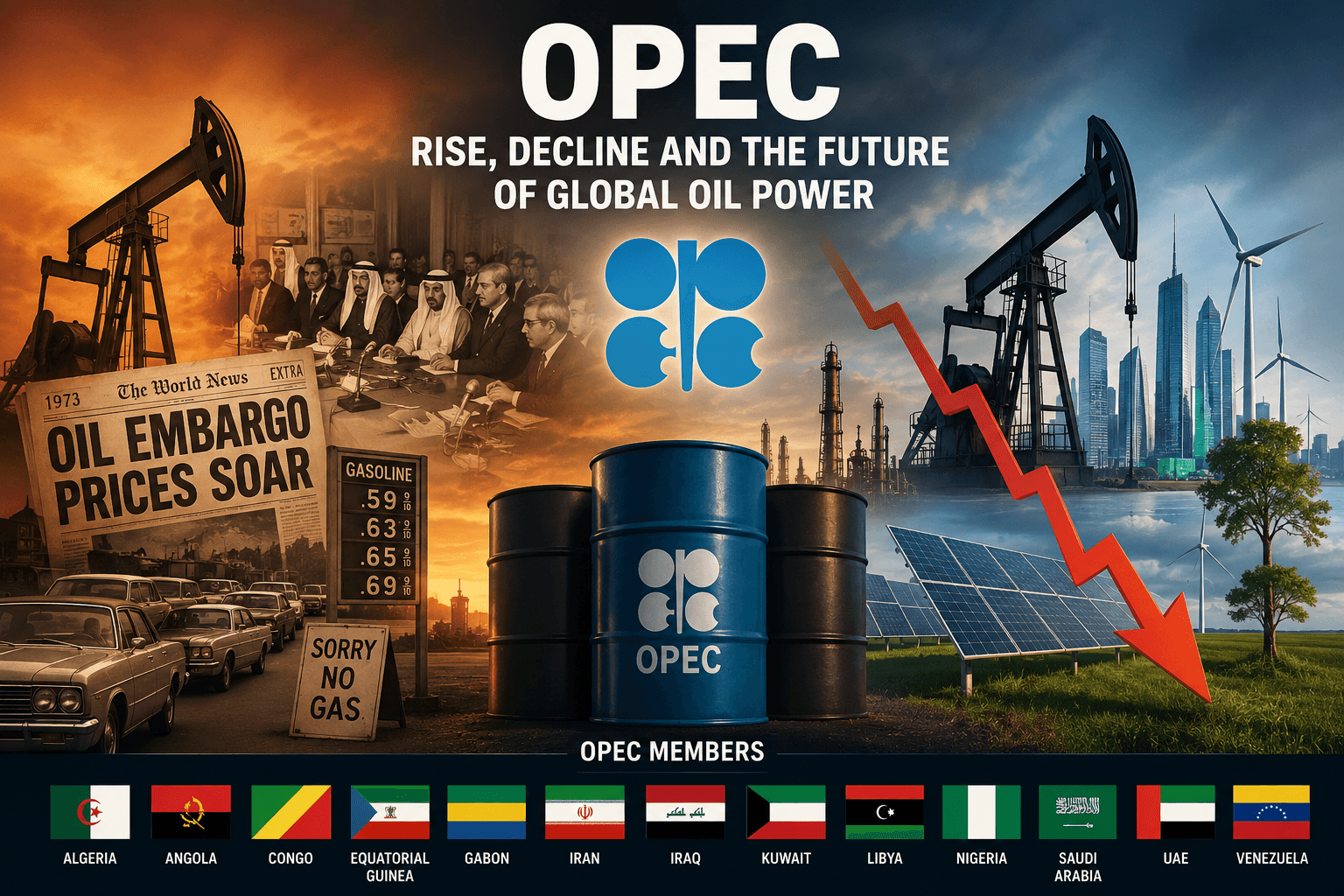
For more than six decades, the Organization of the Petroleum Exporting Countries (OPEC) has stood at the center of global energy politics. Few international organizations have influenced the world economy as profoundly as OPEC, whose decisions on oil production have shaped inflation, wars, diplomacy, industrial growth, and even domestic politics across continents. During the 1970s, OPEC was capable of shaking the foundations of Western economies through coordinated oil embargoes and production cuts. Today, however, the organization faces a more uncertain future marked by internal divisions, the rise of alternative energy, growing American shale production, and declining long-term oil demand expectations.
OPEC was founded in September 1960 in Baghdad by five countries: Iran, Iraq, Kuwait, Saudi Arabia, and Venezuela. Its creation reflected frustration among oil-producing nations regarding the dominance of Western oil companies, commonly referred to as the “Seven Sisters.” At the time, multinational corporations largely controlled oil prices and production, while producing states received only a fraction of the profits.
The organization aimed to coordinate petroleum policies among member states in order to stabilize prices and strengthen producer sovereignty over natural resources. Over time, additional countries joined, including Qatar, Indonesia, Libya, the United Arab Emirates, Algeria, Nigeria, Angola, Ecuador, Gabon, Equatorial Guinea, and Congo.
Stay ahead of global events.
Get clear geopolitical analysis in your inbox.
OPEC’s Golden Age in the 1970s
The organization’s headquarters moved from Geneva to Vienna in 1965, where it remains today. Throughout the 1960s, OPEC gradually increased its influence, but its true rise began during the 1970s.
The turning point came with the 1973 oil crisis. Following the Yom Kippur War, Arab oil producers imposed an embargo against states perceived as supporting Israel, particularly the United States and several Western European countries. Oil prices quadrupled in a matter of months, triggering inflation, recession, and panic throughout industrialized economies.
The crisis transformed OPEC into one of the most powerful international organizations in the world. Western governments suddenly realized how dependent modern economies were on Middle Eastern oil. Energy security became a major strategic concern, leading to the creation of strategic petroleum reserves, investments in nuclear energy, and policies aimed at reducing dependence on imported crude oil.
A second oil shock followed after the 1979 Iranian Revolution, which disrupted production and caused another dramatic increase in prices. During this era, OPEC exercised unprecedented market influence. The organization controlled a large share of global oil exports and could strongly affect prices through coordinated production decisions.
Internal Divisions and Structural Weaknesses
Despite its power, OPEC contained important structural weaknesses. Member states often had conflicting interests. Some countries preferred high prices and lower production, while others needed immediate revenues and favored higher output. Violations of production quotas became a recurring issue.
The 1980s exposed these vulnerabilities. High oil prices encouraged non-OPEC production in regions such as the North Sea, Alaska, and Mexico. Simultaneously, Western countries adopted energy efficiency measures that reduced consumption growth. As demand weakened and supply increased, oil prices collapsed in 1986.
From that moment onward, OPEC entered a more defensive phase. Rather than dominating the market, the organization increasingly attempted to manage oversupply and prevent price collapses.
Political rivalries further complicated cooperation inside the cartel. Iran and Saudi Arabia frequently found themselves on opposing sides of regional disputes. Iraq invaded Kuwait in 1990. Libya faced sanctions and instability. Venezuela struggled with severe economic decline. These tensions often undermined collective discipline and reduced the organization’s unity.
Membership Changes: Countries Joining and Leaving OPEC
Membership fluctuations reflect OPEC’s changing role in the global economy. Ecuador suspended its membership in 1992 because of financial difficulties, later rejoined, and eventually left again in 2020. Indonesia suspended participation after becoming a net oil importer. Qatar withdrew in 2019 in order to focus more heavily on natural gas production. Angola left in 2024 following disagreements regarding production quotas.
One of the most significant recent developments has been the withdrawal of the United Arab Emirates. In 2026, the UAE announced its exit from both OPEC and OPEC+, citing strategic national interests and dissatisfaction with production restrictions. The decision represented a major symbolic and economic blow because the UAE had long been one of the organization’s most influential producers.
The UAE’s departure illustrates a broader problem facing OPEC today: ambitious producers increasingly seek flexibility rather than collective restraint. Abu Dhabi has invested heavily in expanding production capacity and appears unwilling to limit future output for the sake of cartel discipline. Analysts also interpret the decision as evidence of growing regional competition between the UAE and Saudi Arabia.
How OPEC Works: Mechanisms and Production Quotas
To understand OPEC’s contemporary relevance, it is important to examine how the organization functions. OPEC operates primarily through production quotas. Member states meet regularly to determine how much oil should collectively enter the market. By reducing supply, OPEC attempts to raise prices. By increasing supply, it may seek to calm markets or defend market share.
Since 2016, OPEC has expanded cooperation through the creation of OPEC+, an alliance including non-member producers such as Russia and Kazakhstan. This broader coalition emerged after the collapse in oil prices caused by oversupply and competition from American shale oil producers.
OPEC+ became particularly important during the COVID-19 pandemic. As global demand collapsed in 2020, the group implemented historic production cuts in order to stabilize prices. These measures demonstrated that the organization still retained significant influence over short-term market conditions.
The Decline of Oil Consumption and the Energy Transition
Nevertheless, OPEC’s long-term position has weakened considerably compared to the 1970s. One major reason is the rise of the United States as a leading oil producer. The shale revolution dramatically increased American output, reducing U.S. dependence on Middle Eastern imports and limiting OPEC’s pricing power.
Technological changes also threaten the organization’s future. Electric vehicles, renewable energy, battery storage, and decarbonization policies are gradually reducing expected growth in oil demand. Governments worldwide increasingly promote climate policies aimed at reducing fossil fuel consumption.
Even OPEC itself has acknowledged slower future demand growth. Economic uncertainty and the global energy transition have forced the organization to revise several long-term forecasts downward.
This does not mean oil will disappear quickly. Petroleum remains essential for transportation, aviation, petrochemicals, agriculture, and industrial production. Developing countries in Asia and Africa will likely continue increasing energy consumption for decades. However, the era of permanently rising oil demand may eventually end.
OPEC’s Contemporary Relevance
The energy transition creates a strategic dilemma for OPEC members. Some states, especially Gulf monarchies, are attempting economic diversification through investments in tourism, finance, logistics, and technology. Saudi Arabia’s Vision 2030 is perhaps the most ambitious example of this effort. Yet many producers remain heavily dependent on oil revenues to finance state budgets and maintain social stability.
The organization therefore faces pressure from multiple directions: internal rivalries, competition from non-OPEC producers, environmental policies, and structural changes in global energy consumption.
Despite these challenges, declaring the “death” of OPEC would be premature. The organization still controls a large share of global proven oil reserves and continues to influence prices through coordinated actions. Sudden geopolitical crises in the Middle East can rapidly restore its importance through supply disruptions and market instability.
Oil markets also remain psychologically sensitive to OPEC announcements. Traders, governments, and corporations continue monitoring production meetings closely because even modest changes in output targets can affect inflation, transportation costs, and financial markets worldwide.
Conclusion
In many ways, OPEC today resembles a declining but still influential power. It no longer possesses the overwhelming dominance it enjoyed during the 1970s, yet it remains too important to ignore. Its future relevance will depend largely on three factors: the pace of the global energy transition, the cohesion of remaining member states, and the ability of major producers such as Saudi Arabia to maintain collective discipline.
The rise and decline of OPEC reflects broader transformations in the international system itself. The organization emerged during an era when oil defined geopolitical power. It flourished when industrial economies depended overwhelmingly on imported crude. Now it confronts a world increasingly shaped by technological innovation, renewable energy, and fragmented geopolitical competition.
Whether OPEC survives as a major force or gradually loses relevance, its historical impact on the modern world remains undeniable. Few organizations have influenced global politics, economics, and international relations as deeply as the oil cartel founded in Baghdad in 1960.
You May Also Like
The Thucydides Trap Is a Myth: What Athens, Sparta, and History Actually Reveal
Geography Does Not Disappear: How Maps Still Shape Global Politics
The 10 Maritime Chokepoints That Control the Global Economy
The World’s Nuclear Powers: Capabilities, History, and Risks to Humanity