There are ideas that, at first glance, appear unquestionably just. The creation of a Palestinian state is one of them. It seems like the natural, moral, and, for many, inevitable solution. Yet this apparent self-evidence conceals a fundamental problem: what is just in principle is not always sustainable in practice.
The refusal of Benjamin Netanyahu to accept the creation of a Palestinian state, even under pressure from actors including the United States, cannot be reduced to mere political rigidity. Rather, it reflects a strategic assessment of risks perceived as significant.
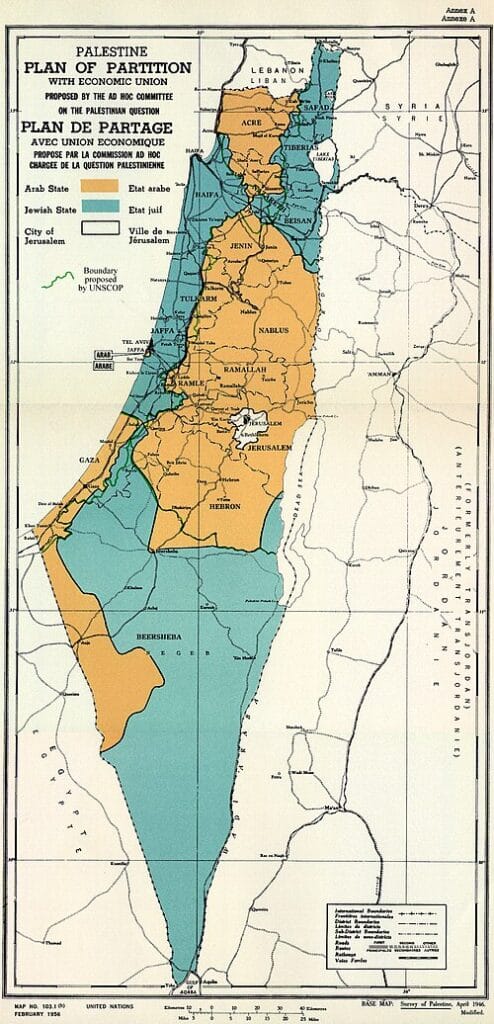
In theory, such a decision would allow for the implementation of UN Resolution 181 (November 29, 1947) and would address a legitimate Palestinian aspiration. In practice, however, geopolitical realities and conditions on the ground complicate this perspective considerably. The issue is not the legitimacy of the idea, but the consequences of its implementation.
Stay ahead of global events.
Get clear geopolitical analysis in your inbox.
The following arguments outline why this solution, though seemingly reasonable, may become problematic for Israel’s security:
1. Internationalization of the Conflict and Constraints on Israel
A Palestinian state composed of the Gaza Strip and the West Bank would join the United Nations as a full member and would transform this institution into a more active force in the long-standing and complex Israeli–Palestinian conflict. Even the U.S. veto would no longer be able to consistently shield Israel from the pressure of the majority of UN member states. The pro-Palestinian stance of the UN General Assembly has long been an established reality.
How would the situation evolve once an independent Palestinian state operates under the protection of international law? It is highly likely that Israel’s freedom of movement in Palestinian territories would be significantly reduced. Frequent monitoring missions could emerge, and possibly even UN peacekeeping forces deployed at the request of the Palestinians.
Such developments could bring benefits in terms of regional peace and human rights—an area where Israel has often been criticized in relation to Palestinians. However, these same constraints would negatively affect Israel’s ability to combat and deter terrorism. Israel’s discretionary and disproportionate responses—considered by many as part of its standard counterterrorism doctrine—would take place under intense international scrutiny, amplifying negative global opinion and increasing diplomatic pressure from platforms such as New York.
Propaganda remains one of the most effective tools available to the Palestinians, and it has been used with considerable skill in recent months.
2. From Asymmetric Warfare to Conventional Threat
A Palestinian state would have the right, like any sovereign and independent state, to develop regular armed forces. These forces could be trained and equipped with support from various actors in the Muslim world. The Israeli Defense Forces would no longer face only poorly equipped militias, but potentially conventional forces equipped with rockets, drones, artillery, and significant manpower.
Hamas has already demonstrated that even rudimentary means can challenge Israel. What, then, could a standing army achieve? Palestinians have shown that they can surprise Israel—there is no clear reason why such surprise could not occur again.
Geography further amplifies this risk. The West Bank’s elevated terrain makes it an ideal platform for striking targets across Israeli territory. While Israel would most likely maintain military superiority, the question remains: is that sufficient to eliminate major risks?
Israel was caught off guard in 1973 and again in 2023, and in 2006 it faced serious challenges from Hezbollah. It can be attacked from two directions—Gaza and the West Bank—or even three, if Hezbollah is included from southern Lebanon.
Geography has always shaped Israeli strategy. The occupation of the Golan Heights was driven precisely by the need to neutralize elevated positions from which attacks could be launched. The West Bank could, on a much larger scale, become what the Golan Heights once represented.
3. The Limits of Nuclear Deterrence
At this point, one might invoke Israel’s nuclear arsenal as a guarantee of security. This assumption is misleading. Nuclear deterrence is effective against distant enemies, not those in immediate proximity.
If a Palestinian state were to become an existential threat and Israel were to use nuclear weapons, the consequences would be catastrophic. Gaza and the West Bank would become uninhabitable, but radioactive fallout would inevitably affect Israel itself. The political and diplomatic repercussions would be equally severe.
Therefore, against a nearby adversary, nuclear capability is not a credible security guarantee.
4. The Uncertainty of American Support
The political landscape in Washington changes with elections. It is far from certain that U.S. support for Israel will remain equally strong in the coming decades. Without substantial backing from its traditional ally—an ally increasingly influenced by pro-Palestinian sentiments within segments of its population—Israel could become significantly more vulnerable.
There are also certain strategic parallels, albeit imperfect, between Israel and the historical Kingdom of Jerusalem. Both relied heavily on external support. The Kingdom ultimately collapsed when Western backing diminished.
If U.S. support for Israel were to decline substantially, this could create conditions for increased vulnerability, particularly in the presence of a Palestinian state capable of exploiting such a shift.
5. The Risk of Hostile Alliances
A Palestinian state, like any other, would have the right to enter into political and military alliances. What would such a state look like if it established security agreements with Syria, Lebanon, or Iran?
One might argue that Israel could defeat such a coalition, as it has done before. However, less conventional—yet not implausible—scenarios must also be considered. If Turkey, Saudi Arabia, or Egypt were to provide security guarantees to a Palestinian state, would Israel still maintain a relaxed strategic posture?
Most likely not.
Turkey under Erdoğan appears to be moving away from its secular legacy and positioning itself as a defender of Palestinian interests. A conflict involving a Palestinian state allied with a NATO member such as Turkey would be considerably more complex.
The scenario could extend further. Russia, for example, might seek to establish ties with a Palestinian state as a means of exerting pressure in the broader geopolitical competition with NATO.
6. The Persistence of Terrorism Under State Cover
There is no guarantee that a Palestinian state would abandon terrorism. It might formally condemn such actions while tolerating or indirectly supporting them.
In such a situation, Israel would face a paradox: constrained diplomatically while still exposed to attacks. It would be required to present evidence to an already skeptical international community, limiting its operational flexibility.
Additionally, the presence of a significant Palestinian community within Israel could, under certain conditions, lead to increased internal tensions, influenced by political and symbolic developments linked to a Palestinian state.
7. The Uncertainty of Internal Political Evolution
It is far from certain that a Palestinian state would evolve into a stable and consolidated democracy—a condition often regarded as necessary, though by no means sufficient, for durable peace. The mere adoption of democratic institutions does not guarantee moderation, institutional resilience, or long-term political stability. In fragile or polarized societies, electoral mechanisms can just as easily become vehicles for contestation, radicalization, or institutional capture.
Even if democratic structures were formally established, the substance of political life would remain contingent on deeper factors: elite cohesion, control over security apparatuses, economic viability, and, not least, the role of competing ideological currents within society. In such contexts, democratic outcomes can be highly volatile, especially when national identity, historical grievances, and unresolved conflicts continue to shape political behavior.
The experience of Mohamed Morsi is instructive in this regard. His election in 2012 demonstrated how democratic openings can facilitate the rise of actors whose agendas may not align with liberal or stabilizing trajectories. More broadly, it illustrates a recurring pattern in transitional political systems: electoral legitimacy does not necessarily translate into political moderation or institutional balance.
In the Palestinian case, internal divisions, the legacy of factional competition, and the enduring centrality of the conflict with Israel could exert strong pressures on any emerging political system. Under such conditions, it is plausible that democratic forms might coexist with, or gradually give way to, more centralized, authoritarian, or ideologically rigid forms of governance.
The key issue, therefore, is not whether democracy is possible, but whether it would be sufficiently stable, moderate, and resilient to contribute to a durable peace—rather than becoming another arena in which conflict dynamics are reproduced in political form.
8. The Absence of Strategic Depth and a Plan B
A final argument lies in the absence of a “plan B” for Israel. Its strategic reality allows for almost no margin of error. Unlike larger states, Israel cannot trade space for time, absorb major territorial losses, or retreat in order to reorganize. A decisive military defeat would not merely be a setback—it would carry existential consequences.
This condition is rooted in structural factors: limited territory, high population density, and the proximity of potential adversaries to critical infrastructure and urban centers. In such a context, even relatively small breaches can produce disproportionate strategic effects. The traditional military logic of fallback lines, strategic depth, and phased defense is, to a large extent, unavailable.
The experience of the Yom Kippur War illustrates this vulnerability with particular clarity. Israel, despite its military strength, was caught off guard and initially suffered significant setbacks on multiple fronts. Although it ultimately recovered and reversed the situation, this outcome depended on rapid mobilization, external support, and a series of contingent factors. The early stages of the war demonstrated how quickly the strategic balance can shift when surprise and coordination are achieved by adversaries. A similar shock, under less favorable conditions, could produce far more severe consequences.
Israel’s security doctrine—centered on preemption, speed, and decisive engagements—emerges precisely from this structural constraint. Prolonged wars of attrition or defensive withdrawals are inherently disadvantageous for a state that lacks depth. Success, therefore, must be consistent, while failure—even if rare—can be catastrophic.
Under these conditions, risk is not linear but cumulative and asymmetric. Each additional vulnerability—geographical, political, or military—does not simply add to the overall risk profile; it can amplify systemic fragility. The creation of a Palestinian state, particularly in geographically sensitive areas such as the West Bank, would introduce new variables into an already compressed strategic environment.
Even if most scenarios remain manageable, the problem lies in the tail risk—the low-probability, high-impact outcomes. In Israel’s case, such outcomes cannot be dismissed, because the cost of being wrong even once may be irreversible. This transforms strategic decision-making into a calculus not of likelihood, but of consequence.
In this light, the issue is not whether a Palestinian state would inevitably lead to disaster, but whether Israel can afford to operate in a security environment where the margin for error is effectively nonexistent.
9. Territorial Fragmentation and the Problem of Political Cohesion
A Palestinian state would, in all likelihood, consist of two geographically discontinuous entities: the Gaza Strip and the West Bank. Beyond the absence of territorial contiguity, these areas have evolved under distinct political, administrative, and security structures.
This raises a fundamental question of state functionality: the capacity to exercise coherent and unified authority across fragmented space. States lacking territorial cohesion often struggle with coordination, legitimacy, and control, and may drift toward dual power structures or internal competition.
In such a scenario, Israel would not be dealing with a single, predictable counterpart, but with a fragmented political entity, potentially characterized by competing centers of authority and inconsistent strategic behavior.
10. The Challenge of Monopoly over the Means of Violence
A defining feature of a sovereign state is its ability to establish a monopoly over the legitimate use of force. In the Palestinian context, this condition would be particularly difficult to fulfill.
The existence of armed non-state actors, entrenched networks, and competing factions raises serious doubts about the capacity of a future Palestinian state to fully control its own security environment. Even with political will, the practical dismantling, integration, or neutralization of such groups is historically complex and often incomplete.
The result could be a formally sovereign state that lacks effective control over parts of its territory—an outcome that would generate persistent security risks and complicate deterrence dynamics for Israel.
11. The Problem of Irreversibility
State creation is, by its nature, a largely irreversible process. Once internationally recognized, a state acquires legal protections, diplomatic standing, and political legitimacy that are difficult to retract or renegotiate.
If the internal evolution of such a state were to become destabilizing—through militarization, radicalization, or institutional failure—the range of available corrective measures would be severely constrained. Any attempt to reverse or fundamentally alter the situation would carry high political, legal, and potentially military costs.
This transforms the initial decision into a long-term structural commitment, with limited capacity for adjustment once the process has been completed.
12. The Risk of Strategic Precedent
The acceptance of a Palestinian state under conditions perceived as unfavorable could establish a broader strategic precedent. It may signal that sustained pressure—whether diplomatic, political, or violent—can yield significant concessions.
Such a perception could influence the behavior of other regional actors, encouraging similar strategies and thereby complicating Israel’s overall security posture. In this sense, the decision would extend beyond the bilateral Israeli–Palestinian framework and affect the wider strategic environment.
13. Temporal Dynamics: Conflict Resolution or Conflict Deferral?
An often underexplored dimension concerns the temporal effects of statehood. While the creation of a Palestinian state might reduce tensions in the short term, it does not necessarily resolve the underlying drivers of conflict.
Statehood could instead provide the institutional, territorial, and diplomatic framework for the consolidation of resources, legitimacy, and strategic capacity. Under such conditions, conflict is not eliminated but potentially deferred, re-emerging later in a more structured and possibly more challenging form.
The key question, therefore, is not only whether a Palestinian state would bring immediate de-escalation, but whether it might transform the conflict into one that is more difficult to manage in the long run.
Conclusion
The Palestinians deserve a state of their own. However, this does not oblige Israel to accept its creation under any circumstances. In the current context, such a development could significantly increase the risks to Israel’s security.
The issue is not legitimacy, but sustainability.
Benjamin Netanyahu may be judged in many ways, but not as irrational. His position reflects an understanding that Israel’s problem is not its strength, but its structural vulnerabilities. In the present context, these vulnerabilities make the acceptance of a Palestinian state extremely difficult.
You May Also Like
The Case Against a Nuclear-Armed Iran
What Happens if Russia Wins the War in Ukraine?
The Case for a Unified European Army: Strategic Autonomy, Security, and the Future of EU Power
Greenland, the Gordian Knot of the Transatlantic Relationship
From “America First” to “America Alone”: What the Strait of Hormuz Reveals