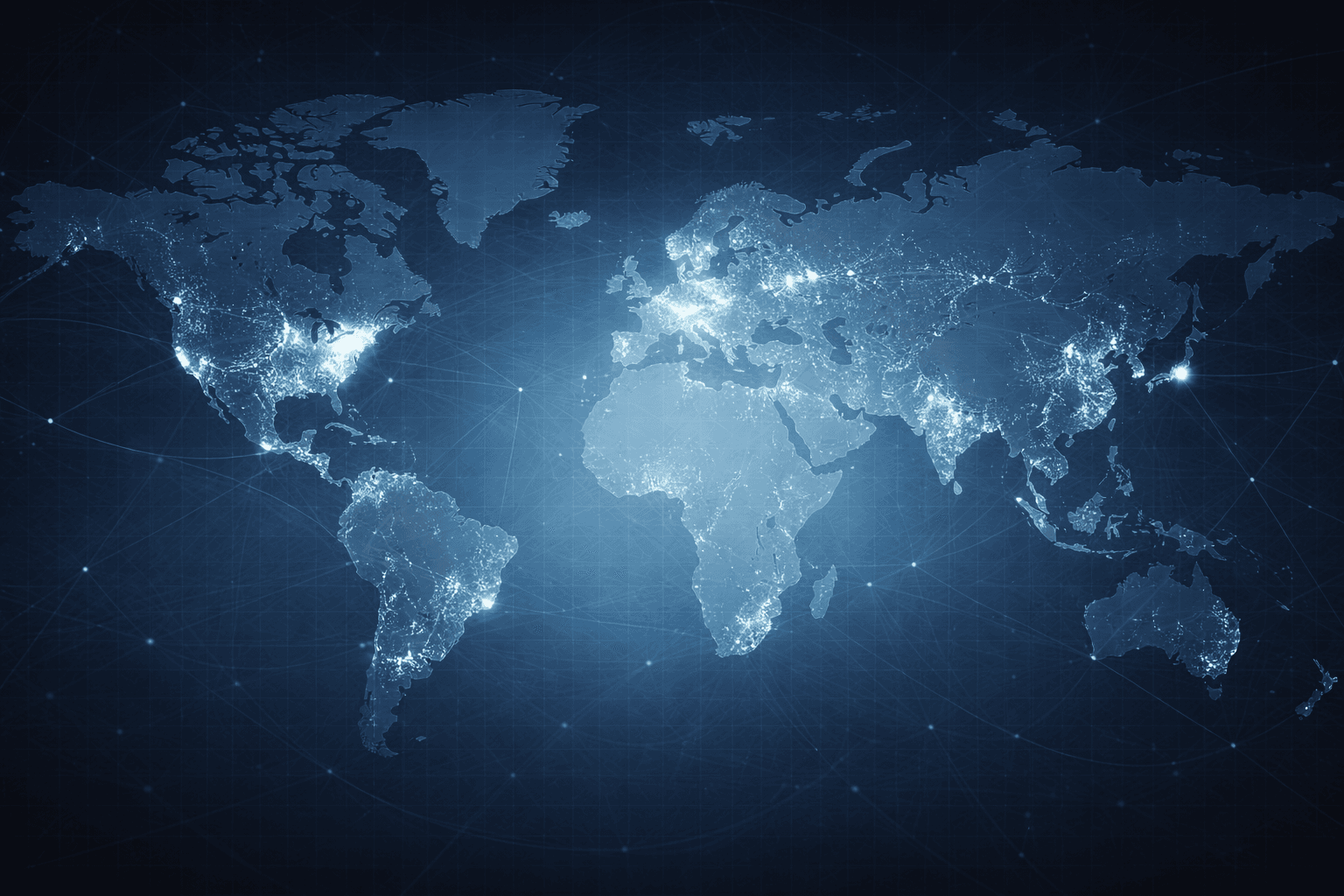
Introduction: The Illusion of a Borderless World
Globalization, digital networks, and advanced military technologies have encouraged a persistent illusion: that geography no longer matters. Information travels instantly, capital moves across continents in milliseconds, and precision weapons can strike targets thousands of kilometers away. Yet beneath this surface, the structure of international politics remains deeply rooted in physical space.
Geography has not been replaced—it has been obscured. States still operate within constraints imposed by terrain, distance, climate, and access to resources. These constraints shape not only what states can do, but what they feel compelled to do.
The core principle remains unchanged: geography limits strategic choice. It does not dictate exact outcomes, but it defines the range of viable options. Understanding global politics without geography is like trying to understand chess without the board.
Stay ahead of global events.
Get clear geopolitical analysis in your inbox.
Russia: Strategic Depth and the Trauma of Exposure
Russia’s geopolitical behavior is often interpreted through ideology or leadership. However, its deeper logic lies in geography—specifically, vulnerability.
Western Russia is exposed through the vast North European Plain, a flat corridor that has historically enabled large-scale invasions. This is not a theoretical concern; it is a recurring historical experience:
- Charles XII of Sweden invaded Russia during the Great Northern War, advancing deep into its territory before being defeated at Poltava (1709).
- Napoleon Bonaparte reached Moscow in 1812.
- Adolf Hitler launched Operation Barbarossa in 1941.
- During World War I, Imperial Germany achieved significant early successes on the Eastern Front, pushing deep into Russian territory.
These repeated incursions have shaped a strategic culture centered on depth, buffers, and preemption.
Russia’s pursuit of strategic depth is rooted in geographic vulnerability, but this same behavior generates insecurity among its neighbors. For states in Eastern Europe, NATO expansion has not been an imposition, but a deliberate choice driven by historical memory and perceived risk. This creates a classic security dilemma: each side’s attempt to increase its own security reduces the security of the other.
Russia fears vulnerability; its neighbors fear Russia. NATO’s expansion reflects this mutual insecurity, illustrating a classic security dilemma rather than a one-sided process.
China and India: When Geography Reduces Conflict
China and India are often described as rising rivals, yet their relationship has remained relatively contained compared to other great-power rivalries. Geography explains much of this restraint.
The Himalayas form one of the most formidable natural barriers on Earth:
- Extreme altitude
- Harsh climate
- Limited infrastructure
- Logistical constraints for large-scale military operations
These conditions make sustained invasion across the region extraordinarily difficult. As a result, while border tensions exist, geography discourages full-scale war.
China’s main strategic pressure lies elsewhere—at sea. Its coastline is constrained by a chain of islands that limits direct access to the Pacific. This creates a form of maritime containment, pushing China to:
- Expand naval capabilities
- Assert control over nearby waters
- Develop alternative trade routes
Thus, while geography reduces conflict in one direction (India), it intensifies strategic competition in another (maritime Asia).
The United States: Continental Security and Hemispheric Control
The United States occupies one of the most advantageous geographic positions in history.
Protected by the Atlantic and Pacific Oceans, and bordered by relatively weak neighbors, the U.S. enjoys a level of security that most states can only approximate. This security has enabled a unique strategic posture: global projection without existential vulnerability at home.
But geography does more than protect the United States—it also enables control.
The United States and Hemispheric Exclusivity
This same principle operates beyond Europe. The United States, benefiting from exceptional geographic security, has consistently acted to prevent the rise—or intrusion—of rival great powers in its own hemisphere.
The logic, formalized in the Monroe Doctrine, is straightforward: no external great power should establish a strategic foothold in the Western Hemisphere.
This has led to a long-standing pattern of behavior:
- Opposition to European intervention in the Americas
- Strategic involvement in Central America and the Caribbean
- Sensitivity to external military or political presence near U.S. borders
The underlying principle is geographic, not ideological. Even a distant power becomes a direct concern once it establishes proximity.
In this sense, U.S. strategy mirrors that of continental powers: distance creates safety; proximity creates threat. The difference is that the United States has largely succeeded in maintaining that distance.
Why Greenland Matters
Interest in Greenland is often misunderstood as opportunistic or symbolic. In reality, it reflects geographic logic.
Greenland offers:
- A strategic position in the Arctic
- Proximity to emerging polar shipping routes
- Early warning and missile defense advantages
- A forward position between North America and Eurasia
As Arctic ice melts, new maritime routes become viable, increasing Greenland’s importance. Control or influence over this territory enhances the United States’ ability to monitor and shape activity in the northern approaches to its continent.
In short, Greenland is not peripheral—it is a geostrategic node.
Romania: A State on the Edge of the Plain
Romania’s geographic position illustrates the challenges faced by states located in exposed regions.
Situated near the Black Sea and at the intersection of Central and Eastern Europe, Romania lies along historical invasion routes. The Carpathian Mountains provide partial protection, but they do not eliminate vulnerability.
This has led to its characterization as being on a “highway of invasions” or in a “dangerous neighborhood.”
Consequences of this geography include:
- Repeated historical incursions
- Strategic importance for larger powers
- A persistent emphasis on alliances (NATO, EU)
Romania’s behavior reflects a broader pattern: states in exposed positions tend to externalize their security through partnerships. In this context, Romania’s consistent support for Ukraine is not merely political alignment, but a strategic calculation: a resilient and independent Ukraine functions as a buffer, helping to keep Russian military pressure at a distance from Romania’s own borders.
Israel and the Golan Heights: Geography as Immediate Necessity
Few examples demonstrate the immediacy of geography more clearly than Israel.
The Golan Heights overlook northern Israel, providing a commanding elevation advantage. Prior to 1967, artillery positioned there posed a direct threat to Israeli population centers.
Control of the Golan Heights offers:
- Surveillance over surrounding territory
- Defensive depth
- A buffer against potential attacks
For Israel, relinquishing this territory is not a symbolic concession but a concrete strategic liability with immediate security implications.
This case highlights a key principle: in certain contexts, geography is not abstract—it is existential.
Geography and the Fear of Powerful Neighbors
Geography does not only shape how states defend themselves—it also shapes whom they fear. One of the most persistent patterns in international politics is simple: states resist the emergence of powerful neighbors in their immediate vicinity. Proximity magnifies threat.
This logic has deep historical roots.
For centuries, France opposed the political consolidation of the German lands. A fragmented German space meant multiple smaller entities rather than a single powerful state on France’s eastern frontier. The eventual unification of Germany in 1871 fundamentally altered the balance of power in Europe, creating precisely the scenario French strategists had long sought to avoid: a strong, industrialized state directly across an exposed land border.
A similar dynamic can be observed in the case of Austria and the Italian peninsula. The Risorgimento was resisted by the Habsburg Empire not only for ideological reasons, but for strategic ones. Austrian control over northern Italy provided depth and influence; a unified Italy would replace a manageable frontier with a potentially assertive neighbor. Again, geography dictated the stakes: control over nearby space translates into security—or insecurity.
These examples illustrate a broader rule: states prefer weak neighbors to strong ones, especially when no natural barriers exist between them.
A General Rule of Geopolitics
From France and Germany to Austria and Italy, and from Europe to the Americas, the pattern is consistent:
- States resist the consolidation of power near their borders
- Geographic proximity intensifies perceived threat
- Strategic behavior aims to preserve favorable local balances of power
Geography, once again, does not dictate outcomes—but it defines what states are willing to accept, and what they will oppose at almost any cost.
Islands and Strategic Insulation
States such as Australia, Iceland, and New Zealand benefit from geographic isolation.
- Australia is protected by vast oceans and lacks powerful nearby adversaries.
- Iceland has no land borders and occupies a remote position.
- New Zealand is one of the most isolated nations globally.
This isolation reduces the likelihood of invasion and allows these countries to prioritize economic development and internal stability over territorial defense.
Geography, in these cases, functions as a silent security guarantee.
Chokepoints, Trade, and the Persistence of Distance
Global trade depends on a limited number of critical routes and chokepoints:
- Strait of Hormuz
- Strait of Malacca
- Suez Canal
These narrow passages concentrate risk. Disruption in any of them can have global repercussions.
Despite advances in transportation and logistics, movement still depends on geography. Goods, energy, and military forces must traverse physical space, and that space is unevenly structured.
Technology and the Enduring Relevance of Terrain
Technology has transformed warfare and economics, but it has not abolished geography.
- Precision weapons still require basing and logistics
- Cyber capabilities depend on physical infrastructure
- Naval power remains tied to sea lanes and ports
In many cases, technology increases the importance of specific geographic نقاط:
- Ports
- Airbases
- Undersea cables
- Arctic routes
Rather than eliminating geography, technology reconfigures its significance.
Strategic Culture: Thinking Through Geography
Over time, geography shapes how states perceive threats and opportunities:
- Russia seeks buffers
- China seeks access
- The United States seeks control of approaches
- Smaller states seek protection
These patterns are not coincidental—they are adaptations to enduring spatial realities.
Conclusion: Geography Sets the Stage
“Geography is destiny” is an oversimplification—but not an empty one.
Geography does not dictate outcomes. Leadership, institutions, and chance all matter. However, geography defines the boundaries of possibility.
- It determines where threats emerge
- It shapes how power is projected
- It influences which strategies are viable
In a world often described as fluid and borderless, the physical map remains stubbornly relevant.
Geography does not disappear. It endures—quietly, persistently—structuring global politics in ways that no technology has yet been able to erase.
You May Also Like
The Thucydides Trap Is a Myth: What Athens, Sparta, and History Actually Reveal
The 10 Maritime Chokepoints That Control the Global Economy
The World’s Nuclear Powers: Capabilities, History, and Risks to Humanity