In modern warfare, military victories do not always translate into long-term strategic success. Throughout history, nations have often won battles and even entire wars only to discover that securing a lasting peace is a far more complex challenge. This question has resurfaced following the recent confrontation between the United States and Iran during Donald Trump’s presidency. While supporters of the operation argue that Washington achieved a decisive military success, critics contend that the long-term consequences may prove far less favorable. The central question remains: did the United States win the war but lose the peace?
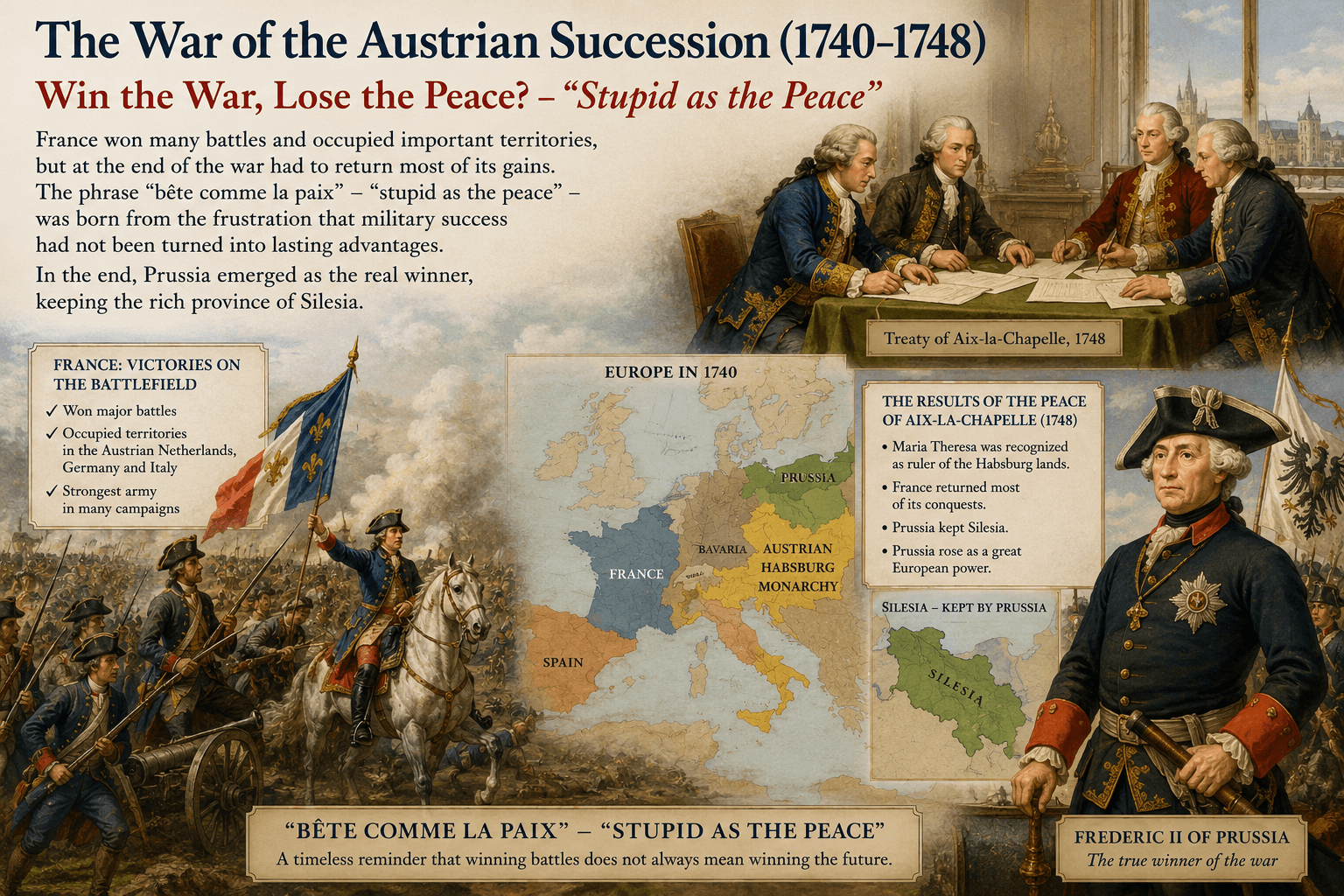
History offers many examples of military victories that failed to deliver lasting political gains. One of the most famous comes from the War of the Austrian Succession (1740–1748), when France won important battles and occupied significant territories, only to return most of its conquests in the peace settlement. Many contemporaries felt that French military achievements had been squandered by diplomacy, giving rise to the expression “bête comme la paix” (“stupid as the peace”). While France had often prevailed on the battlefield, it was Prussia that emerged as the conflict’s principal beneficiary by retaining the rich province of Silesia. Nearly three centuries later, a similar question is being asked about the confrontation between the United States and Iran: did Washington achieve a military victory only to discover that winning the peace may prove far more difficult than winning the war?
Stay ahead of global events.
Get clear geopolitical analysis in your inbox.
Why Did Trump Decide to Strike Iran?
The roots of the conflict lie in years of escalating tensions between Washington and Tehran. Since the Islamic Revolution of 1979, relations between the two countries have been marked by mutual distrust, economic sanctions, and periodic confrontations. Under Donald Trump, the situation deteriorated further after the United States withdrew from the Joint Comprehensive Plan of Action (JCPOA), commonly known as the Iran nuclear deal.
The Trump administration argued that the agreement failed to permanently prevent Iran from developing nuclear weapons and did not adequately address Tehran’s regional activities. As concerns grew over Iran’s nuclear ambitions, Washington adopted a strategy of “maximum pressure,” combining severe economic sanctions with military deterrence.
When intelligence reports suggested that Iran’s nuclear program was advancing despite international pressure, the administration concluded that military action was necessary. The stated objective was clear: prevent Iran from acquiring nuclear weapons and restore American credibility in the Middle East.
A Tactical Military Success
From a purely military perspective, the operation appeared highly effective. American forces targeted key facilities associated with Iran’s nuclear infrastructure, employing advanced precision-guided munitions and sophisticated intelligence capabilities.
According to supporters of the strikes, the operation demonstrated several advantages of American military power. First, the attacks reportedly inflicted significant damage on facilities considered essential to Iran’s nuclear program. Second, the United States achieved its objectives without suffering substantial casualties. Third, the operation showcased the technological superiority of American air and missile forces.
For many analysts, the strikes reinforced a message that Washington remained willing and capable of using force to protect its strategic interests. In that sense, the operation could be viewed as a clear tactical victory.
Military success, however, is only one component of a broader strategic equation.
Iran’s Response: Defeat or Survival?
Although Iran suffered significant damage, the regime itself remained intact. Unlike conventional wars aimed at regime change, the American operation focused primarily on military and nuclear targets rather than the political leadership.
This distinction is important. History suggests that governments can survive severe military setbacks while preserving their political authority and strategic objectives. Iran’s leadership quickly portrayed the attacks as evidence of foreign aggression, using the crisis to strengthen domestic unity and reinforce nationalist sentiment.
Moreover, Iran retained many of the tools that have long made it a significant regional power. Its influence through allied groups, its missile capabilities, and its political networks across the Middle East were not eliminated by the strikes.
As a result, some observers argue that Iran suffered a tactical defeat but achieved strategic survival. The country’s leadership remained in power, and its broader geopolitical ambitions did not disappear.
Regional Consequences
The impact of the confrontation extended beyond the borders of Iran and the United States. Across the Middle East, governments, military planners, and investors closely monitored developments.
For Israel, the strikes were generally welcomed as a significant setback for a long-standing adversary. Israeli officials have consistently viewed Iran’s nuclear program as an existential threat and have advocated strong measures to prevent its advancement.
Several Gulf Arab states also viewed the weakening of Iran’s capabilities as beneficial to regional security. However, these governments simultaneously feared that escalation could destabilize the region and threaten economic growth.
The broader concern is that military action may encourage a regional arms race. If governments conclude that security ultimately depends on military strength rather than diplomatic agreements, they may invest more heavily in advanced weapons programs.
Such developments could increase instability rather than reduce it.
The Diplomatic Battlefield
Military operations often generate diplomatic consequences that extend far beyond the battlefield. The American strikes produced mixed reactions among major international actors.
Some governments supported the objective of preventing nuclear proliferation but expressed concern about the use of force. Others criticized the operation as a violation of international norms and warned that it could undermine diplomatic efforts.
Russia and China, both seeking greater influence in global affairs, used the crisis to criticize American unilateralism. European governments found themselves in a difficult position, balancing concerns about Iran’s nuclear activities with support for diplomatic solutions.
The result was a more fragmented international landscape. Rather than creating a broad consensus, the conflict highlighted divisions among the world’s major powers.
Did the Strikes End Iran’s Nuclear Ambitions?
One of the most important questions concerns the long-term effectiveness of military action against nuclear programs.
Destroying facilities is not the same as eliminating scientific knowledge. Nuclear expertise cannot be bombed out of existence. Engineers, scientists, technical data, and industrial experience often survive even the most successful military operations.
Historical examples illustrate this challenge. Countries have repeatedly rebuilt strategic programs after suffering military setbacks. In some cases, external attacks have actually strengthened political determination to pursue advanced weapons capabilities.
For this reason, many experts argue that military strikes can delay a nuclear program but rarely eliminate the underlying motivation behind it.
If Iran’s leadership continues to view nuclear capability as essential to national security, reconstruction efforts may eventually follow.
The Argument That America Won the War but Lost the Peace
Critics of the operation point to several factors supporting this interpretation.
First, military action may have increased anti-American sentiment among parts of the Iranian population. While opposition to the government exists within Iran, foreign attacks often strengthen nationalist reactions.
Second, the confrontation may have reduced incentives for diplomatic compromise. Leaders facing external pressure frequently adopt more hardline positions rather than appearing weak.
Third, the crisis may have encouraged Tehran to seek new partnerships with countries willing to challenge American influence. Such realignments could complicate Washington’s long-term strategic objectives.
Finally, critics argue that no clear political framework emerged to replace the damaged status quo. Military force can create opportunities, but lasting stability usually requires diplomatic solutions, economic reconstruction, and political agreements.
Without those elements, tactical victories may produce only temporary results.
The Argument That America Won Both the War and the Peace
Supporters of Trump’s approach offer a different interpretation.
They argue that deterrence works only when threats are credible. By demonstrating a willingness to use force, the United States reinforced its position not only in relation to Iran but also in the eyes of allies and adversaries worldwide.
They also contend that delaying Iran’s nuclear progress by several years would represent a significant strategic achievement. In international politics, time itself can be valuable. Political conditions, leadership changes, and diplomatic opportunities may emerge during the period created by military action.
Furthermore, supporters maintain that failure to act could have allowed Iran’s nuclear capabilities to advance unchecked, creating even greater risks in the future.
From this perspective, the operation may ultimately strengthen regional security rather than weaken it.
Conclusion
Determining whether the United States won the war but lost the peace depends largely on the timeframe used for evaluation.
In military terms, Washington appears to have achieved many of its immediate objectives. The operation demonstrated American military superiority, damaged critical targets, and reinforced the credibility of U.S. deterrence.
The strategic picture, however, remains far more uncertain. Iran’s government survived, regional tensions persist, and questions about the future of the country’s nuclear ambitions remain unresolved.
History often teaches that military victories are easier to measure than political outcomes. The true verdict on Trump’s confrontation with Iran will not be delivered by battlefield assessments or damage reports. Instead, it will depend on whether the Middle East becomes more stable, more secure, and less prone to conflict in the years ahead.
Only then will it be possible to determine whether the United States merely won a military confrontation—or achieved a lasting strategic success.
You May Also Like
OPEC’s Rise and Decline: How the Oil Cartel Shaped the Modern World
BRICS: What It Is and What It Wants to Become
Soft Power vs Hard Power: What’s the Difference and Why It Matters
What Is Geopolitics? Meaning, Examples, and Why It Matters Today
Why a Palestinian State May Pose Strategic Risks for Israel