Why Pakistan Cannot Buy What the Abraham Accords Are Selling
Author: Dr. Vikas Bhardwaj
In May 2026, Donald Trump placed a conference call to the leaders of Saudi Arabia, Pakistan, Turkey, Egypt, and Jordan and asked them, in effect, to buy what the Abraham Accords were selling. The Emirati, Bahraini, Moroccan, and Sudanese signatories had already bought in: they traded recognition of Israel for concrete American dividends — F-35 fighters, sovereignty over Western Sahara, removal from terrorism blacklists. Pakistan’s Defence Minister Khawaja Asif refused before the call ended. This was not a miscalculation or a posture. It was the only response structurally available to Islamabad.
Stay ahead of global events.
Get clear geopolitical analysis in your inbox.
The puzzle is genuine. Field Marshal Asim Munir — constitutionally tenured through 2030 as Pakistan’s first Chief of Defence Forces, elevated after the May 2025 India conflict, shielded from prosecution by the 27th Amendment — is the most powerful military figure Pakistan has produced since Zia-ul-Haq. If the institution controls the state, why can’t it simply decide? Because the institution that controls the state is itself trapped inside an ideological architecture of its own construction. The Abraham Accords did not create Pakistan’s dilemma. They have merely illuminated a structural failure that began in 1977.
Washington, Riyadh, or Tel Aviv do not block Pakistan. It is blocked by four decades of its own strategic choices, now calcified into institutional constraints that no single actor — not even Munir — can dissolve.
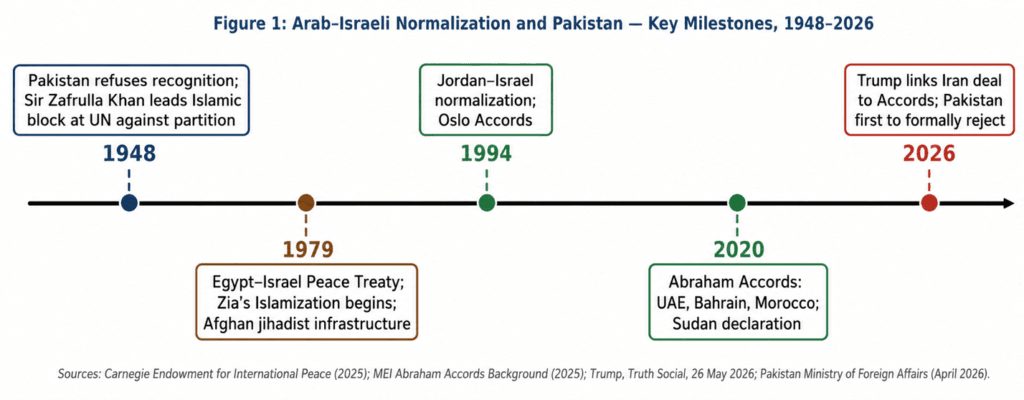
Figure 1: Arab–Israeli Normalization and Pakistan — Key Milestones, 1948–2026 Sources: Carnegie Endowment for International Peace (2025); MEI (2025); Trump, Truth Social, 26 May 2026; Pakistan Ministry of Foreign Affairs (April 2026).
THE ACCORDS WERE TRANSACTIONS — PAKISTAN HAS NOTHING EQUIVALENT TO OFFER
The Abraham Accords, signed at the White House in September 2020, were not peace agreements in any idealistic diplomatic sense. They were strategic transactions in which every signatory received a discrete, measurable, sovereign-level benefit — and crucially, every signatory possessed the institutional capacity to absorb domestic political blowback. The UAE’s Al-Nahyan family needed to answer to no electorate, no Islamist party, and no jihadist network that would interpret normalization as civilizational betrayal. Morocco’s US recognition of Western Sahara sovereignty was worth more than any Palestine optics. Sudan needed off the terrorism list more than it needed solidarity with Islamabad.
Pakistan’s offer — diffuse goodwill, investment signals, IMF sympathy — does not come close to matching the domestic cost of recognition. More critically, Pakistan lacks what every prior signatory possessed: the institutional capacity to manage domestic blowback. The Abraham Accords exposed this asymmetry before Trump’s phone call ended.
Table 1: The Abraham Accords Were Strategic Transactions — Pakistan Has No Equivalent Absorption Capacity
| Signatory | US Concession Received | Strategic Logic | Domestic Absorption Capacity |
| UAE (2020) | Prospective $23bn F-35 / MQ-9 package; US security umbrella against Iran | Counter-Iran containment; integration into US defence architecture | High: Al-Nahyan family controls all domestic variables; no Islamist veto; no elections |
| Bahrain (2020) | Enhanced US security guarantees; Israeli drone and intelligence cooperation | Existential Iranian threat; regime survival; US Fifth Fleet proximity | High: Al-Khalifa monarchy manages clerical narrative; civil society restricted |
| Morocco (2020) | US recognition of sovereignty over Western Sahara; Israeli air-defence systems | Territorial legitimacy; military modernisation; Israeli intelligence access | High: palace frames policy as royal prerogative; religious institutions palace-controlled |
| Sudan (2021) | Removal from US state-sponsors-of-terrorism list; debt relief | Economic survival; Western reintegration; military government legitimacy | Medium: military government; no mass Islamist religious veto in normalisation decision |
| Pakistan (2026) | Offered: goodwill, investment signals, IMF sympathy | Unclear: no discrete territorial, security, or economic incentive matches political cost | None: 74% unfavourable views of Jewish people (Pew 2019); mass Islamist mobilisation capacity; militant-network blowback risk |
Sources: Carnegie Endowment for International Peace (April 2025); Middle East Institute; Britannica; Congressional Research Service; Pew Research Center (2019).
THE DECISIVE VARIABLE IS STATE CONTROL OVER THE RELIGIOUS ECOSYSTEM
The Egypt-Jordan comparison demolishes the argument that Pakistan’s refusal reflects democratic pressure alone. Both Egypt and Jordan normalized despite mass popular opposition, because their governments possessed institutional authority to manage the religious sphere. Egypt’s Al-Azhar operates under state direction. Jordan’s Hashemite monarchy claims custodianship of Jerusalem’s holy sites — an authority that paradoxically allowed King Hussein to frame the 1994 peace as a royal Islamic responsibility rather than capitulation to Western pressure.
Pakistan’s military possesses neither instrument. A 2019 Pew Research survey found 74 percent of Pakistanis held unfavorable views of Jewish people. This is not merely public opinion — it is an institutional inheritance that GHQ manufactured over decades. The decisive variable is not regime type. It is state control over the religious ecosystem. Pakistan, uniquely among the states discussed, has none.
Table 2: The Decisive Variable Is State Control Over the Religious Ecosystem, Not Regime Type
| Country | Regime Type | State Control of Religious Sphere | How Normalization Was Managed |
| Egypt (1979) | Authoritarian republic; competitive military politics | High: Al-Azhar under state direction; President controlled narrative | Imposed from above; Sadat assassinated 1981; Arab League suspended Egypt until 1989; “cold peace” endures |
| Jordan (1994) | Hashemite monarchy; managed pluralism | High: King claims custodianship of Jerusalem’s holy sites — religious authority to frame peace as Islamic duty | Oslo process provided political cover; palace-directed; “cold peace” publicly unpopular but institutionally stable |
| UAE / Bahrain (2020) | Hereditary monarchies; civil society suppressed | Total: no autonomous religious-political organizations permitted | Closed-system decision; no accountability; warm economic peace with Israel; billions in bilateral trade |
| Pakistan (2026) | Hybrid civil-military state; competitive Islamist politics | None: madrassa network autonomous; Islamist parties hold veto power; GHQ is embedded inside the ideology it constructed | Normalization structurally foreclosed: no religious institution exists within the state that could legitimate recognition |
Sources: INSS Strategic Assessment (May 2023; August 2023); Chatham House; Pew Research Center (2019); Middle East Eye; Author’s analysis.
PAKISTAN IS NOT WAITING FOR ISRAEL. PAKISTAN IS WAITING FOR SAUDI ARABIA.
Pakistan is not waiting for Israel. Pakistan is waiting for Saudi Arabia. And Saudi Arabia is waiting for Palestinian statehood that may never come.
The financial architecture of Saudi-Pakistani dependence makes this structural, not merely political. According to IOM data from the State Bank of Pakistan, Saudi Arabia accounted for USD 7.4 billion — 25 percent — of Pakistan’s total remittances in FY2024; the UAE added USD 5.5 billion (18.7 percent). GCC states collectively supply over 55 percent of inflows that reached a record USD 38.3 billion in FY2025, a 26.6 percent year-on-year rise. Beyond remittances, Riyadh has functioned as Pakistan’s lender of last resort: USD 6 billion in 2018, USD 4.2 billion in 2021, USD 3 billion rolled over in 2022. Saudi deposits in Pakistani banks signal confidence to the IMF, which has extended twenty-three programmes to Islamabad since 1958, including the current USD 7 billion Extended Fund Facility.
In September 2025, Islamabad and Riyadh formalized this architecture with the Strategic Mutual Defence Pact — the first bilateral defence agreement Pakistan has ever signed with any foreign state, personally stewarded by Munir alongside Prime Minister Sharif and Crown Prince Mohammed bin Salman. For Islamabad to normalize before Riyadh would mean positioning Rawalpindi ahead of Mecca in the Islamic world’s most symbolically charged foreign policy question. No Pakistani leader — civilian or military — can survive that optic.
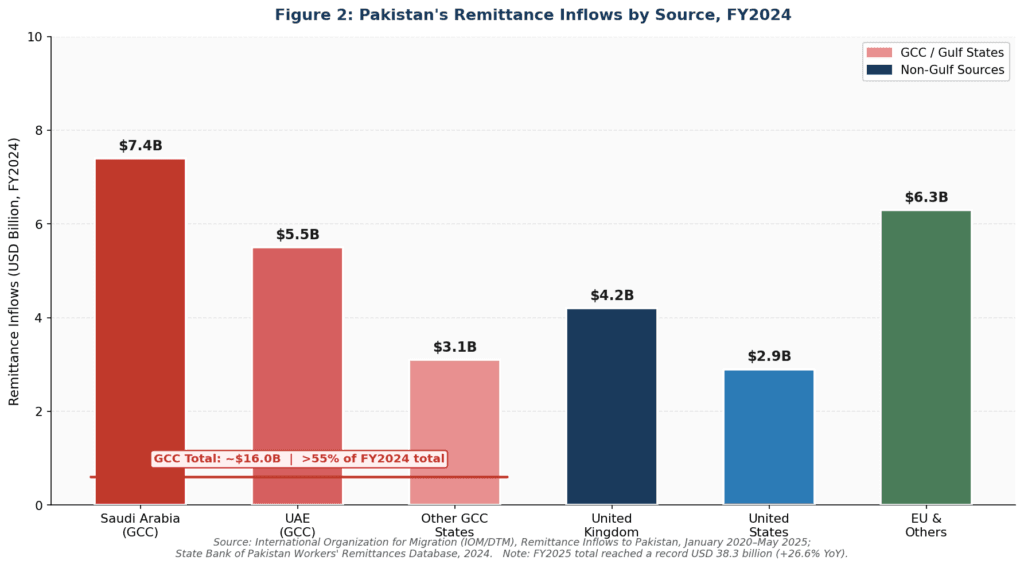
Figure 2: Pakistan’s Structural Dependence on Gulf States — Remittance Inflows by Source, FY2024 Sources: IOM/DTM, Remittance Inflows to Pakistan, January 2020–May 2025 (2025); State Bank of Pakistan, 2024. Note: FY2025 total reached a record USD 38.3 billion (+26.6% YoY).
THE MONSTERS OF ITS OWN MAKING
The deepest constraint on Pakistan’s flexibility is neither economic dependence nor Saudi caution. It is the accumulated consequence of deliberate choices made over four decades of ideological statecraft — choices that served their immediate geopolitical purpose and simultaneously destroyed the state’s future flexibility. General Zia-ul-Haq’s Islamization project, launched in 1977 and turbocharged by the Soviet invasion of Afghanistan in 1979, weaponized Islamic ideology as a substitute for democratic legitimacy and as an instrument of regional power projection. The ISI cultivated an institutional appetite for deploying religiously motivated proxies that outlasted the Cold War by decades.
Lashkar-e-Taiba, Jaish-e-Mohammed, and the Afghan Taliban were not aberrations — they were deliberate investments. The Hudson Institute has characterized LeT as the Pakistani army’s ‘most subservient proxy,’ a description borne out by the fact that LeT has never attacked inside Pakistan — a record that reveals the institutional protection GHQ extended. The 2008 Mumbai attacks demonstrated how deeply these networks had been institutionalized and how difficult their selective discipline had become. Pakistan’s passport bearing ‘valid for all countries except Israel’ is not a bureaucratic holdover — it is the visible tip of a decades-deep ideological infrastructure the state built for strategic advantage and now cannot dismantle for strategic gain.
The very networks once cultivated as instruments of state power have become constraints on state policy. Islamabad spent decades building the ecosystem that now prevents it from adapting to a changing world.
Table 3: The Mechanism of Self-Entrapment — How Pakistan’s Strategic Choices Became Structural Constraints
| Policy Decision | Original Strategic Logic | How It Became a Structural Constraint |
| Islamization under Zia-ul-Haq (1977–1988) | Replace democratic legitimacy with Islamic legitimacy; mobilize for Afghan jihad; earn Gulf donor funding | Islamist worldview embedded in military culture, curriculum, and judiciary; Gulf-funded madrassa network institutionalized; GHQ itself now ideologically entangled in the ecosystem it created |
| LeT, JeM, Afghan Taliban cultivated as strategic proxies | Achieve strategic depth in Afghanistan; bleed India in Kashmir through deniable, religiously motivated networks | Networks institutionalized beyond state discipline; LeT never attacked inside Pakistan — that protection reveal GHQ’s investment; Mumbai 2008 demonstrated these assets became permanent liabilities |
| Palestine framed as existential Islamic cause, not foreign policy position | Earn OIC leadership credibility; signal Islamic solidarity; differentiate Pakistan from Arab pragmatists | Anti-Israel passport cited as “immovable red line” by Defence Minister Asif (May 2026); normalization now requires repudiating a founding ideological commitment, not merely revising a policy position |
| Religious-political parties enabled as mobilization instruments | Channel discontent outward; sustain civil-military elite cohesion through Islamic solidarity narratives | Jamaat-ud-Dawa, JUI-F, and allied networks retain veto-level foreign policy influence; banning one group disperses but does not dissolve the network or its ideological grammar |
Sources: Fair, C. Christine, Fighting to the End (Oxford University Press, 2014); Hudson Institute (2018); Radical Politics (May 2025); Britannica; Author’s analysis.
WHY EVEN THE MOST POWERFUL PAKISTANI LEADER IN A GENERATION CANNOT NORMALIZE
Munir’s paradox is that his power makes the trap visible. He is the most dominant Pakistani leader since Zia: field marshal, first Chief of Defence Forces, constitutionally secured, trusted by Washington — CENTCOM has called Pakistan a ‘phenomenal partner’ in counterterrorism — architect of the September 2025 Saudi defence pact, and the broker who positioned Pakistan as Iran-US interlocutor during the 2026 regional crisis. If any individual in Pakistan’s history had the institutional authority to decide normalization, it is Munir. That he cannot is the proof that the constraint is structural, not personal.
There is one further complication that makes normalization harder, not easier. Operation Sindoor in May 2025 brought India’s use of Israeli precision munitions, HAROP loitering drones, and Barak-8 air-defence systems into direct confrontation with Pakistan. Israeli military technology is now directly associated in Pakistani public consciousness with attacks on Pakistani territory. Any GHQ overture toward Tel Aviv would be framed domestically as embracing the armourer of India’s strikes. Munir’s rational calculus is therefore unambiguous: maintain the public refusal, extract US goodwill through counterterrorism cooperation and Iran mediation, and wait for Saudi cover before any movement is conceivable.
Table 4: Why Even the Most Powerful Pakistani Leader in a Generation Cannot Normalize
| Dimension | Normalize with Israel | Strategic Ambiguity (Current Path) |
| Political survival | Fatal: Islamist parties mobilize; TTP gains propaganda windfall; Munir’s “defender of faith” legitimacy collapses; military cohesion fractures | Secure: domestic legitimacy maintained; “principled stance” narrative intact; Islamist parties remain manageable |
| Economic gain | Marginal: IMF goodwill, investment signalling; Gulf remittances are indifferent to recognition — UAE normalized yet Pakistan workers’ remittances from Gulf continue regardless | No loss: Gulf states impose no financial penalty for non-recognition; Saudi architecture — remittances, deposits, IMF cover — continues regardless of Accords participation |
| Security risk | Severe: LeT networks, Deobandi parties, and TTP treat recognition as civilizational betrayal; risk of intra-Pakistan escalation that destabilizes military’s own support base; Operation Sindoor has made Israeli arms toxic domestically | Contained: existing militant equilibrium maintained; no new threat vectors activated by inaction |
| Diplomatic value | Narrow: gains Washington’s approval but risks OIC credibility; Operation Sindoor dynamic means Israeli arms are now publicly associated with strikes on Pakistani soil — any Israeli embrace becomes domestically toxic | Broader: Pakistan extracts counterterrorism value from Washington AND Islamic solidarity credibility from OIC simultaneously — a balance only strategic ambiguity preserves |
| Net strategic logic | Irrational under current structural conditions: no incentive matches the cost; no domestic institution can absorb the blowback; recognition without Saudi cover is political suicide | Rational optimum: preserves all future options, extracts present dividends from both Washington and Riyadh without triggering irreversible domestic fracture |
Sources: Carnegie Endowment (May 2026); Atlantic Council, Kugelman; Modern Diplomacy (December 2025); Author’s analysis.
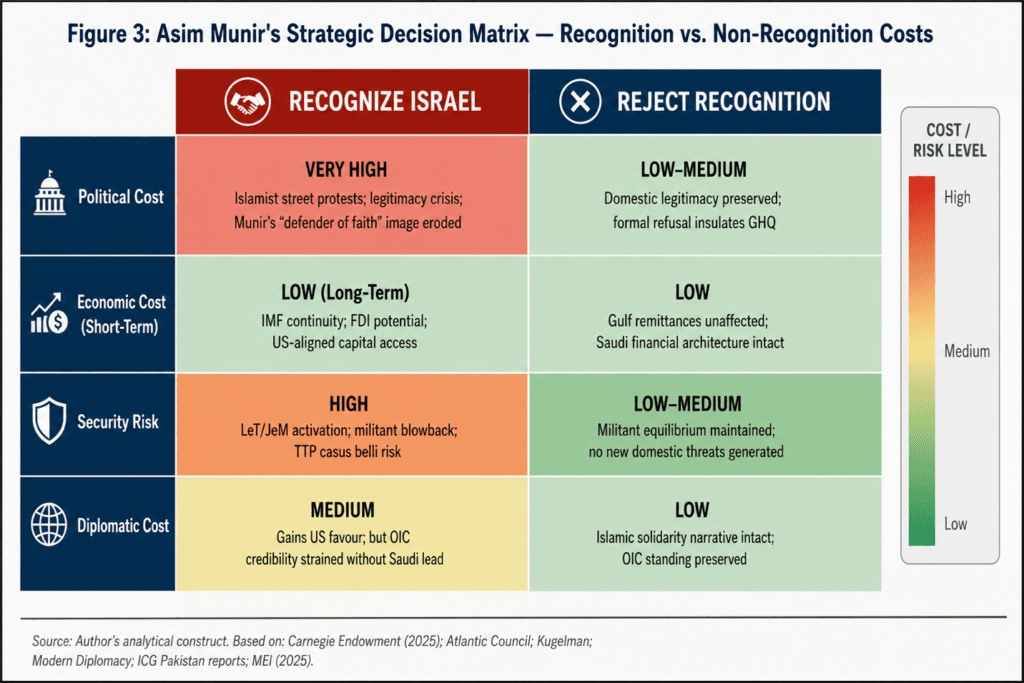
Figure 3: Strategic Decision Matrix — Costs and Risks of Recognition vs. Non-Recognition for Islamabad Source: Author’s analytical construct based on Carnegie Endowment (2025); Atlantic Council (Kugelman); Modern Diplomacy; ICG Pakistan reports; MEI (2025).
THREE FUTURES FOR PAKISTAN
Scenario A — Saudi Arabia normalizes first (Probability: Medium, approximately 25–30 percent): Pakistan follows within 12–18 months, with Munir framing recognition as ‘Islamic consensus’ behind Riyadh’s lead. The September 2025 defence pact provides exactly the institutional infrastructure for coordinated movement. Saudi public opinion has hardened substantially since October 2023, however, constraining Crown Prince MBS’s room to manoeuvre.
Scenario B — Strategic ambiguity maintained (Probability: High, approximately 50–60 percent): Pakistan sustains formal non-recognition while extracting US goodwill through counterterrorism cooperation and regional mediation value. Pakistan’s first primary fiscal surplus in fourteen years and the IMF’s December 2025 disbursement of USD 1.2 billion provide modest stabilization that reduces, but does not eliminate, external pressure. This is the path of least resistance.
Scenario C — Regional escalation collapses the Accords (Probability: Medium-Low, approximately 15–25 percent): A deepening Iran conflict or new Gaza catastrophe derails the Accords framework. Pakistan’s refusal is retroactively vindicated, and Islamabad derives reputational capital from having held firm against American pressure.
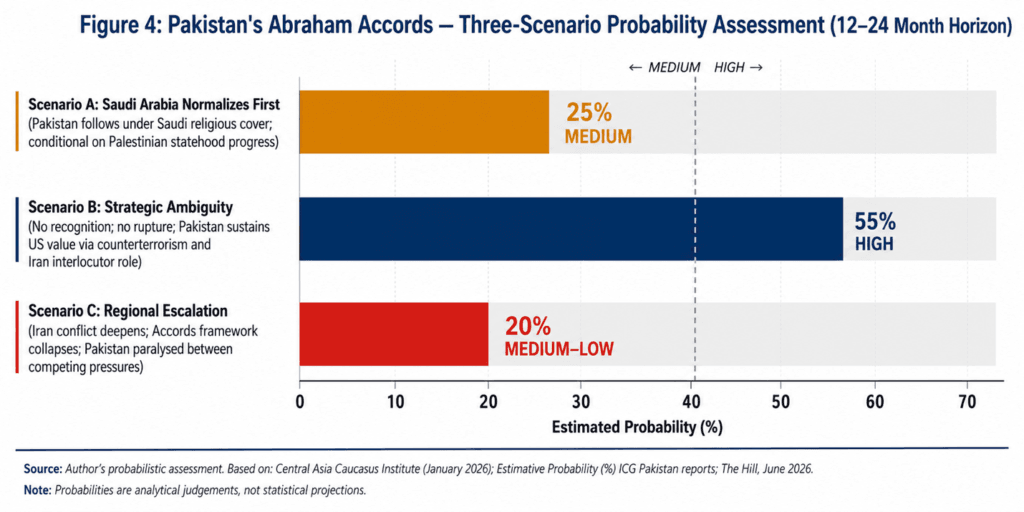
Figure 4: Three-Scenario Probability Assessment — Pakistan and the Abraham Accords (12–24 Month Horizon) Source: Author’s assessment. Based on: Central Asia Caucasus Institute (January 2026); Carnegie Endowment (2025); MEI; ICG; The Hill, June 2026. Note: Probabilities are analytical judgements, not statistical projections.
IMPLICATIONS FOR INDIA AND POLICY PRESCRIPTIONS
For India, Operation Sindoor has created a triangular dynamic — India, Israel, Pakistan — that will shape South Asian security for years. Munir’s repositioning of Pakistan as a US counterterrorism partner and Iran-US interlocutor constrains New Delhi’s diplomatic space in ways that India cannot easily offset. The September 2025 Saudi-Pakistan Strategic Defence Pact also introduces structural uncertainty into a Gulf region on which India’s economy depends — diaspora remittances exceeding USD 40 billion annually, energy imports, and I2U2 investments. A Pakistan locked in Abraham Accords refusal is a Pakistan that continues to define its identity partly in opposition to India’s regional relationships and will resist any geopolitical reconfiguration that aligns New Delhi, Tel Aviv, and Washington within a common strategic frame.
Three prescriptions follow. For Pakistan: the prerequisite for any foreign policy reorientation is not normalization itself but reform of the ideological ecosystem that forecloses it — madrassa curriculum reform, civilian oversight of religious-political organizations, and a counter-narrative to the jihadist calculus. These are conditions of normalization’s possibility, not alternatives to it. For the United States: transactional phone calls are inadequate when constraints are structural; Washington must engineer the Saudi pathway rather than simply pressure Islamabad. For Saudi Arabia: Islamabad will follow Riyadh, but it cannot lead.
CONCLUSION
Pakistan’s Abraham Accords dilemma is not ultimately about Israel. It is a case study in how states lose strategic flexibility when ideological narratives and proxy networks are institutionalized as instruments of national security policy. The Gulf monarchies that joined the Accords could absorb normalization costs because they controlled their domestic ideological ecosystems. Pakistan cannot, because it constructed one it no longer commands.
Field Marshal Munir is among the most capable strategists Pakistan has produced — but brilliance cannot dissolve structural traps of institutional design. The greatest obstacle to normalization is not Washington’s conditionality, Riyadh’s theological authority, Tehran’s regional power, or Tel Aviv’s occupation policies. It is the compounded legacy of policies that Pakistan itself created, nurtured, and exported as instruments of state power. Until Islamabad reckons seriously with that inheritance, it will remain caught between its geopolitical ambitions and the monsters it manufactured to serve them.
References
Arab News. “Pakistan rules out joining Abraham Accords after Trump call.” 26 May 2026.
Carnegie Endowment for International Peace. “The Abraham Accords After Gaza: A Change of Context.” April 2025.
Carnegie Endowment for International Peace. “Pakistan’s Military Consolidation Under Munir Faces Critical Challenges.” May 2026.
Central Asia Caucasus Institute. “Pakistan and the Abraham Accords: Implications for Central Asia.” January 2026.
Fair, C. Christine. Fighting to the End: The Pakistan Army’s Way of War. Oxford University Press, 2014.
Hudson Institute. “The Milli Muslim League: The Domestic Politics of Pakistan’s Lashkar-e-Taiba.” 2018.
International Monetary Fund. Extended Fund Facility, Pakistan Programme, USD 7 billion. IMF Country Report No. 24/310, September 2024.
International Organization for Migration (IOM/DTM). “Remittance Inflows to Pakistan, January 2020–May 2025.” 2025.
INSS. “Pakistan-Israel Relations: A Chance of Normalization?” Strategic Assessment, Vol. 26, No. 2, May 2023.
INSS. “The Many Faces of Normalization: Models of Arab-Israeli Relations.” Strategic Assessment, August 2023.
Middle East Eye. “Why Pakistan will likely refuse to join the Abraham Accords.” June 2026.
Middle East Institute. “The Abraham Accords: Background and Analysis.” Updated November 2025.
Modern Diplomacy. “Pakistan’s Army Chief Asim Munir Faces Defining Test Over Trump’s Gaza Plan.” December 2025.
Pakistan Ministry of Foreign Affairs. “Recognition of Israel Not Under Consideration.” Press Statement, April 2026.
Pew Research Center. Global Attitudes Survey, 2019. Pakistan favorability data.
Radical Politics. “A State of Strategic Hostility: Terrorism as the Grammar of Pakistan’s Foreign Policy.” May 2025.
State Bank of Pakistan. Workers’ Remittances Database, 2024.
Trump, Donald. Truth Social post on Abraham Accords and Iran deal framework. 26 May 2026.
Xinhua. “Pakistan’s remittances surge 26.6 pct in fiscal 2025.” July 2025.
Funding: No funding was received for this research.
Conflict of Interest: The author declares no conflict of interest.
Author’s Bio: Vikas Bhardwaj is a scholar of international political economy, holding a Ph.D. and M.Phil. from the Centre for Russian and Central Asian Studies, School of International Studies, Jawaharlal Nehru University (JNU), New Delhi. His work focuses on economic statecraft, sanctions, energy geopolitics, and global economic governance.
He has worked as a researcher with numerous institutions, including the Indian Institute of Public Administration (IIPA), contributing to multiple policy evaluation projects commissioned by the Government of India Ministries. Bhardwaj holds nine academic degrees and has published in international peer-reviewed journals on the Russian economy, geopolitical conflict, and shifting global power dynamics.
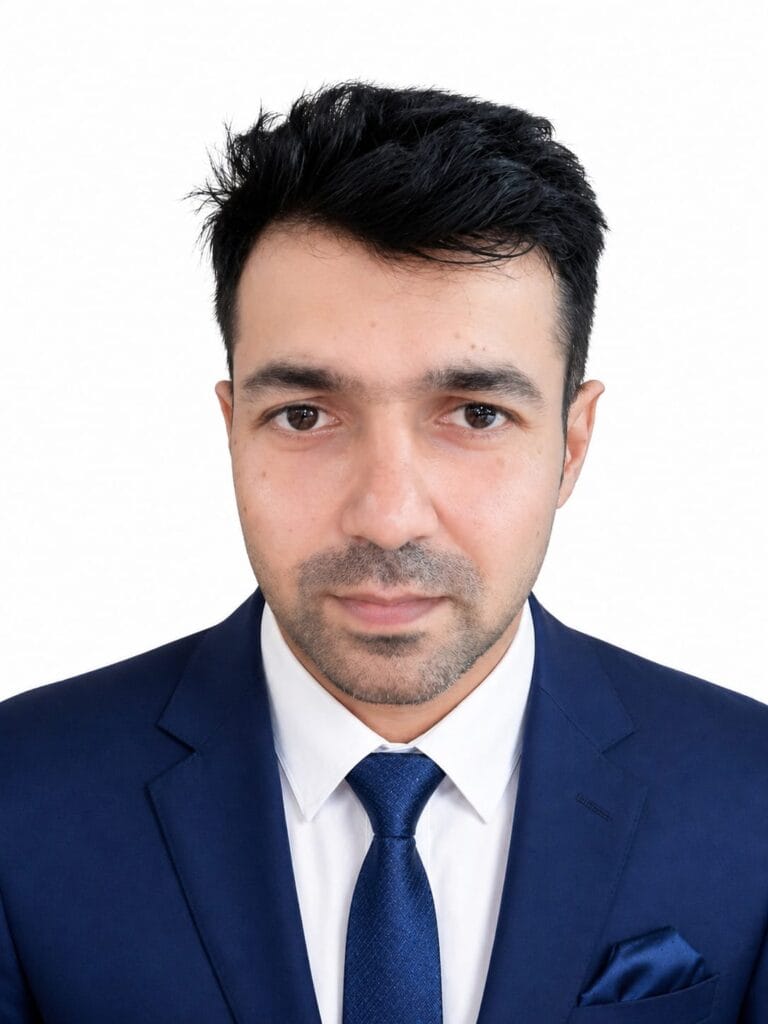
Dr. Vikas Bhardwaj, Ph.D., Centre for Russian Studies, School of International Studies, Jawaharlal Nehru University, New Delhi
Contact: vikasbhardwaj@live.in | +91 7503655898
Disclaimer
The views and opinions expressed in this article are solely those of the author and do not necessarily reflect the official position, editorial policy, or views of Geopolitical Brief, its editors, contributors, or affiliated organizations. The publication of this article does not constitute an endorsement of the arguments, analyses, or conclusions presented herein. Geopolitical Brief is committed to fostering informed discussion and the exchange of diverse perspectives on international affairs and geopolitical developments.
You May Also Like
The Degradation of Democracy in Turkey: From Atatürk’s Republic to Erdoğan’s Neo‑Ottoman Ambitions
Soft Power vs Hard Power: What’s the Difference and Why It Matters
What Is Geopolitics? Meaning, Examples, and Why It Matters Today
Hybrid Warfare: A Misleading Label for an Enduring Reality
Naval Blockade: History and Strategic Utility