Introduction
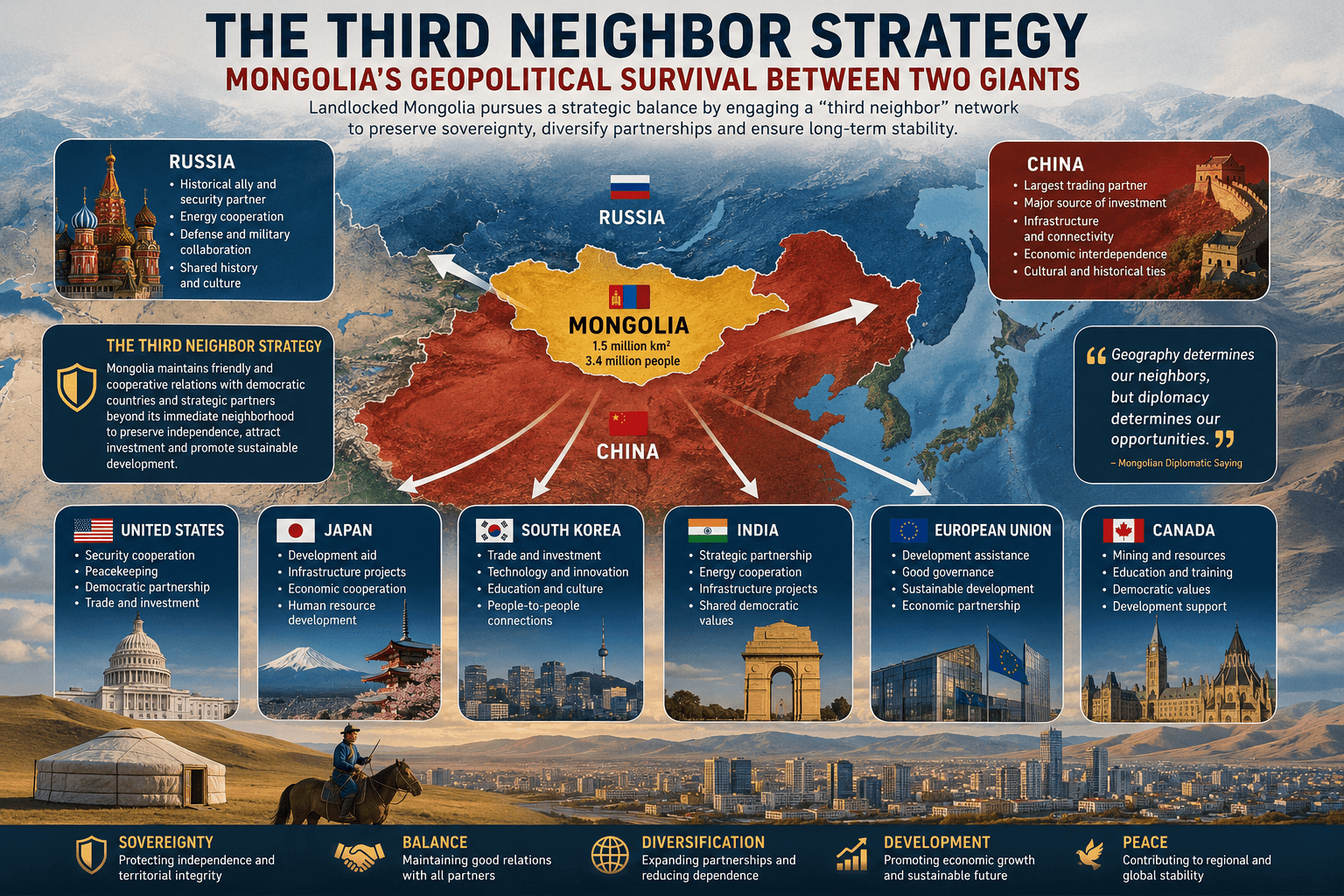
Few countries face a geopolitical challenge as unique as Mongolia’s. Situated between two of the world’s most powerful states—Russia to the north and China to the south—Mongolia occupies a strategic position at the heart of Eurasia. With no access to the sea and a population of just over three million people, the country might appear vulnerable to external influence. Yet, since the end of the Cold War, Mongolia has developed an innovative foreign policy doctrine designed to preserve its sovereignty and strategic autonomy: the Third Neighbor Strategy.
This policy has enabled Mongolia to cultivate strong political, economic, and security ties with countries beyond its immediate neighborhood, including the United States, Japan, South Korea, India, Canada, and members of the European Union. In an era marked by intensifying great-power competition, Mongolia’s experience offers valuable lessons about how small and medium-sized states can navigate complex geopolitical environments without becoming subordinate to larger powers.
As one Mongolian diplomat aptly observed, “Geography determines our neighbors, but diplomacy determines our opportunities.” This idea captures the essence of Mongolia’s foreign policy in the twenty-first century.
Stay ahead of global events.
Get clear geopolitical analysis in your inbox.
Mongolia: A Brief Historical Overview
Modern Mongolia traces its origins to the vast empire established by Genghis Khan in 1206. Under his leadership and that of his successors, the Mongol Empire became the largest contiguous land empire in history, stretching from Eastern Europe to the Pacific Ocean. Although the empire eventually fragmented, the legacy of Mongol statehood remained a central element of the nation’s identity.
From the seventeenth century onward, Mongolia gradually fell under the control of the Qing Empire, ruled by the Manchu dynasty in China. Following the collapse of the Qing dynasty in 1911, Mongolia declared its independence, but its status remained contested amid regional instability and competing foreign interests. In 1921, with Soviet support, Mongolian revolutionaries expelled Chinese forces and established a new political order. Three years later, the Mongolian People’s Republic was proclaimed, becoming the second socialist state in the world after the Soviet Union.
Throughout the Cold War, Mongolia remained closely aligned with the Soviet Union, serving as a strategic buffer between Moscow and Beijing. Soviet economic assistance, military cooperation, and political influence shaped nearly every aspect of Mongolian life. During the Sino-Soviet split of the 1960s and 1970s, Mongolia’s geopolitical importance increased significantly as tensions between its two giant neighbors escalated. However, the country’s sovereignty was often constrained by its dependence on Moscow.
The end of the Cold War brought profound change. Inspired by democratic movements across Eastern Europe and aided by the reforms taking place within the Soviet Union, Mongolia experienced a peaceful democratic revolution in 1990. The ruling communist party relinquished its monopoly on power, multi-party elections were introduced, and the country embarked on a transition toward democracy and a market economy. This transformation marked the beginning of a new era in Mongolian foreign policy, ultimately leading to the development of the Third Neighbor Strategy as a means of safeguarding national independence in a rapidly changing geopolitical environment.
Mongolia’s Geopolitical Dilemma
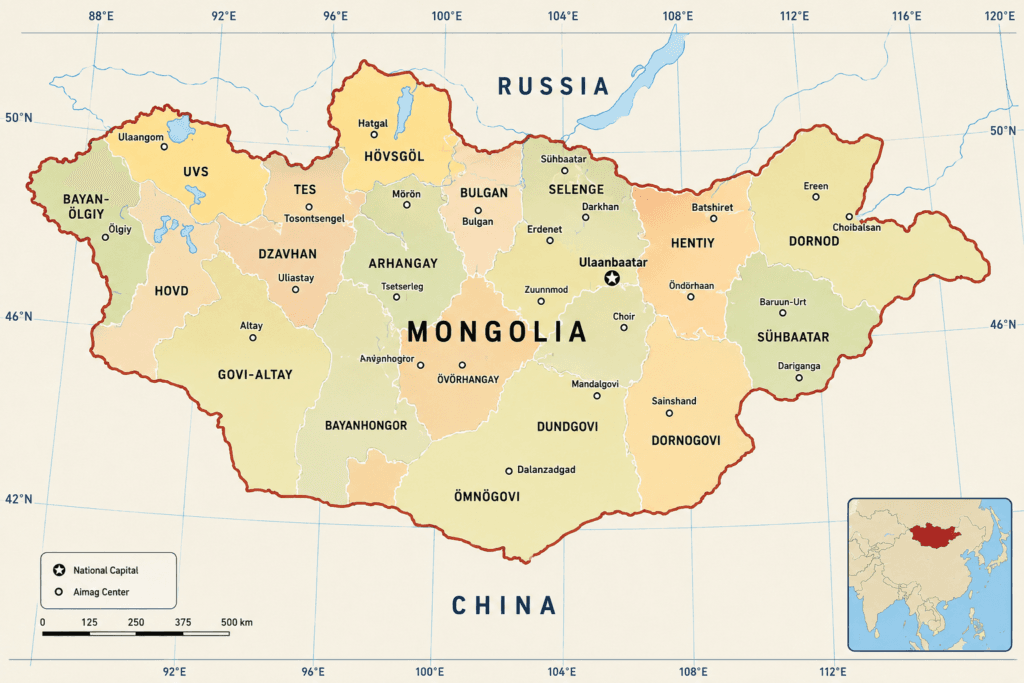
Geography has always shaped Mongolia’s destiny. The country occupies a vast territory of approximately 1.5 million square kilometers, yet it remains one of the world’s most sparsely populated nations. More importantly, Mongolia is completely landlocked, sharing borders exclusively with Russia and China.
Historically, this location has been both an advantage and a challenge. During the era of the Mongol Empire in the thirteenth century, Mongolia stood at the center of Eurasian affairs. However, following the empire’s decline, the region increasingly became an object of competition among neighboring powers.
Throughout much of the twentieth century, Mongolia functioned as a Soviet satellite state. The Soviet Union provided security guarantees and economic assistance, while Mongolia served as a strategic buffer between Moscow and Beijing. The collapse of the Soviet Union in 1991 fundamentally transformed Mongolia’s strategic environment. Suddenly, the country had to redefine its foreign policy and secure its independence without relying exclusively on Moscow.
At the same time, China’s economic rise created both opportunities and risks. China quickly became Mongolia’s largest trading partner and the primary destination for its mineral exports. While this relationship generated economic growth, it also increased concerns about excessive dependence on a single market.
Faced with these realities, Mongolia needed a strategy that would allow it to maintain productive relations with both neighbors while preventing overreliance on either of them.
The Birth of the Third Neighbor Concept
The origins of the Third Neighbor Strategy can be traced to the democratic revolution of 1990, which transformed Mongolia from a socialist one-party state into a democratic republic.
In August 1990, during a visit to Ulaanbaatar, U.S. Secretary of State James Baker referred to the United States as Mongolia’s “third neighbor.” The phrase resonated strongly with Mongolian policymakers because it offered a conceptual framework for expanding the country’s diplomatic horizons beyond its geographic constraints.
Over time, the concept evolved into a comprehensive foreign policy doctrine. Rather than referring solely to the United States, the term “third neighbor” came to encompass a broad network of democratic and economically developed partners capable of supporting Mongolia’s sovereignty and development.
The strategy was eventually incorporated into Mongolia’s official foreign policy documents and became one of the pillars of its international engagement.
Who Are Mongolia’s Third Neighbors?
Although the United States remains the most prominent third neighbor, Mongolia’s approach is deliberately diversified.
United States
Relations between Mongolia and the United States have strengthened considerably since the early 1990s. The two countries cooperate in areas ranging from military training and peacekeeping operations to economic development and democratic governance.
Mongolia has participated in international peacekeeping missions and regularly hosts military exercises involving U.S. forces. These activities enhance Mongolia’s international profile while reinforcing its strategic partnerships.
Japan
Japan has become one of Mongolia’s most important economic partners. Japanese development assistance has contributed significantly to infrastructure projects, education, and institutional reform.
Tokyo also views Mongolia as an important democratic partner in Northeast Asia, making bilateral relations mutually beneficial.
South Korea
South Korea’s growing economic influence has expanded opportunities for trade, investment, and cultural exchange. Thousands of Mongolian citizens work or study in South Korea, creating strong people-to-people connections.
India
India’s relationship with Mongolia has gained strategic significance in recent years. Both countries emphasize democratic values and share an interest in maintaining a stable balance of power in Asia.
India has invested in infrastructure and energy projects while strengthening diplomatic cooperation with Ulaanbaatar.
Europe and Canada
The European Union and Canada also play important roles in Mongolia’s Third Neighbor Strategy. These partners provide development assistance, support democratic institutions, and encourage economic diversification.
By cultivating multiple third neighbors, Mongolia reduces the risk of becoming excessively dependent on any single external actor.
Balancing Russia and China
The greatest challenge facing Mongolia is maintaining equilibrium between its two powerful neighbors.
Russia remains an important security partner. Historical ties, energy cooperation, and transportation networks continue to connect the two countries. Moscow’s influence has declined compared to the Soviet era, but it remains a significant actor in Mongolian foreign policy.
China, meanwhile, dominates Mongolia’s economic landscape. The vast majority of Mongolian exports—particularly coal, copper, and other mineral resources—are destined for Chinese markets. Chinese demand has fueled Mongolia’s economic growth, but it has also created structural vulnerabilities.
Mongolian policymakers recognize that neither confrontation nor excessive dependence serves the national interest. Instead, they pursue a policy of pragmatic engagement with both neighbors while simultaneously expanding partnerships elsewhere.
This balancing act requires considerable diplomatic skill. Mongolia cannot afford to alienate either Russia or China, yet it must preserve sufficient strategic space to conduct an independent foreign policy.
The Third Neighbor Strategy provides the mechanism through which this delicate equilibrium can be maintained.
The Importance of Critical Minerals
Mongolia’s geopolitical significance has increased due to the growing global demand for critical minerals.
The country possesses substantial deposits of copper, coal, gold, uranium, and rare earth elements. These resources are increasingly important for advanced manufacturing, renewable energy technologies, electric vehicles, and defense industries.
As global powers compete for access to strategic resources, Mongolia’s mineral wealth enhances its international relevance.
For Western countries seeking to diversify supply chains away from excessive dependence on China, Mongolia represents a potentially valuable partner. At the same time, China remains the most convenient and profitable market for many Mongolian exports.
This situation creates both opportunities and challenges. Mongolia must attract foreign investment while ensuring that economic development does not compromise national sovereignty.
Challenges to the Third Neighbor Strategy
Despite its successes, the Third Neighbor Strategy faces several significant obstacles.
Geographic Reality
No foreign policy doctrine can change geography. Russia and China will always remain Mongolia’s immediate neighbors. Their economic and political influence will continue to shape Mongolia’s strategic environment.
Economic Dependence
China accounts for the overwhelming majority of Mongolia’s exports. Diversifying trade relationships remains a long-term objective, but achieving this goal is difficult due to geographic constraints and transportation costs.
Great-Power Competition
The intensifying rivalry between China and the United States presents new challenges. Mongolia seeks friendly relations with both countries, yet increasing polarization may make neutrality more difficult to sustain.
Regional Instability
Events such as the war in Ukraine have altered Eurasian geopolitics and generated uncertainty throughout the region. Mongolia must adapt to changing circumstances while preserving its carefully balanced foreign policy.
Lessons for Small States
Mongolia’s experience offers valuable insights for other countries facing geopolitical pressures.
First, small states are not necessarily passive actors. Through skillful diplomacy, they can create strategic options that enhance their autonomy.
Second, diversification is essential. Reliance on a single partner—whether economic or security-related—can create vulnerabilities.
Third, soft power, democratic governance, and international partnerships can serve as important sources of resilience.
The Third Neighbor Strategy demonstrates that geography does not completely determine a country’s destiny. While physical location imposes constraints, effective diplomacy can expand opportunities and reduce risks.
Conclusion
Mongolia’s Third Neighbor Strategy stands as one of the most innovative foreign policy doctrines developed by a small state in the post-Cold War era. Confronted with the challenge of living between Russia and China, Mongolia chose neither isolation nor alignment with a single power. Instead, it pursued a sophisticated policy of diversification, balance, and international engagement.
More than three decades after the concept first emerged, the strategy remains central to Mongolia’s geopolitical survival. As global competition intensifies and Eurasia becomes increasingly important to international politics, Mongolia’s ability to maintain strategic autonomy will continue to be tested.
Yet the country’s experience demonstrates an important truth: even in a world dominated by great powers, smaller states can preserve their independence through prudent diplomacy, diversified partnerships, and a clear understanding of their national interests.
In this sense, Mongolia’s Third Neighbor Strategy is more than a foreign policy doctrine—it is a blueprint for geopolitical survival in the twenty-first century.
You May Also Like
OPEC’s Rise and Decline: How the Oil Cartel Shaped the Modern World
BRICS: What It Is and What It Wants to Become
Soft Power vs Hard Power: What’s the Difference and Why It Matters
What Is Geopolitics? Meaning, Examples, and Why It Matters Today
The Thucydides Trap Is a Myth: What Athens, Sparta, and History Actually Reveal