Table of Contents
How the battle for the ocean floor is reshaping global power
The Geography of Power Has Changed
Geopolitical power has always been inseparable from the ability to control the principal arteries through which wealth, information, and military capabilities circulate. In different historical periods these arteries assumed different forms. During the age of empires, strategic advantage depended primarily upon the command of maritime routes that connected continents and sustained colonial economies. The twentieth century witnessed the emergence of oil pipelines, air transport, and global energy networks as indispensable instruments of national power. The twenty-first century, however, is witnessing another transformation. The decisive infrastructure of international politics is no longer defined solely by territory, natural resources, or even traditional sea lanes, but increasingly by the invisible digital networks lying thousands of meters beneath the world’s oceans.
This article argues that undersea fiber-optic cables have become the maritime strategic assets of the Information Age. They should no longer be understood merely as components of global telecommunications infrastructure, but as critical geopolitical assets whose protection, ownership, and control increasingly shape economic competitiveness, military effectiveness, intelligence capabilities, technological leadership, and diplomatic influence. Just as Alfred Thayer Mahan demonstrated that command of the sea constituted the foundation of great-power status during the nineteenth century, command over the world’s digital arteries is becoming an equally decisive determinant of power in the twenty-first.
Stay ahead of global events.
Get clear geopolitical analysis in your inbox.
This transformation reflects a broader evolution in the nature of geopolitics itself. Classical geopolitical thought emphasized the strategic significance of territory, geography, and access to natural resources. Contemporary international competition, while continuing to value these traditional factors, has become progressively centered upon the control of global flows rather than merely spaces. Financial transactions, artificial intelligence, cloud computing, military command systems, financial markets, satellite coordination, scientific cooperation, and governmental communications all depend upon uninterrupted flows of digital information. These flows, contrary to popular perception, do not primarily travel through satellites orbiting the Earth. Instead, they move through an extensive network of submarine fiber-optic cables connecting every inhabited continent.
The widespread belief that satellites constitute the backbone of the global Internet represents one of the most persistent misconceptions surrounding digital infrastructure. Satellites remain indispensable for navigation, military reconnaissance, remote sensing, and communications in isolated regions, yet they carry only a relatively small proportion of international Internet traffic. The overwhelming majority of global digital communications—including financial transfers worth trillions of dollars, cloud services, government communications, intelligence exchanges, and commercial transactions—travel through submarine cables resting on the ocean floor. The stability of the global economy therefore depends less upon objects orbiting in space than upon infrastructure that remains largely invisible to the public.
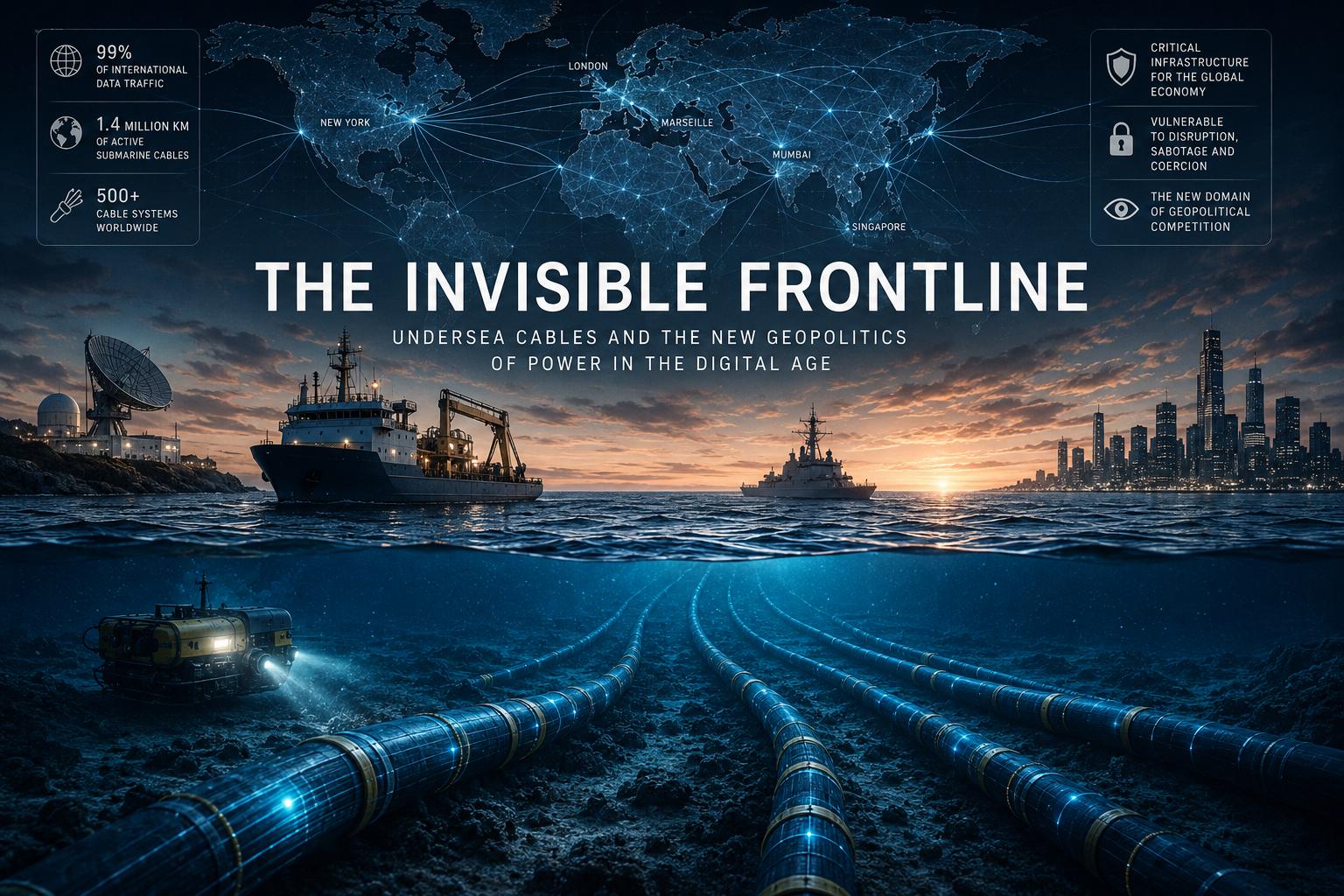
Paradoxically, one of the most indispensable components of globalization is also one of its least visible. Hundreds of submarine cable systems, extending across hundreds of thousands of kilometers beneath the oceans, silently connect financial centers, military headquarters, data centers, research institutions, multinational corporations, and governments. Every email transmitted across continents, every international financial transaction, every cloud-based service, every artificial intelligence model trained simultaneously across multiple data centers, and every encrypted diplomatic communication relies upon infrastructure that very few citizens—and even relatively few policymakers—ever consider.
This growing dependence has fundamentally altered the strategic meaning of maritime geography. Oceans no longer function exclusively as corridors through which merchant fleets transport physical goods or naval forces project military power. They have become the physical foundation of the world’s digital civilization. The seabed has evolved into an arena where technological competition, intelligence gathering, economic security, and military deterrence increasingly intersect. As states continue to digitize virtually every aspect of governance, defense, finance, healthcare, transportation, and industrial production, the vulnerability of this underwater infrastructure becomes inseparable from national security itself.
The strategic implications of this transformation extend far beyond communications technology. A successful disruption of major submarine cable systems would not merely slow Internet access. It could interrupt financial markets, complicate military command and control, hinder intelligence cooperation among allies, delay emergency response systems, disrupt logistics networks, and undermine public confidence during periods of international crisis. Modern societies have become so deeply integrated into digital networks that attacks upon information infrastructure may generate consequences comparable to those traditionally associated with attacks against ports, railways, pipelines, or electrical grids.
Consequently, undersea cables should be viewed not as passive civilian infrastructure but as critical strategic assets whose security increasingly determines the resilience of entire states. They constitute the hidden architecture upon which the contemporary international system operates. Their protection can no longer remain solely a commercial concern delegated to private telecommunications companies. Instead, safeguarding these digital arteries is becoming an essential responsibility of national governments and military alliances, transforming the ocean floor into one of the most consequential—and least understood—frontlines of twenty-first-century geopolitics.
The New Strategic Chokepoints
The strategic value of maritime chokepoints has occupied a central position in geopolitical thinking for centuries. From the Strait of Gibraltar and the Suez Canal to the Strait of Malacca and the Turkish Straits, control over narrow maritime passages has repeatedly shaped the rise and decline of great powers. Classical naval theorists understood that commercial prosperity and military influence depended not merely upon the possession of naval fleets but upon the ability to secure the routes through which commerce and communication flowed. While the geography of these traditional chokepoints remains unchanged, the emergence of a global digital economy has created an entirely new category of strategic bottlenecks lying beneath the surface of the sea.
Unlike shipping routes, submarine cable networks are not evenly distributed across the oceans. Economic logic, engineering constraints, seabed topography, and historical patterns of connectivity have concentrated hundreds of cable systems into relatively limited maritime corridors. Numerous transatlantic cables converge upon a small number of landing stations linking North America with Western Europe. Similar concentrations exist in the Mediterranean Sea, the Red Sea, the Persian Gulf, the South China Sea, and the waters surrounding Taiwan and Japan. These areas have therefore acquired a strategic significance extending well beyond their traditional maritime importance. They have become digital chokepoints whose disruption could reverberate throughout the global economy within minutes.
This concentration creates a structural paradox at the heart of globalization. The digital revolution is often perceived as decentralized, resilient, and borderless, yet the physical infrastructure supporting it remains remarkably concentrated. The apparent immateriality of cyberspace conceals an underlying geography characterized by fixed routes, vulnerable landing stations, limited repair capabilities, and highly specialized maintenance vessels. The Internet may appear virtual to its users, but its architecture remains profoundly physical.
The vulnerability of these networks has become increasingly evident during the past decade. Several incidents involving damaged submarine cables—whether caused by anchors, fishing activity, earthquakes, or suspected sabotage—have demonstrated that localized disruptions may generate consequences extending far beyond the immediate region. More importantly, these incidents have transformed what was once regarded primarily as an engineering problem into a matter of national security. Governments have gradually recognized that an attack upon digital infrastructure may produce strategic effects comparable to those traditionally associated with attacks against ports, airports, pipelines, or electrical grids.
Particularly significant is the Baltic Sea, where geopolitical tensions following Russia’s invasion of Ukraine have fundamentally altered perceptions of underwater infrastructure security. Multiple investigations into damaged telecommunications cables and energy pipelines have underscored the growing concern that hybrid warfare increasingly targets critical civilian infrastructure located beneath the sea. Whether every incident reflects deliberate sabotage or accidental damage is, in some respects, less important than the broader strategic reality: states must now plan for the possibility that submarine infrastructure will become an intentional target during periods of political confrontation.
A similar dynamic characterizes the Indo-Pacific. The waters surrounding Taiwan illustrate how digital infrastructure has become intertwined with military strategy. Taiwan occupies a central position within global semiconductor production, but it also depends heavily upon submarine cable connections linking the island with regional and global communication networks. Any military crisis involving the Taiwan Strait would therefore extend beyond conventional naval and air operations. Disruptions affecting undersea communications could complicate financial transactions, governmental coordination, military command structures, and civilian communications simultaneously, increasing both uncertainty and strategic pressure during an already volatile crisis.
The Red Sea represents another emerging digital chokepoint. Traditionally recognized as one of the world’s most important commercial shipping corridors, it also carries a substantial proportion of submarine cable traffic connecting Europe, the Middle East, Africa, and Asia. Instability in this region therefore threatens not only maritime commerce but also the uninterrupted flow of global digital communications. The convergence of physical trade routes and digital infrastructure within the same geographical corridor illustrates how contemporary geopolitics increasingly links traditional and technological dimensions of power.
These developments reveal a broader transformation in strategic thought. For much of modern history, military planners sought to protect ports, naval bases, merchant fleets, and energy infrastructure because these assets enabled national prosperity and military projection. Today, governments must add submarine fiber-optic cables to that list of strategic priorities. Their destruction may not produce spectacular images comparable to missile strikes against cities or warships, yet their cumulative effects could prove equally destabilizing by disrupting the informational systems upon which modern societies depend.
The emergence of digital chokepoints therefore represents more than a technological evolution; it signifies a conceptual shift in the geography of power itself. Strategic competition increasingly revolves around the security of networks rather than merely the defense of territory. Geography has not disappeared in the digital age. Instead, it has acquired new dimensions beneath the oceans, where the physical foundations of cyberspace silently determine the resilience, influence, and strategic autonomy of states.
Who Controls the Global Internet? The Strategic Competition Beneath the Oceans
One of the defining characteristics of the global submarine cable network is that its ownership structure no longer reflects the traditional model of state-controlled strategic infrastructure. During much of the twentieth century, international telecommunications were dominated by national operators acting under direct governmental supervision. The architecture of the contemporary Internet, however, has evolved in a fundamentally different direction. Today, the world’s digital connectivity increasingly depends upon a complex partnership in which governments establish regulatory and security frameworks while private technology corporations finance, build, operate, and expand much of the infrastructure itself. This transformation has blurred the traditional distinction between economic power and geopolitical influence.
The rise of hyperscale technology companies has profoundly altered the strategic landscape. Corporations such as Google, Meta, Microsoft, and Amazon are no longer merely providers of digital services; they have become major investors in the physical infrastructure that sustains the global Internet. Their participation reflects simple economic logic. Cloud computing, artificial intelligence, streaming platforms, digital advertising, and real-time global services require enormous volumes of reliable, high-capacity data transmission. Dependence upon third-party telecommunications providers has therefore become strategically and commercially insufficient. By financing and, in several cases, directly owning submarine cable systems, these companies have acquired unprecedented influence over the architecture of global digital connectivity.
This development raises a broader geopolitical question. If information constitutes one of the principal sources of power in the twenty-first century, can infrastructure carrying that information remain solely a commercial asset? The answer is increasingly negative. Governments have come to recognize that privately owned digital infrastructure often performs functions that are essential to national security. Military communications, intelligence cooperation, financial stability, emergency response systems, diplomatic coordination, and critical industrial operations all rely upon networks that, although frequently financed by private actors, have become indispensable components of national resilience. Consequently, the relationship between states and technology companies has evolved from commercial regulation toward strategic partnership.
No country has understood this transformation more clearly than the United States. Washington increasingly views digital infrastructure as an extension of its broader strategy to preserve technological leadership and secure the international order upon which American power has long depended. This approach extends beyond military superiority into the governance of standards, technological ecosystems, semiconductor production, artificial intelligence, cloud services, and global communications networks. Protecting submarine cables has therefore become inseparable from protecting the broader digital architecture supporting the American economy and its alliance system.
China has reached remarkably similar conclusions, although it pursues different strategic objectives. Beijing’s Digital Silk Road seeks not only to expand technological cooperation but also to reduce China’s dependence upon infrastructure designed or influenced by strategic competitors. Investment in digital connectivity—including fiber-optic networks, telecommunications infrastructure, data centers, satellite systems, and submarine cables—forms part of a wider effort to reshape the geography of globalization. Rather than relying upon networks whose governance may ultimately remain under Western influence, China seeks to diversify routes, strengthen indigenous technological capabilities, and establish alternative corridors linking Asia, Africa, the Middle East, and Latin America.
The competition between Washington and Beijing should therefore not be interpreted simply as a contest over telecommunications contracts. It represents a struggle over the future architecture of globalization itself. Every new submarine cable creates more than an additional communication route; it establishes long-term patterns of economic interdependence, technological standards, cybersecurity practices, regulatory influence, and strategic partnerships. Infrastructure decisions made today may shape geopolitical alignments for decades because submarine cables typically remain operational for more than two decades after installation.
Europe occupies a more complex position within this emerging rivalry. The European Union possesses advanced technological capabilities, highly developed digital markets, and extensive regulatory influence, yet it remains comparatively dependent upon infrastructure whose strategic direction is often determined elsewhere. European governments have increasingly emphasized digital sovereignty, cybersecurity, and critical infrastructure protection, but translating these ambitions into coordinated investment remains a significant challenge. If strategic autonomy is to become more than a political aspiration, Europe will need to treat digital connectivity as a geopolitical asset rather than merely as a commercial necessity.
This transformation illustrates a broader evolution in international politics. During the industrial era, geopolitical influence was measured largely by the production of steel, coal, oil, and military hardware. In the information age, influence increasingly derives from the ability to design, secure, manage, and protect the networks through which knowledge, finance, communications, and innovation circulate. Submarine cables have therefore become far more than engineering projects resting silently on the seabed. They represent the physical manifestation of global power relationships, where commercial investment, technological competition, national security, and grand strategy converge into a single strategic domain.
The twenty-first century will not be defined solely by competition over territory or natural resources. It will also be defined by competition over the infrastructure that connects the world’s economies and societies. Beneath the oceans, beyond the attention of most citizens, an invisible geopolitical contest is already underway—one whose outcome may prove as consequential as any rivalry fought on land, at sea, in the air, or even in outer space.
Hybrid Warfare Beneath the Sea
The strategic significance of submarine cables extends beyond great-power competition in peacetime. As international rivalries intensify and the distinction between war and peace becomes increasingly blurred, underwater digital infrastructure is emerging as one of the most attractive targets of hybrid warfare. Unlike conventional military attacks, operations directed against submarine cables may generate profound economic and political consequences while remaining below the threshold that traditionally justifies an immediate military response. This ambiguity makes them particularly valuable instruments for states seeking to exert pressure without triggering open armed conflict.
Hybrid warfare is fundamentally characterized by the coordinated use of military, economic, cyber, informational, and political instruments to weaken an adversary while avoiding direct escalation. Within this framework, attacks against critical infrastructure occupy a central role because they undermine public confidence, disrupt economic activity, and force governments to divert resources toward crisis management. Undersea cables fit this logic almost perfectly. They are geographically dispersed, technically difficult to monitor continuously, costly to repair, and indispensable for the functioning of modern societies.
Unlike cyberattacks, which may be mitigated through software updates or network isolation, physical damage to submarine cables often requires specialized repair vessels, highly trained crews, favorable weather conditions, and complex international coordination. Repairs may take days or even weeks depending on the location, depth, and extent of the damage. During periods of geopolitical crisis, these delays may significantly amplify the strategic impact of even limited disruptions, particularly if multiple cables are targeted simultaneously.
This vulnerability has profound military implications. Modern armed forces depend upon uninterrupted digital communications for command and control, intelligence sharing, logistics, satellite coordination, and precision operations. Contemporary military effectiveness increasingly rests upon information superiority rather than numerical superiority alone. A disruption affecting strategic communication links may therefore reduce operational effectiveness without a single missile being launched against military installations. In this sense, submarine cables have become an integral component of military infrastructure despite their overwhelmingly civilian appearance.
Intelligence agencies have long understood the strategic importance of underwater communications. Throughout the Cold War, submarine cables represented valuable sources of intelligence as well as potential instruments of strategic disruption. While technologies have evolved dramatically since that period, the underlying logic remains remarkably consistent. Information continues to constitute one of the most valuable strategic resources, and the infrastructure carrying that information inevitably becomes an object of intelligence interest. Advances in artificial intelligence, cloud computing, and quantum technologies will likely increase rather than diminish this importance.
The growing convergence between cyber operations and physical infrastructure further complicates strategic planning. Traditionally, cybersecurity focused upon protecting software, networks, and digital systems from unauthorized access. Today, however, governments increasingly recognize that cybersecurity cannot be separated from physical security. Servers, data centers, satellite ground stations, electrical grids, and submarine cables form a single interconnected ecosystem whose resilience depends upon the protection of every component. The weakest physical link may ultimately compromise the most sophisticated digital defenses.
For NATO and its partners, this reality demands a significant adjustment in strategic doctrine. Maritime security can no longer be understood exclusively through the lens of naval fleets, anti-submarine warfare, or freedom of navigation. It must also encompass the protection of the underwater infrastructure upon which Allied economies and defense systems depend. Surveillance technologies, autonomous underwater vehicles, seabed sensors, and multinational intelligence-sharing mechanisms are therefore becoming essential complements to traditional naval capabilities. The defense of the seabed is gradually emerging as a distinct operational domain requiring dedicated resources, specialized expertise, and sustained international cooperation.
Toward a New Maritime Doctrine for the Information Age
The emergence of submarine cables as strategic assets suggests that classical geopolitical theory requires adaptation rather than abandonment. Alfred Thayer Mahan argued that maritime supremacy depended upon the ability to control the sea lines of communication sustaining commerce and national prosperity. His central insight remains remarkably relevant, but the nature of those lines of communication has fundamentally evolved. Today, the most valuable cargo transported across the oceans is increasingly intangible. Instead of spices, manufactured goods, or oil, the oceans carry data—the essential resource of the digital economy.
This transformation does not invalidate classical maritime strategy; it expands it. Naval power remains indispensable because the physical security of submarine cables ultimately depends upon secure maritime environments. Yet the strategic objective is no longer limited to protecting merchant shipping. It now includes safeguarding the informational infrastructure that enables global finance, artificial intelligence, scientific cooperation, military interoperability, and governmental decision-making. Maritime power has therefore acquired a new digital dimension.
The implications extend beyond military doctrine. States seeking long-term geopolitical influence must invest not only in naval capabilities but also in resilient digital infrastructure, diversified cable routes, rapid repair capacity, trusted technological partnerships, and regulatory frameworks capable of protecting critical assets. Strategic resilience will increasingly be measured by the capacity to absorb disruption without suffering systemic failure. In the information age, redundancy is becoming as important as strength.
This evolution also challenges prevailing assumptions about globalization. For decades, digital interdependence was widely regarded as a force reducing geopolitical competition by making conflict economically irrational. Experience has demonstrated the opposite. Interdependence creates mutual benefits, but it also creates mutual vulnerabilities. The same networks that facilitate unprecedented global connectivity may become instruments of coercion when strategic rivalry intensifies. Consequently, resilience—not merely efficiency—must become a guiding principle of infrastructure development.
Ultimately, the contest unfolding beneath the oceans reflects a broader transformation in the distribution of global power. Geography has not disappeared in the digital era; it has simply acquired new strategic layers. The seabed has become an extension of international politics, where commercial investment, technological innovation, intelligence competition, military planning, and diplomatic influence intersect. States that fail to recognize this transformation risk protecting yesterday’s strategic assets while neglecting those that will determine tomorrow’s balance of power.
Conclusion
The history of geopolitics can be understood as the history of societies seeking to secure the networks upon which their prosperity and security depended. In different eras these networks consisted of rivers, caravan routes, oceanic trade lanes, railways, oil pipelines, and air corridors. Each technological revolution produced a corresponding transformation in strategic geography. The digital revolution is no exception. It has simply relocated one of the world’s most consequential geopolitical frontiers to the floor of the oceans.
Submarine fiber-optic cables should therefore be understood as far more than engineering achievements or commercial infrastructure. They constitute the hidden circulatory system of the international order. Their uninterrupted operation sustains financial markets, military alliances, scientific collaboration, diplomatic communication, digital commerce, and the everyday functioning of modern societies. Their vulnerability exposes an equally fundamental truth: the information age remains deeply dependent upon physical geography.
The strategic competition of the twenty-first century will not be decided solely by the number of aircraft carriers, missile systems, satellites, or artificial intelligence algorithms that states possess. It will also depend upon their ability to secure the physical infrastructure through which information flows. Control of territory remains important; control of data flows is becoming indispensable.
If Alfred Thayer Mahan demonstrated that mastery of the sea defined the great powers of the industrial age, the emerging strategic reality suggests a broader proposition for the digital era: the great powers of the twenty-first century will be those capable not only of commanding the oceans above the surface, but also of protecting the invisible networks beneath them. That is where one of the decisive frontlines of contemporary geopolitics already exists.
You May Also Like
7 Unspoken Rules of Geopolitics That Great Powers Never Admit
Geography Does Not Disappear: How Maps Still Shape Global Politics
The 10 Maritime Chokepoints That Control the Global Economy