
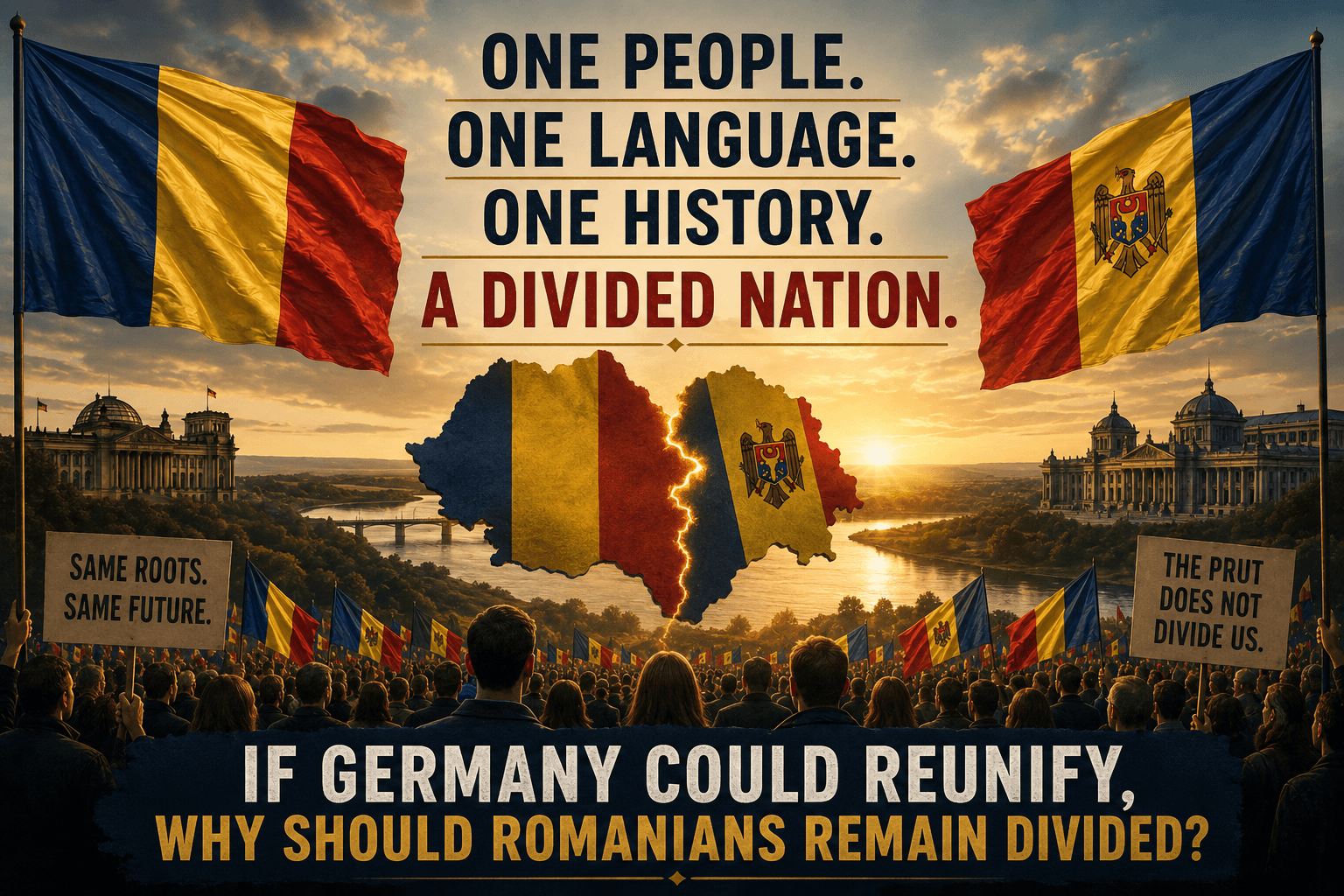
The German ambassador’s controversial remarks in Moldova raise a larger question: why was German national reunification accepted as legitimate, while the political division of Romanian-speaking populations across the Prut is treated as a permanent geopolitical reality?
A Diplomatic Controversy About More Than Diplomacy
The controversy generated by the recent statements of Germany’s ambassador to the Republic of Moldova, Hubert Knirsch, is more consequential than an ordinary diplomatic dispute. During an interview broadcast by Jurnal TV on July 7, the ambassador discussed the possibility of unification between Romania and the Republic of Moldova and the historical, linguistic, cultural, and religious relationship between the populations living on the two sides of the Prut River. Knirsch acknowledged that Romania and Moldova are sovereign states whose citizens are entitled to determine their political future, but his subsequent remarks challenged the premise that Romanians and the majority population of the Republic of Moldova share the same language, culture, religion, and national identity. His comments provoked criticism because they appeared to endorse, intentionally or not, a conception of Moldovan identity historically associated with Russian imperial rule and Soviet nation-building.
The controversy therefore concerns more than the diplomatic wisdom of an ambassador commenting on an extraordinarily sensitive historical question. It raises a fundamental issue about the relationship between statehood and national identity. The existence of the Republic of Moldova as a sovereign state is an indisputable political and legal reality. The existence of a Moldovan civic identity is equally real, as is the presence of ethnic, linguistic, and regional minorities whose rights and political preferences cannot be ignored. None of these facts, however, demonstrates that the Romanian-speaking majority of the Republic of Moldova constitutes a people historically, linguistically, and culturally unrelated to the Romanian nation. A state can develop a distinct political identity without requiring the invention of an entirely separate ethnolinguistic history for its majority population.
Stay ahead of global events.
Get clear geopolitical analysis in your inbox.
Moldovan Statehood and Romanian Identity Are Not Mutually Exclusive
The distinction is essential. Defending the sovereignty of the Republic of Moldova does not require denying the Romanian character of the language spoken by the majority of its population or the existence of a common cultural and historical space extending across the Prut. Moldova’s Constitutional Court ruled in 2013 that the Declaration of Independence, which identifies the state language as Romanian, prevails over the inconsistent terminology of the 1994 Constitution. In March 2023, the Moldovan Parliament adopted legislation replacing references to the “Moldovan language” with “Romanian language” throughout national legislation. These were not symbolic decisions imposed by Romania upon its neighbor but decisions made by the constitutional institutions of the Republic of Moldova itself.
The shared cultural canon is equally difficult to ignore. Mihai Eminescu occupies a foundational position in the literary culture taught, commemorated, and claimed on both sides of the Prut. Stephen the Great, the medieval ruler of the Principality of Moldavia, remains the central figure of Moldovan historical memory while simultaneously occupying a defining place in the broader Romanian historical tradition. The medieval Principality of Moldavia cannot simply be projected backward as the historical equivalent of the modern Republic of Moldova, just as the existence of an independent Austrian state today cannot be used to erase Austria’s place in the broader history of German-speaking Central Europe. Political borders created by empires, wars, occupations, annexations, and the collapse of multinational states can produce distinct political communities, but they do not retroactively create separate languages, unrelated cultural traditions, or entirely independent historical origins.
The real question is therefore not whether every citizen of the Republic of Moldova is Romanian. Clearly, this is not the case. Moldova includes Ukrainians, Russians, Gagauz, Bulgarians, Roma, and citizens who sincerely identify primarily or exclusively as Moldovan. Nor is the question whether an independent Moldovan civic identity can legitimately exist. More than three decades of independent statehood have inevitably contributed to the development of such an identity. The question is whether the Romanian-speaking majority east of the Prut can legitimately be presented as a people whose historical separation from Romanians developed naturally and independently of Russian imperial conquest, Soviet territorial engineering, and deliberate policies of nation-building. On that question, history is far less ambiguous.
The Imperial Origins of the Romanian–Moldovan Question
The modern Romanian–Moldovan question cannot be understood without the geopolitical history of Eastern Europe. In 1812, following the Russo-Turkish War, the Russian Empire annexed the eastern part of the Principality of Moldavia, the territory that subsequently became known as Bessarabia. The annexation divided a historical principality and placed its eastern population under a different imperial administration. After the collapse of the Russian Empire, Bessarabia united with Romania in 1918 and remained within the Romanian state until June 1940, when the Soviet Union issued an ultimatum demanding the evacuation of Bessarabia and Northern Bukovina.
The Soviet ultimatum was delivered within the geopolitical context created by the Molotov–Ribbentrop Pact of August 1939 and the secret protocols dividing Eastern Europe into German and Soviet spheres of influence. Romania withdrew from the territories without military resistance, and the Soviet Union subsequently created the Moldavian Soviet Socialist Republic from most of Bessarabia and territories east of the Dniester. Soviet rule institutionalized the political and cultural separation of the Romanian-speaking population of Soviet Moldavia from Romania through education, historiography, linguistic policy, censorship, the use of the Cyrillic alphabet, restrictions on cultural contacts, and the systematic promotion of a distinct Moldovan national consciousness.
The Republic of Moldova that emerged from the collapse of the Soviet Union in 1991 is therefore both a legitimate sovereign state and the historical successor of a territorial and institutional order profoundly shaped by Russian imperial expansion and Soviet nation-building. Recognizing the first reality does not require denying the second. Yet diplomatic discourse often treats the existence of the modern Moldovan state as retrospective evidence that Romanians and Moldovans followed entirely separate historical trajectories. This transforms the geopolitical consequences of imperial expansion into an argument about ethnolinguistic identity.
From James Pettit to Hubert Knirsch
Hubert Knirsch is not the first Western ambassador in Chișinău to provoke controversy by discussing Moldovan identity and the possibility of reunification with Romania. In August 2016, U.S. ambassador James Pettit declared that “Moldova is not Romania” and argued that unification was not a practical solution to the country’s problems. Moldova, he maintained, should remain a sovereign and independent state and pursue its own political development.
Pettit’s remarks provoked criticism in both Romania and the Republic of Moldova because they appeared to transform the consequences of Soviet territorial expansion into a permanent geopolitical settlement whose historical origins should no longer be questioned. Yet his position reflected something deeper than the personal opinions of an American diplomat. Since the collapse of the Soviet Union, Western governments have consistently supported the sovereignty, territorial integrity, institutional consolidation, and Western integration of the Republic of Moldova. The strategic objective of Washington, Berlin, and Brussels has never been to resolve the Romanian national question created by the Soviet annexation of Bessarabia. Their objective has been to transform Moldova into a stable, democratic, independent, and increasingly Western-oriented state.
From this perspective, unification with Romania is unnecessary and potentially destabilizing. Moldova can enter the European Union as an independent state. Its institutions can be consolidated, Russian influence can be reduced, and its economy and political system can gradually be integrated into the Western order without reopening the question of European borders. Ten years after Pettit’s remarks, the controversy surrounding Knirsch suggests that the fundamental strategic assumptions of Western diplomacy have changed little.
The German Paradox
Germany’s position is particularly interesting because modern Germany is itself the product of extraordinary transformations of the European territorial order. Few states have benefited more dramatically from the international system’s willingness to reconsider borders, state sovereignty, and the political consequences of previous wars. Any serious comparison must distinguish between the Anschluss of Austria in 1938 and German reunification in 1990. The two events were fundamentally different in their political, legal, and moral character. Yet considering them alongside the Romanian–Moldovan question reveals an enduring tension between national self-determination, territorial stability, and great-power interests.
The Anschluss was presented by Nazi Germany as the realization of German national unity. Significant support for union with Germany existed among sections of the Austrian population, and the idea of a common German nation long predated Hitler’s rise to power. The process that produced the Anschluss, however, was neither free nor democratic. Hitler threatened intervention, Austrian Chancellor Kurt Schuschnigg was forced from office, German troops entered Austria, political opponents were arrested, and the subsequent plebiscite was conducted under totalitarian conditions. The Western powers did not intervene militarily, but their acceptance of the accomplished fact cannot be interpreted as democratic or legal legitimization of Nazi Germany’s actions.
The relevance of 1938 lies elsewhere. The Anschluss demonstrates that the international response to territorial transformations has never depended exclusively upon abstract principles. Great powers tolerate, oppose, recognize, or reverse territorial changes according to the balance of power and their strategic interests. The principle became even clearer in 1990, although under fundamentally different democratic and geopolitical circumstances.
1990: Reunification Without a Referendum
German reunification is usually described as the restoration of the national unity of a people divided by the consequences of the Second World War and the Cold War. That description is broadly accurate, but it can obscure the institutional mechanism through which reunification occurred. There was no national referendum in the German Democratic Republic asking citizens whether their sovereign state should cease to exist and become part of the Federal Republic of Germany.
Democratic legitimacy was instead derived from the elections of March 18, 1990, the first and only free parliamentary elections in the history of the GDR. Political forces advocating rapid reunification obtained a clear mandate. On August 23, the Volkskammer decided that the German Democratic Republic would accede to the Federal Republic under Article 23 of the West German Basic Law, effective October 3. The Two Plus Four negotiations involving the two German states, the United States, the Soviet Union, France, and the United Kingdom resolved the international dimensions of reunification.
The constitutional mechanism matters. The Federal Republic of Germany and the German Democratic Republic did not dissolve themselves and create an entirely new German state on equal constitutional foundations. The Federal Republic continued to exist. Its Basic Law remained in force. Its international legal personality, institutions, membership in NATO, and participation in the European Communities continued. The German Democratic Republic disappeared as a sovereign state, and its territory joined the constitutional, political, economic, and strategic order of the Federal Republic.
The process possessed democratic legitimacy and broad popular support. The use of the term “annexation” is therefore misleading if it implies military conquest or incorporation against the wishes of the East German population. Yet the underlying institutional reality is indisputable: one German state survived, expanded its territory and population, and extended its political system eastward, while the other state ceased to exist. German reunification demonstrates that the disappearance of a sovereign state through democratic accession to another state is compatible with the European international order.
Yoram Hazony and the Principle of National Self-Determination
The broader argument developed by Yoram Hazony in The Virtue of Nationalism is relevant to this problem because it challenges the assumption that the Western international order consistently applies the principle of national independence. Hazony defends nationalism as an international order based upon “the collective right of a free people to rule themselves.” His argument concerns the tension between national independence and political systems that seek to subordinate national states to broader imperial or supranational structures.
Applied to the German case, the principle appears straightforward. Germans living in the GDR were permitted to overcome the political division produced by the Second World War and the Cold War. East Germany disappeared, the Federal Republic expanded, NATO and the European Communities extended to the territory of the former GDR, and the international order adapted to the transformation. The process was accepted because national aspiration, democratic legitimacy, the institutional capacity of West Germany, American support, Soviet acceptance, and eventual agreement among the major European powers converged at a unique historical moment.
The German precedent does not prove that Romania and Moldova should unite, nor does it demonstrate that the two situations are identical. It establishes a narrower but important principle: the international legal personality of an existing state does not create an absolute obligation for that state to exist forever. A sovereign state may democratically decide to disappear through accession to another state, and the international system may recognize such a transformation as legitimate.
Why Is Romanian Reunification Treated Differently?
The most important difference between Germany in 1990 and the contemporary Romanian–Moldovan question is democratic consent. The East German elections demonstrated overwhelming political momentum toward rapid reunification. No comparable and indisputable majority currently exists in the Republic of Moldova in favor of immediate union with Romania. This distinction is fundamental. Any attempt to impose reunification against the wishes of Moldova’s citizens would violate precisely the principle of national self-determination invoked to justify such a union.
Moldova is also more politically and ethnically complex than the GDR was in 1990. The country contains Russian-speaking and Ukrainian minorities, the autonomous territorial unit of Gagauzia, and the unresolved separatist conflict in Transnistria, where Russian troops remain present. These circumstances would make any process of reunification extraordinarily difficult. Yet none of them eliminates the central theoretical question.
Suppose that political circumstances changed. Suppose that a clear, stable, and democratically expressed majority of Moldovan citizens supported union with Romania. Suppose that this preference was demonstrated through free elections, a referendum, or legitimate parliamentary decisions, and that Romania democratically accepted reunification. Would Germany support the right of Moldovan citizens to determine their national future? Would the United States and the European Union accept the disappearance of the Republic of Moldova as an independent state, just as they accepted the disappearance of the German Democratic Republic? Or would Western governments insist that Moldovan sovereignty, territorial integrity, minority rights, relations with Russia, and regional stability made such a transformation unacceptable?
The question is hypothetical because the necessary democratic conditions do not currently exist. Nevertheless, it exposes the tension between universal political principles and geopolitical interests. If the answer is that democratic consent would be sufficient, there is no fundamental Western double standard: the difference between the German and Romanian–Moldovan cases is primarily the absence of a clear popular mandate. If democratic consent would not be sufficient, then the problem becomes considerably more serious. It would suggest that the right of national self-determination is recognized only when its consequences coincide with the strategic preferences of major powers.
Europe’s Selective Principles
International politics has never applied self-determination consistently. The Soviet Union dissolved into fifteen internationally recognized states. Czechoslovakia disappeared through peaceful political agreement. Yugoslavia fragmented through wars, foreign intervention, contested processes of recognition, and continuing territorial disputes. German reunification eliminated one sovereign state and enlarged another. Kosovo declared independence and was recognized by many Western governments but rejected by others. Scotland was permitted to hold an independence referendum with the consent of the British government, while Catalonia’s unilateral attempt at secession was rejected by Spain and received no support from the European Union.
There is no universal mechanism determining when a people may create a state, dissolve a state, leave an existing state, or join another one. Self-determination operates inside an international system dominated by existing states, strategic interests, security calculations, military alliances, legal precedents, and great-power preferences. National aspirations become politically realizable when domestic legitimacy and international acceptance coincide. Germany achieved that coincidence in 1990. Romania and Moldova have not.
This reality complicates the language of universal principles frequently employed by Western diplomacy. Territorial integrity is defended in some circumstances and modified in others. National self-determination is celebrated in some cases and subordinated to constitutional order or regional stability in others. The difference is rarely explained by legal principles alone. Power, strategic opportunity, and international consensus remain decisive.
Germany’s Strategic Interest in an Independent Moldova
Berlin has understandable strategic reasons to prefer the continued existence of an independent Republic of Moldova. Germany seeks stability on the eastern frontier of the European Union, the reduction of Russian influence, the consolidation of democratic institutions, and Moldova’s gradual integration into European political, economic, and legal structures. Unification with Romania would immediately raise difficult questions concerning Transnistria, Gagauzia, minority protections, Russia’s military presence, NATO’s territorial guarantees, and the geopolitical consequences of the disappearance of a post-Soviet state.
From the perspective of German diplomacy, European integration without territorial transformation is the more predictable strategy. Moldova can enter the European Union as an independent state without reopening the borders created by the dissolution of the Soviet Union. Such a policy is not necessarily anti-Romanian, nor does it imply support for Russian geopolitical interests. Yet Germany’s own historical experience makes this preference particularly significant. The Federal Republic benefited from the international system’s willingness to permit the disappearance of another sovereign state when democratic legitimacy and geopolitical opportunity aligned.
Germany is therefore entitled to defend the existing European territorial order, but its diplomats should be especially careful when transforming a strategic preference for Moldovan independence into historical or ethnolinguistic claims about the identity of the Romanian-speaking majority. The existence of the Republic of Moldova as a state and the Romanian historical and cultural identity of much of its population are not contradictory propositions.
Russia and the Geopolitics of Moldovan Identity
Russia approaches the Romanian–Moldovan question from an entirely different strategic perspective. Moscow has historically regarded the territory of the Republic of Moldova as part of its sphere of influence and has used the Transnistrian conflict, military presence, energy dependence, political networks, media influence, and historical narratives to preserve leverage over the country. The promotion of a Moldovan identity fundamentally opposed to Romanian identity has long served Russian and Soviet geopolitical interests because it weakens cultural identification with Romania and complicates Moldova’s complete integration into the Western strategic space.
This produces an uncomfortable paradox. Western diplomats who defend Moldovan statehood and Russian strategists who seek to preserve Russian influence may favor the continued existence of an independent Moldovan state for entirely different reasons. Germany wants Moldova integrated into the European order. Russia wants to prevent Moldova’s complete integration into that order. The geopolitical conflict is therefore not necessarily over whether Moldova should exist but over the strategic system to which it should belong.
Statements by Western diplomats that appear to endorse historical narratives created or institutionalized during Soviet rule are particularly problematic in this context. A German ambassador can defend Moldova’s sovereignty without questioning the Romanian character of its majority language. He can recognize the country’s minorities without presenting the majority population as historically unrelated to Romanians. He can oppose immediate reunification without converting the political border established through Russian imperial expansion and Soviet annexation into evidence of a separate ethnolinguistic origin.
The Question Western Diplomacy Avoids
The controversy surrounding Hubert Knirsch should therefore not be reduced to an argument over whether a German ambassador possesses sufficient knowledge of Romanian history. The larger issue concerns the relationship between national self-determination and power. Germany reunified because East Germans wanted reunification, West Germany possessed the institutional and economic capacity to achieve it, the United States strongly supported the process, the Soviet Union ultimately accepted it, and the other European powers negotiated the consequences. National will was necessary, but national will alone was not sufficient. Agreement among the major powers transformed German reunification from a national aspiration into geopolitical reality.
The Romanian–Moldovan case demonstrates the other side of the same principle. Historical arguments alone cannot produce reunification. Common language and culture cannot produce it. The memory of Soviet annexation cannot produce it. Even democratic consent might encounter substantial international resistance if reunification threatened the strategic interests of major powers. The European order rests simultaneously upon national self-determination and territorial stability, two principles that can come into direct conflict. When they do, the international system does not possess a neutral mechanism capable of determining which principle should prevail.
This is why Knirsch’s statements matter. A representative of the state that benefited most spectacularly from the peaceful disappearance of another European state in 1990 should be especially sensitive to the distinction between defending existing sovereignty and denying historical national connections. Germany’s reunification demonstrates that borders and states can change when democratic legitimacy, national aspiration, and international acceptance converge. Nothing in that precedent requires Romania and Moldova to unite. But neither does the current existence of two sovereign states justify presenting the Romanian-speaking populations on the two sides of the Prut as historically unrelated peoples.
Conclusion: If Germany Could Reunify, Could Romania and Moldova?
The comparison between German reunification and the possibility of Romanian–Moldovan union should not be used to claim that the two cases are identical. The GDR emerged from the division of Germany after military defeat and occupation. The Republic of Moldova emerged from the dissolution of the Soviet Union and has existed as an internationally recognized sovereign state for more than three decades. East Germans demonstrated a clear political preference for rapid reunification in 1990. No comparable democratic consensus currently exists in Moldova. The presence of minorities, Gagauz autonomy, the Transnistrian conflict, Russian troops, and the broader confrontation between Russia and the West make the geopolitical circumstances fundamentally different.
Yet the German precedent establishes an important principle. Sovereign states are not eternal. Internationally recognized political arrangements are not immutable. A state may democratically decide to disappear and join another state, and the European international order can accommodate such transformations when they possess democratic legitimacy and sufficient international acceptance.
The controversy surrounding Hubert Knirsch ultimately raises a question that extends far beyond the identity of Moldova’s population. If a clear democratic majority of Moldovan citizens someday demanded union with Romania, would Germany recognize their right to make that choice? Would the United States and the European Union accept the disappearance of the Republic of Moldova, just as the international community accepted the disappearance of East Germany? Or would the principles invoked to legitimize German reunification suddenly be subordinated to territorial stability and geopolitical convenience?
Until such democratic conditions exist, the question remains hypothetical. But one principle should already be clear. Defending the sovereignty of the Republic of Moldova does not require rewriting the history of its Romanian-speaking majority. Recognizing the existence of minorities and a Moldovan civic identity does not require denying the Romanian language, the shared cultural canon represented by Mihai Eminescu, the common historical memory surrounding Stephen the Great, or the decisive role of Russian imperial expansion and Soviet nation-building in creating the political separation that exists today.
Germany reunified in 1990 because national aspiration, democratic legitimacy, strategic opportunity, and great-power agreement converged at a unique historical moment. Romania and Moldova have never experienced such a convergence. Whether they ever will remains uncertain. But Europe cannot credibly defend national self-determination as a universal principle if national unity is recognized only when it coincides with the strategic interests of powerful states.
Sources and Further Reading
- Constitutional Court of the Republic of Moldova. Judgment No. 36 of 5 December 2013 on the Interpretation of Article 13(1) of the Constitution in Correlation with the Preamble of the Constitution and the Declaration of Independence of the Republic of Moldova. The Court ruled that, in the event of divergence, the Declaration of Independence—which identifies Romanian as the state language—prevails over the text of Article 13 of the Constitution.
- Parliament of the Republic of Moldova. Law No. 52 of 16 March 2023 on the Implementation of Certain Considerations of Decisions of the Constitutional Court. The legislation replaced the phrase “Moldovan language” with “Romanian language” in the Constitution and other Moldovan legislation.
- Basic Law for the Federal Republic of Germany. Article 23, version in force before German reunification. This constitutional provision established the mechanism through which other parts of Germany could accede to the Federal Republic and provided the legal basis for the accession of the German Democratic Republic in 1990.
- Volkskammer of the German Democratic Republic. Resolution on the Accession of the German Democratic Republic to the Federal Republic of Germany, 23 August 1990. The East German parliament voted for accession to the Federal Republic under Article 23 of the Basic Law, effective from 3 October 1990.
- Federal Republic of Germany and German Democratic Republic. Treaty between the Federal Republic of Germany and the German Democratic Republic on the Establishment of German Unity (Unification Treaty), 31 August 1990. The treaty established the legal and institutional conditions under which the GDR acceded to the Federal Republic.
- Federal Republic of Germany, German Democratic Republic, France, the Soviet Union, the United Kingdom, and the United States. Treaty on the Final Settlement with Respect to Germany (Two Plus Four Treaty), 12 September 1990. The treaty resolved the international aspects of German reunification and restored full sovereignty to the reunified German state.
- United States Department of State, Office of the Historian. The Collapse of the Soviet Union and German Reunification, 1989–1990. An institutional overview of American diplomacy, the negotiations among the major powers, and the international context that made German reunification possible.
- Pettit, James D. Interview with Moldovan media, August 2016. The U.S. ambassador to the Republic of Moldova argued that union with Romania was not a practical solution to Moldova’s problems and emphasized the continued development of Moldova as a sovereign and independent state. His statements generated significant controversy in Romania and the Republic of Moldova.
- Knirsch, Hubert. Interview on Jurnal TV’s Cabinetul din umbră, broadcast in July 2026. The relevant video excerpt and the ambassador’s statements were subsequently reproduced by HotNews in “VIDEO Ambasadorul Germaniei la Chișinău, declarații controversate despre identitatea moldovenilor,” published on 12 July 2026. The excerpt documents Knirsch’s statement that a possible union between Romania and the Republic of Moldova is a matter for the citizens of the two sovereign states, as well as his subsequent questioning of the assertion that Romania and the Republic of Moldova share the same language and religion. Available online: HotNews — video excerpt and transcript of Hubert Knirsch’s remarks
- Hazony, Yoram. The Virtue of Nationalism. New York: Basic Books, 2018. Hazony’s defense of the national state and his discussion of national independence provide a theoretical framework for examining the tension between self-determination, sovereign statehood, and supranational political orders.
- King, Charles. The Moldovans: Romania, Russia, and the Politics of Culture. Stanford: Hoover Institution Press, 2000. A major scholarly study of Moldovan identity, Bessarabia, Soviet nationality policy, language politics, and the historical relationship between Moldova, Romania, and Russia.
- Hitchins, Keith. Rumania, 1866–1947. Oxford: Clarendon Press, 1994. A comprehensive scholarly history of modern Romania that provides essential historical context for Bessarabia’s union with Romania in 1918, the interwar period, and the Soviet territorial ultimatum of 1940.
- Declaration of Independence of the Republic of Moldova, 27 August 1991. The founding document of the independent Moldovan state identifies Romanian as the state language and condemns the Molotov–Ribbentrop Pact and its secret protocols as well as the Soviet acts that resulted in the occupation of Bessarabia and Northern Bukovina.
- Treaty of Non-Aggression between Germany and the Union of Soviet Socialist Republics (Molotov–Ribbentrop Pact), 23 August 1939, and its Secret Additional Protocol. The diplomatic agreement that divided parts of Eastern Europe into German and Soviet spheres of influence and provided the geopolitical context for the Soviet ultimatum to Romania and the occupation of Bessarabia in June 1940.
You May Also Like
The Degradation of Democracy in Turkey: From Atatürk’s Republic to Erdoğan’s Neo‑Ottoman Ambitions
Soft Power vs Hard Power: What’s the Difference and Why It Matters
What Is Geopolitics? Meaning, Examples, and Why It Matters Today
Hybrid Warfare: A Misleading Label for an Enduring Reality
Naval Blockade: History and Strategic Utility
A historical point worth remembering is that the political geography of Bessarabia has changed repeatedly. Following the Treaty of Paris in 1856, southern Bessarabia was returned to the Principality of Moldavia. After the union of Moldavia and Wallachia in 1859, the region became part of the United Principalities and remained part of Romania until 1878, when it was ceded to the Russian Empire.
Moreover, after the Romanian Army entered Bessarabia in 1941, the entire region was restored to Romanian administration until 1944.
Therefore, the often-repeated claim that Russia ruled Bessarabia continuously from 1812 to 1918, and that the Soviet Union controlled the region continuously from 1940 to 1991, is historically inaccurate. Russian and Soviet rule over Bessarabia was interrupted by periods in which parts or all of the region were under Moldavian or Romanian sovereignty and administration.
Another peculiar narrative promoted by some Russian and pro-Russian propagandists reverses the traditional question of Romanian–Moldovan unification. Instead of discussing the possible unification of the Republic of Moldova with Romania, this narrative suggests that the Romanian region of Moldavia—the western part of the historical Principality of Moldavia—should be separated from Romania and united with the Republic of Moldova. Rooted in Soviet-style Moldovenism, this argument portrays Moldavians as a nation entirely distinct from Romanians and implicitly presents the 1859 union of Moldavia and Wallachia not as a national unification, but as the disappearance or even annexation of the Moldavian state. The purpose of such narratives is less territorial than political: to question Romanian national unity, reinforce a separate Moldovan identity, and reverse the historical logic behind the modern Romanian state.