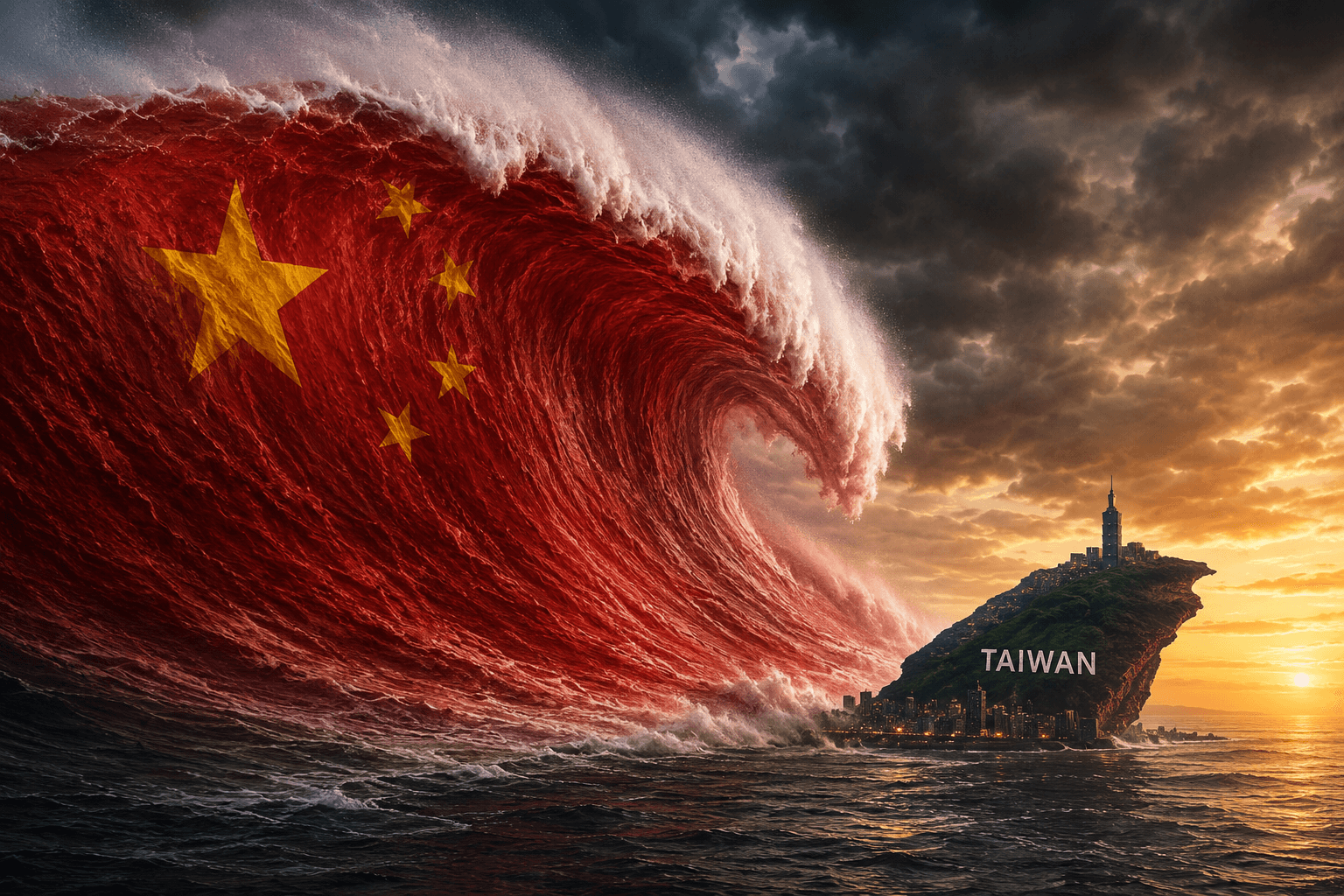
The phrase “Taiwan is a rebel province” has become so deeply embedded in discussions of the Taiwan Strait that its historical assumptions are rarely examined. The People’s Republic of China (PRC) maintains that Taiwan is an inseparable part of China, temporarily separated from the mainland by the unfinished consequences of the Chinese Civil War. From Beijing’s perspective, reunification is therefore not territorial expansion but the completion of national unity after more than seven decades of political division. Yet the historical sequence of events allows for a provocative reversal of this argument. The Republic of China (ROC) was established in 1912, governed mainland China for decades, participated in the creation of the United Nations, became one of the five permanent members of the Security Council, and continued to represent China internationally after the communist victory of 1949. The People’s Republic of China, by contrast, emerged from an armed revolutionary movement that overthrew the ROC government on the mainland but never conquered Taiwan. If historical continuity rather than military victory were the principal measure of political legitimacy, which government actually rebelled against which?
Stay ahead of global events.
Get clear geopolitical analysis in your inbox.
The question is deliberately provocative, and it should not be confused with a legal argument that the PRC is literally a rebel province or an unrecognized government. The PRC is recognized by most states, represents China at the United Nations, exercises sovereignty over the overwhelming majority of the territory historically associated with modern China, and is one of the world’s most powerful states. Nevertheless, reversing Beijing’s familiar terminology exposes a deeper historical problem. Modern Chinese territorial legitimacy cannot be understood solely through timeless concepts of national unity. It is also the product of revolution, civil war, imperial inheritance, military conquest, demographic transformation, diplomatic recognition, and geopolitical power. Tibet, Xinjiang, Mongolia, Korea, the wars with India and Vietnam, the expansion of Chinese power in the South China Sea, and the unresolved confrontation with Taiwan all reveal the tension between the PRC’s anti-imperialist origins and its determination to inherit, consolidate, and sometimes expand the geopolitical space of earlier Chinese states.
The Revolution That Created the People’s Republic
The People’s Republic of China was born not from a peaceful constitutional transformation of the Republic of China but from one of the largest civil wars of the twentieth century. The Republic of China had been established in 1912 following the collapse of the Qing dynasty. Its political authority was repeatedly fragmented by warlordism, foreign intervention, the Japanese invasion, and internal conflict, but it remained the internationally recognized Chinese state. The Chinese Communist Party, founded in 1921, initially cooperated with the Nationalist Kuomintang before the alliance collapsed and the two movements became bitter enemies.
After Japan’s defeat in 1945, the civil war resumed on a massive scale. Mao Zedong’s communist forces gradually defeated Chiang Kai-shek’s Nationalist armies, gaining control over most of mainland China. On October 1, 1949, Mao proclaimed the People’s Republic of China in Beijing. The ROC government retreated to Taiwan, where it continued to exist under the same constitutional framework and maintained its claim to represent China.
This sequence matters because the conventional language of “secession” does not adequately describe Taiwan’s political position. Taiwan did not declare independence from the People’s Republic of China. The PRC never governed Taiwan. Instead, two rival governments emerged from a civil war, each initially claiming to represent China. One controlled the mainland; the other survived on Taiwan and several smaller islands.
Military victory gradually transformed the international understanding of legitimacy. The PRC controlled the mainland, possessed a vastly larger population, developed nuclear weapons, and became increasingly impossible to exclude from international institutions. Yet the historical reality remains that the communist movement rebelled against an existing Chinese government, defeated it across most of its territory, established a new state, and failed to eliminate its rival.
This does not make the PRC illegitimate under contemporary international law. States and governments frequently emerge from revolutions and wars. It does, however, complicate Beijing’s insistence that Taiwan is simply a province that rebelled against the central government. The historical relationship between the ROC and the PRC is better understood as the unresolved consequence of a civil war in which the victorious side gained control of most, but not all, of the contested political space.
The China That Kept Its Seat at the United Nations
The international history of the Republic of China further complicates the narrative. The ROC was one of the founding members of the United Nations in 1945 and became one of the five permanent members of the Security Council. After the Nationalist government retreated to Taiwan in 1949, it continued to occupy China’s seat at the United Nations for more than two decades.
This produced an increasingly difficult diplomatic contradiction. The government in Taipei controlled Taiwan and several smaller islands but claimed to represent the entire Chinese nation, while the government in Beijing controlled almost all of mainland China but remained excluded from the United Nations. During the Cold War, American power and the broader geopolitical confrontation with communism helped preserve the ROC’s international position.
The balance gradually shifted. Decolonization brought dozens of new states into the United Nations, many of which supported Beijing’s claim to represent China. The Sino-Soviet split altered Cold War diplomacy, while the United States increasingly recognized that excluding the PRC from major international institutions was strategically unsustainable.
In October 1971, United Nations General Assembly Resolution 2758 recognized the representatives of the People’s Republic of China as “the only legitimate representatives of China to the United Nations” and expelled “the representatives of Chiang Kai-shek.” The PRC subsequently assumed China’s permanent seat on the Security Council.
Resolution 2758 fundamentally transformed international recognition of the two Chinese governments, but its relationship to Taiwan’s sovereignty remains politically contested. Beijing argues that the resolution confirmed the one-China principle and eliminated any basis for separate Taiwanese international representation. Taiwan and several governments sympathetic to greater Taiwanese participation in international organizations argue that the resolution settled the question of who represented China at the United Nations without explicitly determining Taiwan’s sovereignty.
Whatever interpretation one adopts, the historical paradox remains remarkable. For twenty-two years after the proclamation of the People’s Republic, the government based in Taiwan represented China at the United Nations and held a permanent seat on the Security Council. International legitimacy ultimately followed geopolitical reality, but it did so gradually rather than automatically. The transformation demonstrates that recognition, power, and institutional representation can change over time and that the political identity of “China” has itself been historically contested.
The Empire Beijing Inherited
The territorial geography of the People’s Republic cannot be understood without the Qing Empire. The Qing dynasty, ruled by the Manchus from the seventeenth century until 1912, constructed a vast multiethnic empire encompassing territories inhabited by Han Chinese, Manchus, Mongols, Tibetans, Uyghurs, and numerous other peoples.
The Republic of China inherited the political claim to this imperial space, even though its actual control over many frontier regions remained weak or nonexistent. The People’s Republic subsequently inherited the same territorial ambitions. Communist ideology condemned Western and Japanese imperialism, but the PRC did not dismantle the territorial inheritance of the Qing Empire. On the contrary, it sought to consolidate most of it.
This creates one of the central contradictions of modern Chinese political history. The PRC presented itself as the product of national liberation and anti-imperialist revolution while simultaneously asserting sovereignty over the territories of a multiethnic empire created through centuries of conquest and expansion.
Beijing’s response is that Tibetans, Uyghurs, Mongols, and other minorities are constituent peoples of a historically unified Chinese state. Chinese historiography emphasizes long-standing political, economic, and cultural connections between these regions and successive Chinese dynasties. Critics argue that this narrative transforms the fluctuating frontiers of empires into permanent national borders and retrospectively defines imperial expansion as national unification.
The distinction between nation and empire is therefore fundamental. Modern China did not simply inherit a nation-state. It inherited the geopolitical space of an empire and transformed most of its imperial frontiers into claims of national unity.
Tibet and Xinjiang: Integration, Repression, and the Limits of National Unity
Tibet provides one of the clearest examples of the tension between national unification and imperial inheritance. After the collapse of the Qing dynasty, Tibet enjoyed several decades of de facto autonomy, although successive Chinese governments continued to claim sovereignty over the region. In 1950, the People’s Liberation Army entered eastern Tibet and defeated Tibetan forces at Chamdo. The following year, Tibetan representatives signed the Seventeen Point Agreement, which formally incorporated Tibet into the People’s Republic while promising regional autonomy and protection for the existing political and religious system.
Relations deteriorated dramatically. The Tibetan uprising of 1959 was suppressed, and the Dalai Lama fled to India. The PRC subsequently transformed Tibet’s political, economic, and social structures. Beijing argues that Chinese rule ended feudal serfdom, modernized the region, expanded infrastructure, increased life expectancy, and integrated Tibet into the economic development of the Chinese state. Critics emphasize political repression, restrictions on religious institutions, cultural assimilation, population transfers, and the destruction of Tibetan autonomy.
The debate over Tibet illustrates the difficulty of distinguishing liberation from conquest when the victorious state possesses the power to define the historical narrative.
Xinjiang presents an equally complicated and increasingly controversial case. Known by many Uyghur activists and independence movements as East Turkestan, the region became part of the Qing Empire in the eighteenth century and experienced repeated rebellions, foreign intervention, and short-lived separatist governments. Communist forces consolidated control over Xinjiang in 1949.
During the following decades, the Chinese state encouraged economic development, expanded infrastructure, created the Xinjiang Production and Construction Corps, and promoted migration from other parts of China. The proportion of Han Chinese in the region increased significantly, although demographic patterns vary considerably between northern and southern Xinjiang.
Beijing argues that its policies have brought modernization, poverty reduction, infrastructure, education, and protection against terrorism and separatism. Chinese authorities point to violent attacks carried out by Uyghur militants and maintain that extensive security measures were necessary to prevent extremism.
Human rights organizations, researchers, journalists, and several governments have accused the PRC of mass arbitrary detention, coercive political reeducation, intrusive surveillance, restrictions on Islamic religious practices, forced labor, family separation, coercive birth-control policies, and systematic attempts to weaken Uyghur cultural identity. Beijing rejects accusations of genocide and cultural destruction and describes the detention facilities as vocational education and counter-extremism centers.
The debate extends beyond individual human rights violations. It raises the broader question of whether the integration of peripheral territories through migration, security institutions, linguistic standardization, economic dependency, and political control can be described as a form of internal colonialism.
The term is controversial, but the analytical question is legitimate. A state founded on opposition to foreign imperialism has developed powerful mechanisms for integrating minority regions into a centralized political system dominated demographically and institutionally by the Han majority. Whether this process should be understood as modernization, national integration, assimilation, or internal colonialism depends heavily on the political assumptions of the observer.
Mongolia: The Exception That Exposes the Problem
Mongolia provides a revealing counterexample to Beijing’s insistence on the historical inevitability of Chinese territorial unity. Outer Mongolia had been part of the Qing Empire but declared independence following the dynasty’s collapse in 1911. The Republic of China initially refused to accept the permanent separation of the territory, while Russia and later the Soviet Union became the decisive external powers shaping Mongolia’s political future.
After the Second World War, a referendum held in 1945 produced overwhelming support for independence. The ROC government formally recognized Mongolian independence in 1946 under intense geopolitical pressure and within the framework of agreements with the Soviet Union.
When the People’s Republic was established in 1949, Mongolia already existed as an independent state protected by Soviet power. Beijing recognized the Mongolian People’s Republic and established diplomatic relations with it.
The contrast with Taiwan is striking. Both territories had complicated historical relationships with earlier Chinese states. Both became separated from mainland Chinese political authority during periods of revolution, foreign intervention, and state collapse. Yet Mongolia became an internationally recognized independent state, while Beijing insists that permanent Taiwanese separation is historically and politically impossible.
The difference is explained less by immutable historical principles than by geopolitical power. The Soviet Union possessed the military capability to guarantee Mongolian independence. No comparable great power transformed Taiwan into a universally recognized independent state.
Inner Mongolia followed a different trajectory. It remained within the PRC and experienced extensive political, demographic, and linguistic integration. Han Chinese migration transformed the demographic balance, while recent educational policies promoting Mandarin instruction have generated concern among ethnic Mongols about the preservation of their language and identity.
Mongolia therefore exposes the selective relationship between imperial inheritance and modern sovereignty. Historical claims matter, but they survive only when political and military circumstances allow them to survive.
The Wars of the People’s Republic
The external behavior of the PRC further complicates its self-image as a fundamentally defensive power seeking only national reunification and protection against foreign aggression. Since 1949, China has fought major conflicts along several of its borders and intervened decisively in the Korean War.
The Korean War began in June 1950 when North Korean forces invaded South Korea. The invasion nearly destroyed the South Korean state before a United Nations Command led by the United States reversed the military situation. After the landing at Incheon, UN forces crossed the 38th parallel and advanced toward the Chinese border.
China entered the war in October 1950 through the People’s Volunteer Army. Beijing argued that the advance of American-led forces toward the Yalu River created an intolerable threat to Chinese security. Chinese intervention drove UN forces southward and prevented the destruction of Kim Il Sung’s regime.
The context is essential. China did not initiate the Korean War, and its intervention occurred only after foreign forces approached its frontier. Yet the political consequence of Chinese intervention is equally undeniable: the PRC ensured the survival of the North Korean regime, which had launched the original invasion and would later develop into one of the world’s most repressive hereditary dictatorships.
The 1962 Sino-Indian War emerged from unresolved border disputes inherited from imperial cartography and the competing territorial claims of two postcolonial states. China controlled Aksai Chin, a strategically important region connecting Xinjiang and Tibet, while India claimed the territory. In the eastern sector, China rejected the McMahon Line and claimed much of what is today the Indian state of Arunachal Pradesh.
Tensions increased following the Tibetan uprising and the Dalai Lama’s flight to India. India adopted the Forward Policy, establishing military posts in disputed areas. In October 1962, Chinese forces launched coordinated offensives, defeated Indian forces, and advanced rapidly before declaring a unilateral ceasefire and withdrawing in the eastern sector while retaining control of Aksai Chin.
Beijing portrays the conflict as a defensive counterattack against Indian encroachment. Indian interpretations emphasize Chinese territorial expansion and military aggression. The war demonstrates again that modern Asian borders were shaped not only by historical claims but by military power.
In 1979, China invaded Vietnam in what Deng Xiaoping described as an effort to “teach Vietnam a lesson.” The conflict followed Vietnam’s invasion of Cambodia and the overthrow of the Khmer Rouge regime, which had been supported by Beijing. Vietnam had also aligned increasingly closely with the Soviet Union, China’s principal communist rival.
Chinese forces entered northern Vietnam in February 1979 and captured several border cities before withdrawing after less than a month. Both sides claimed victory, and the military effectiveness of the Chinese campaign remains debated.
The geopolitical irony was considerable. A communist China invaded a communist Vietnam partly to punish Hanoi for overthrowing the Khmer Rouge, one of the most murderous regimes of the twentieth century. The war demonstrated that nationalism, strategic rivalry, and balance-of-power politics had become more important than ideological solidarity among communist states.
Taken together, Korea, India, and Vietnam do not prove that the PRC has pursued uninterrupted territorial expansion. Each conflict had specific strategic causes, security dilemmas, and historical contexts. They do demonstrate, however, that China has repeatedly used large-scale military force when its leaders believed fundamental geopolitical interests were threatened.
The South China Sea: Building a Chinese Mare Nostrum
The South China Sea has become the most visible contemporary expression of China’s growing regional power. It is one of the world’s most important maritime corridors, rich in fisheries, potentially significant energy resources, and strategically located between the Pacific and Indian Oceans.
China claims sovereignty over numerous islands, reefs, and maritime features within the area traditionally represented by the “nine-dash line.” These claims overlap with those of Vietnam, the Philippines, Malaysia, Brunei, and Taiwan.
Over several decades, Beijing has gradually strengthened its physical presence. China seized control of the Paracel Islands from South Vietnam in 1974, clashed with Vietnamese forces near Johnson South Reef in 1988, occupied Mischief Reef in the 1990s, and gained control of Scarborough Shoal after a confrontation with the Philippines in 2012.
During the following decade, China dramatically accelerated land reclamation and constructed artificial islands equipped with airfields, radar installations, ports, and military facilities. Beijing argues that its activities occur on Chinese territory and that the facilities serve both civilian and defensive purposes.
In 2016, an arbitral tribunal established under the United Nations Convention on the Law of the Sea ruled in a case initiated by the Philippines that China’s claims to historic rights within the nine-dash line had no legal basis insofar as they exceeded the maritime entitlements permitted by the convention. China rejected the ruling and refused to participate in the proceedings.
The analogy with the Roman concept of Mare Nostrum is imperfect but useful. Rome transformed the Mediterranean into a maritime space dominated by a single great power. China does not control the South China Sea in the same manner, and the United States and regional states continue to operate militarily throughout the region. Yet Beijing appears determined to create a maritime environment in which neighboring states must increasingly accommodate Chinese power.
The objective may not be formal annexation of the entire sea. A more realistic strategic goal is hierarchical control: a regional order in which China possesses the military capabilities, economic influence, and permanent physical infrastructure necessary to shape the behavior of weaker states.
In this sense, the South China Sea may be becoming a Chinese Mare Nostrum—not a closed imperial lake, but a maritime sphere in which Beijing seeks to establish itself as the predominant power and to limit the strategic freedom of external competitors.
The Hundred-Year Marathon and the Question of Chinese Strategy
The historical pattern of Chinese behavior raises a larger question. Are the PRC’s territorial consolidation, military interventions, maritime expansion, technological development, and diplomatic ambitions separate responses to changing circumstances, or do they reflect a coherent long-term strategy to restore China to global primacy?
Michael Pillsbury presents one of the most controversial versions of the second interpretation in The Hundred-Year Marathon. Pillsbury argues that Chinese strategists have pursued a long-term effort to surpass the United States and reshape the international order by 2049, the centenary of the founding of the People’s Republic.
According to this interpretation, Chinese leaders have drawn lessons from ancient strategic thought and the Warring States period, emphasizing deception, patience, the manipulation of stronger adversaries, the acquisition of foreign technology, and the concealment of long-term ambitions. The West, and particularly the United States, allegedly contributed to China’s rise by assuming that economic modernization and integration into international institutions would eventually produce political liberalization and strategic convergence.
The attraction of Pillsbury’s thesis is obvious. China’s rise has been extraordinarily rapid. A country devastated by civil war, foreign invasion, famine, and revolutionary upheaval has become the world’s second-largest economy, a nuclear power, a permanent member of the UN Security Council, a technological competitor to the United States, and the most powerful state in Asia.
Yet the thesis also has significant limitations. Interpreting decades of Chinese policy as components of a single coherent strategy risks imposing retrospective order on a history characterized by dramatic ideological changes, leadership struggles, policy disasters, and strategic reversals. Mao Zedong’s revolutionary foreign policy, Deng Xiaoping’s economic pragmatism, Jiang Zemin’s integration into globalization, Hu Jintao’s emphasis on peaceful development, and Xi Jinping’s more assertive nationalism cannot simply be treated as identical phases of an unchanged master plan.
China has also frequently acted reactively. The Korean War, the Sino-Soviet split, the rapprochement with the United States, the market reforms of the 1980s, the response to the collapse of the Soviet Union, and the expansion of Chinese maritime power all emerged from specific historical circumstances.
Nevertheless, Pillsbury’s argument raises an important question that cannot be dismissed. Chinese strategic culture places considerable emphasis on historical time, national rejuvenation, and the restoration of status lost during the “Century of Humiliation.” Xi Jinping has explicitly connected the “great rejuvenation of the Chinese nation” with the political objectives of the PRC.
Whether this constitutes a secret hundred-year plan is debatable. That China seeks to become the dominant power in Asia, reduce American strategic influence near its borders, acquire leadership in critical technologies, reshape international institutions, and eventually resolve the Taiwan question on terms favorable to Beijing is much more difficult to dispute.
Taiwan: The War Beijing Never Finished
Taiwan brings all these historical contradictions together. The PRC considers Taiwan an inseparable part of China and regards reunification as an essential component of national rejuvenation. Beijing has never renounced the use of force and has increased military pressure around the island.
The historical basis of the Chinese claim is complex. Taiwan was incorporated into the Qing Empire in the seventeenth century, ceded to Japan in 1895 after the First Sino-Japanese War, and placed under ROC administration after Japan’s defeat in 1945. Following the communist victory on the mainland, Taiwan became the refuge of the defeated Nationalist government.
For decades, the ROC itself claimed to represent all of China and opposed Taiwanese independence. The island was governed under authoritarian martial law until democratization transformed its political system during the late twentieth century.
Modern Taiwan possesses nearly every practical characteristic of an independent state. It has its own government, military forces, currency, legal system, taxation system, elections, passports, and foreign relations. Its population has developed an increasingly distinct Taiwanese identity.
Yet Taiwan remains diplomatically isolated. Most states recognize the PRC and maintain only unofficial relations with Taipei. This ambiguity has helped preserve peace while allowing contradictory political positions to coexist.
Beijing argues that the unresolved civil war cannot permanently divide the Chinese nation. From this perspective, the fact that the PRC has never governed Taiwan is irrelevant because sovereignty does not depend on continuous administrative control.
The opposite argument is equally significant. More than seventy-five years have passed since the creation of the PRC. Generations of Taiwanese have lived under a separate political system. The island has transformed from an authoritarian Chinese nationalist regime into a pluralist democracy whose population increasingly defines itself through a distinct political identity.
The fundamental question is therefore no longer simply who won the Chinese Civil War. It is whether military victory on the mainland in 1949 gives the PRC an indefinite right to determine the political future of a population it has never governed.
Here the reversal of Beijing’s familiar terminology becomes analytically useful. The People’s Republic emerged from an armed rebellion against the internationally recognized Republic of China. It conquered the mainland, established a new government, inherited China’s international position, consolidated control over most of the Qing imperial space, and became one of the most powerful states in history.
Yet it never conquered Taiwan.
The PRC demands that the world accept the political consequences of every conflict that consolidated its power while refusing to accept the political consequences of the one war it never finished.
Conclusion: History, Power, and the Right to Define China
Calling the People’s Republic of China a “rebel province” would be legally inaccurate and politically polemical. The PRC is an internationally recognized sovereign state, a permanent member of the United Nations Security Council, and the government controlling mainland China for more than three quarters of a century.
But reversing the conventional accusation directed against Taiwan reveals the weakness of simplistic historical narratives.
The PRC was created by revolution. Its ruling party defeated the government of the Republic of China but did not destroy it. The ROC survived in Taiwan, continued to represent China internationally until 1971, and eventually transformed itself into a democratic political system.
At the same time, the PRC inherited the territorial imagination of the Qing Empire. It incorporated Tibet through military force and political agreement, consolidated Xinjiang through state institutions, migration, economic integration, and extensive coercive policies, integrated Inner Mongolia, and accepted the independence of Outer Mongolia when geopolitical circumstances made any alternative unrealistic.
China intervened in Korea, fought India, invaded Vietnam, and gradually constructed a position of maritime predominance in the South China Sea. None of these events can be reduced to a single explanation of Chinese aggression. Each had distinct causes, security dilemmas, and historical contexts. Together, however, they demonstrate that the territorial and geopolitical order defended by Beijing is not the product of timeless historical rights. It is the result of power, war, diplomacy, demographic change, and international recognition.
Michael Pillsbury’s The Hundred-Year Marathon interprets China’s rise as part of a long-term strategic competition for global primacy. Whether one accepts this thesis or regards it as an excessive attempt to impose coherence on the complicated history of the PRC, the broader strategic question remains.
China is no longer merely defending itself against the international system created by Western powers. It is increasingly powerful enough to reshape that system.
The unresolved status of Taiwan is therefore more than the final chapter of the Chinese Civil War. It is a test of a larger principle: whether historical claims inherited from empires and enforced by powerful states should determine the political future of populations indefinitely.
Perhaps the most uncomfortable question is not why Taiwan refuses to “return” to the People’s Republic of China. Taiwan has never been governed by the PRC.
The more uncomfortable question is why a state created in 1949 should possess an unquestionable right to rule every territory once claimed or governed by earlier Chinese states.
History does not provide a simple answer. But it does reveal a persistent pattern: borders become sacred most often after power has made them possible.
You May Also Like
The Degradation of Democracy in Turkey: From Atatürk’s Republic to Erdoğan’s Neo‑Ottoman Ambitions
BRICS: What It Is and What It Wants to Become
Soft Power vs Hard Power: What’s the Difference and Why It Matters
What Is Geopolitics? Meaning, Examples, and Why It Matters Today
Hybrid Warfare: A Misleading Label for an Enduring Reality