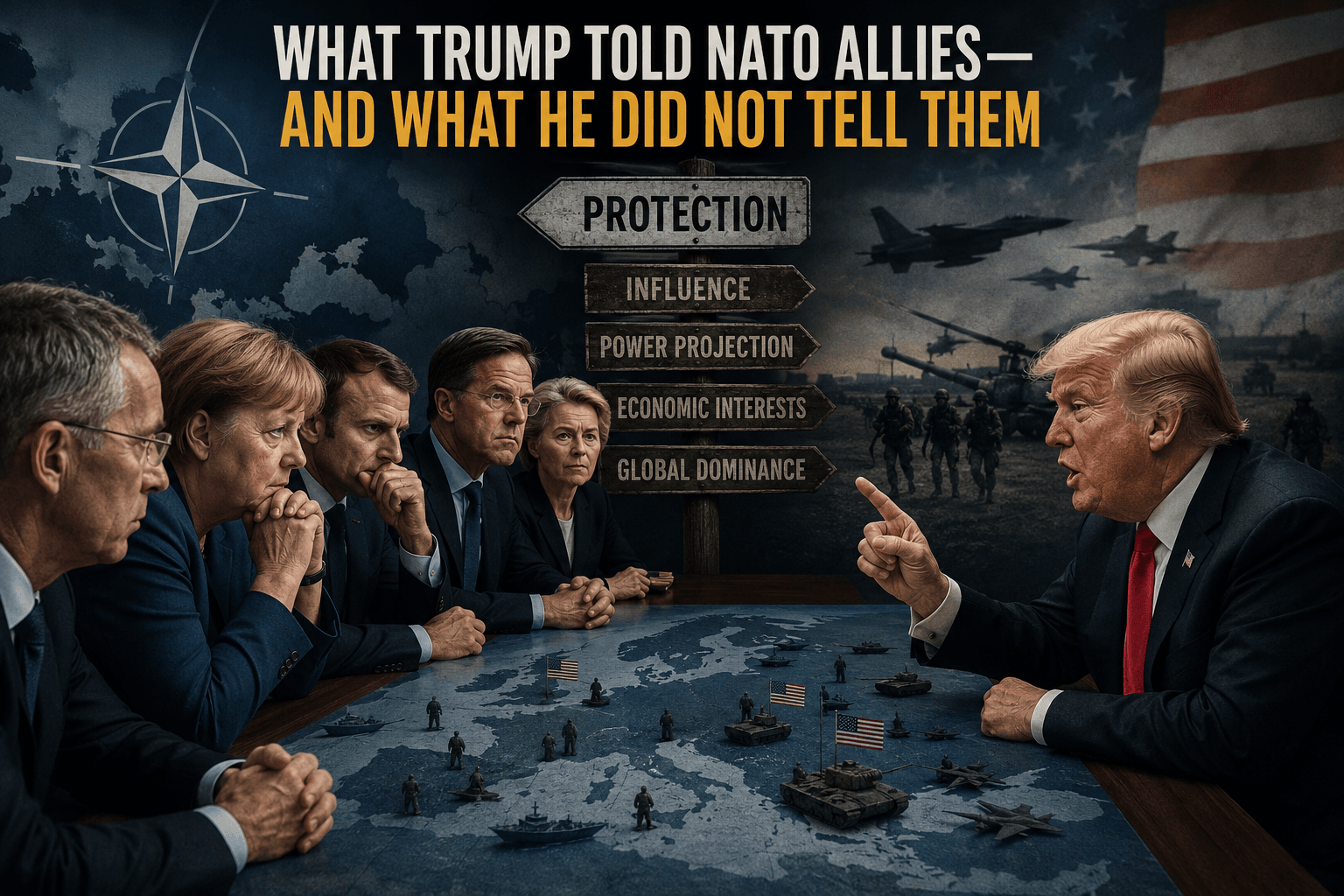
Donald Trump’s criticism of NATO rests on a simple and politically effective argument: the United States has spent enormous amounts of money defending Europe, while wealthy European countries neglected their own militaries and relied on American protection. There is considerable truth in this accusation. But it is only part of the story.
What Trump rarely acknowledges is that NATO was never an American charity project. The United States did not establish the alliance in 1949 merely to protect Europeans from the Soviet Union. NATO served fundamental American strategic interests from the beginning. The permanent military presence of the United States in Europe protected Western Europe, but it also protected the United States by keeping hostile powers away from the Atlantic, containing Soviet influence, providing forward bases for American forces, and establishing Washington as the dominant military power within the Western alliance.
Stay ahead of global events.
Get clear geopolitical analysis in your inbox.
The American security commitment to Europe was therefore not a gift. It was an investment in American power.
During the Cold War, European allies also spent considerable resources on defense. Countries such as Britain, France, West Germany, Italy, and Turkey maintained large armed forces, compulsory military service, extensive weapons industries, and significant military infrastructure. The image of Europeans permanently refusing to pay for their own defense is largely a product of the post-Cold War era.
After 1991, the strategic environment changed dramatically. The Soviet Union disappeared, the Warsaw Pact dissolved, and Western Europe no longer faced an obvious conventional military enemy capable of invading its territory.
European governments responded rationally to this transformation. Defense budgets declined, armies became smaller, compulsory military service disappeared in many countries, and governments redirected resources toward welfare programs, infrastructure, and economic development.
Yet NATO survived.
American troops remained in Europe.
The United States continued to maintain military bases, headquarters, logistical networks, intelligence facilities, airfields, and ports across the continent.
Why?
Because the American military presence in Europe served purposes extending far beyond the defense of Europe itself.
Europe became one of the central platforms of the global American military system. Bases and infrastructure on the continent enabled the United States to deploy forces toward the Middle East, Africa, Central Asia, and the Mediterranean. European facilities supported American operations in Iraq, Afghanistan, Libya, Syria, and elsewhere.
Recent American military operations against Iran have once again demonstrated the strategic importance of geography. Long-range bombers, aircraft carriers, satellites, and precision weapons may dominate public attention, but global power still depends on bases, logistics, intelligence networks, ports, airfields, fuel supplies, and reliable allies.
Europe remains an essential component of that infrastructure.
This is one of the realities missing from Trump’s description of the transatlantic relationship.
Europe’s American Security Protectorate
After the Cold War, Europe gradually became something resembling an American military protectorate.
The term is provocative, but it describes an important geopolitical reality.
The European Union developed into an economic giant without creating an equivalent military structure. European governments accepted American leadership in security and, to a considerable extent, in foreign policy. NATO remained the central institution responsible for European defense, while the United States remained its indispensable military power.
This arrangement was comfortable for both sides.
European governments could spend less on defense while benefiting from the American nuclear umbrella and American military capabilities. Washington, meanwhile, preserved its political influence over Europe, maintained strategically valuable bases, prevented the emergence of an autonomous European military bloc, and ensured that European security remained organized around an institution dominated by the United States.
The demilitarization of Europe was therefore not simply the result of European irresponsibility.
Successive American administrations tolerated it.
One could even argue that Washington indirectly encouraged European strategic dependence. An autonomous European defense system would inevitably have reduced American influence over the continent. A Europe capable of defending itself, producing its own weapons, developing an independent foreign policy, and conducting military operations without American assistance would have been a more difficult partner for Washington to control.
The United States benefited from European dependence.
Trump has rejected the costs associated with this system without fully acknowledging the benefits that the United States derived from it.
He repeatedly tells Americans that their country spent billions and billions of dollars protecting Europe.
What he does not emphasize is that, for much of the post-Cold War period, Europe faced no immediate conventional threat comparable to the Soviet Union.
The United States maintained its military presence because it served broader American strategic interests.
The Ukrainian War and the Failure of the European Security Order
The war in Ukraine exposed the contradictions accumulated after 1991.
Russia bears responsibility for launching the full-scale invasion of Ukraine in February 2022. No serious analysis of the conflict should obscure that fact.
But identifying the aggressor does not eliminate the need to examine how the post-Cold War security system failed.
NATO and the European Union expanded eastward while no durable security architecture acceptable to both Russia and the West was established. Washington rejected the idea that Moscow should possess a veto over the foreign policy choices of independent European states. Russia increasingly interpreted Western expansion as a strategic threat.
These positions became progressively irreconcilable.
The United States played an important role in shaping this outcome because Washington was the dominant power within NATO and the broader European security system.
The result has been catastrophic for Ukraine and profoundly destabilizing for Europe.
At the same time, the war has produced important strategic and economic advantages for the United States.
European countries are purchasing enormous quantities of military equipment. American defense companies have benefited from rising orders and expanding European defense budgets. Europe has dramatically reduced its dependence on Russian energy, while the United States has become a major supplier of liquefied natural gas to European markets.
Most importantly, Russia has been weakened.
Its military has suffered enormous losses. Its economy has become more dependent on China. Its influence in Europe has declined dramatically. NATO has expanded to include Finland and Sweden, transforming the strategic geography of Northern Europe.
None of this proves that Washington wanted the war.
It does demonstrate that the claim that America simply sacrifices its resources to protect ungrateful Europeans is profoundly misleading.
Great powers rarely maintain alliances for charitable reasons.
They maintain alliances because alliances serve their interests.
Who Actually Answered America’s Call?
There is another fact frequently absent from Trump’s criticism of NATO.
The only country in NATO history to invoke Article 5 has been the United States.
After the terrorist attacks of September 11, 2001, America’s European allies responded.
NATO participated in the war in Afghanistan, where European soldiers fought and died alongside Americans. Countries including Britain, France, Germany, Italy, Poland, Romania, Denmark, the Netherlands, and many others deployed troops thousands of kilometers from their own borders.
The war in Iraq was different because NATO did not collectively participate in the invasion and several major European allies opposed it.
Nevertheless, numerous European governments joined the American-led coalition and deployed troops because maintaining the alliance with Washington was considered strategically important.
The transatlantic relationship was based on an implicit principle of reciprocity.
America defended Europe.
Europe supported America when fundamental American interests were threatened.
This is why Trump’s repeated suggestion that the United States might refuse to defend NATO allies represents something more serious than a dispute over military spending.
It challenges the political foundation of the alliance.
European countries sent soldiers to fight alongside Americans because previous administrations in Washington had made clear that alliances involved mutual commitments.
If the United States now declares that those commitments depend entirely on the political calculations of a particular president, European governments must reconsider the strategic value of American guarantees.
What Happens If America Leaves Europe?
Trump appears to believe that withdrawing American forces from Europe would punish Europeans.
The consequences could be very different.
American military bases in Europe are not merely defensive installations. They are essential components of Washington’s ability to project military power toward the Mediterranean, Africa, and the Middle East.
Reducing the American military presence would inevitably weaken that capability.
This matters especially in relation to Israel.
The United States cannot simultaneously reduce its military infrastructure in Europe, demand strategic independence from its allies, and assume that its ability to intervene rapidly in the Middle East will remain unchanged.
Geography still matters.
Logistics still matters.
Allies still matter.
The more fundamental question, however, concerns the future political orientation of Europe.
If the United States refuses to provide credible security guarantees, Europe will eventually develop the military capabilities required to defend itself.
That process has already begun.
European defense budgets are rising. Arms production is expanding. Governments are discussing strategic autonomy, nuclear deterrence, military mobility, and the creation of stronger European defense structures.
A militarily autonomous Europe would fundamentally transform the transatlantic relationship.
Why should a Europe capable of defending itself automatically support American geopolitical priorities?
Why should European governments participate in American attempts to contain China?
Why should Europe become involved in military confrontations in the Indo-Pacific that do not directly threaten European security?
Why should European states host American military bases if Washington no longer considers European defense a vital American interest?
These are questions Trump rarely addresses.
The Strategic Paradox of Trump’s NATO Policy
The United States has every right to demand greater European defense spending.
The imbalance within NATO became unsustainable. Wealthy European countries allowed their military capabilities to deteriorate because they assumed that American protection would continue indefinitely.
Trump was right to expose that problem.
But forcing Europe to rearm while simultaneously destroying confidence in American security guarantees may produce consequences fundamentally opposed to American interests.
A stronger Europe may become a less dependent Europe.
A less dependent Europe may become a more autonomous geopolitical actor.
And an autonomous Europe will not necessarily follow Washington into conflicts with China, Iran, or other American adversaries.
For more than seventy years, NATO gave the United States something extraordinarily valuable: a group of wealthy, technologically advanced countries that accepted American strategic leadership, hosted American military forces, purchased American weapons, supported American military operations, and helped legitimize the international order constructed by Washington.
That system was not free.
But it was enormously advantageous to the United States.
Trump focuses almost exclusively on its costs.
He rarely discusses its benefits.
If American troops eventually leave Europe and Washington abandons its traditional security commitments, Europeans will adapt. They will spend more on defense, expand their military industries, develop stronger European security institutions, and gradually learn to act independently.
The transition would be expensive and potentially dangerous.
But Europe could emerge as a more autonomous global power.
The United States, meanwhile, would lose bases, political influence, military access, reliable partners, weapons markets, and much of its ability to shape European foreign policy.
Washington is concentrating increasingly on China.
But confronting China while simultaneously weakening the transatlantic alliance may prove to be one of the greatest strategic contradictions in modern American foreign policy.
An autonomous Europe would have little reason to subordinate its economic and security interests to Washington’s confrontation with Beijing.
The ultimate paradox is therefore simple.
Trump wants Europeans to become stronger.
But if they become strong enough, they may no longer need the United States.
And if the United States no longer considers Europe worth defending, a militarily capable Europe may eventually conclude that America is no longer worth following.
In such a scenario, Europe would lose its protector.
But the United States would lose an empire of influence.
The second loss may ultimately prove far more consequential than the first.
You May Also Like
BRICS: What It Is and What It Wants to Become
Soft Power vs Hard Power: What’s the Difference and Why It Matters
What Is Geopolitics? Meaning, Examples, and Why It Matters Today
Geography Does Not Disappear: How Maps Still Shape Global Politics
The Virtues of the Paper Tiger: NATO in a Changing World