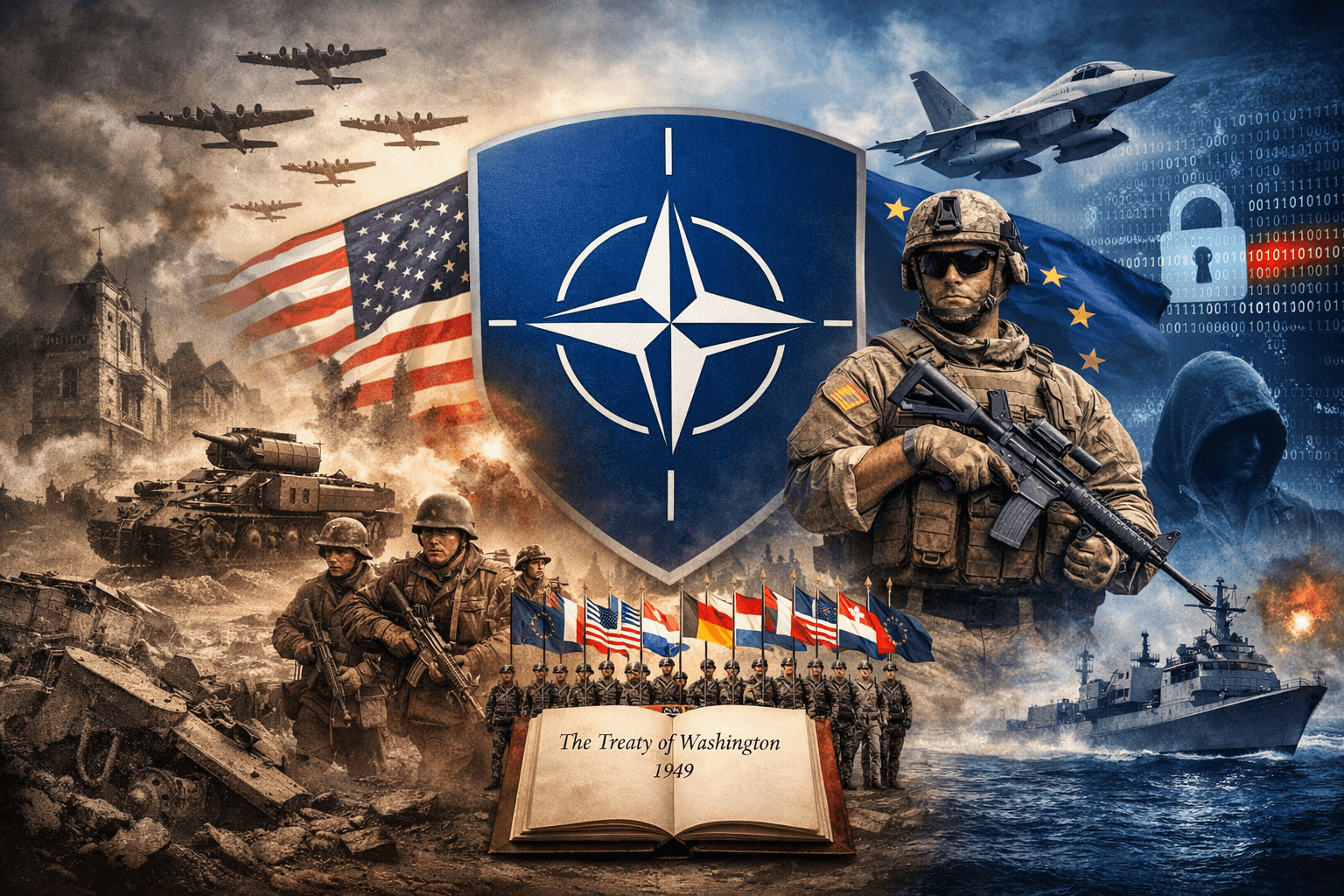
Few international organizations have inspired as many contradictory labels as the North Atlantic Treaty Organization (NATO). To its critics, it has often appeared as a “paper tiger”—a cumbersome, consensus-bound alliance whose military might is diluted by political caution. To its supporters, however, NATO’s greatest strength lies precisely in those features: restraint, unity, and a shared commitment to preventing war rather than waging it. Far from being a weakness, NATO’s supposed fragility is, in many respects, its defining virtue.
At the philosophical core of NATO lies an ancient principle, often attributed to the Roman writer Vegetius: si vis pacem, para bellum—“if you want peace, prepare for war.” NATO embodies this idea not through aggression, but through deterrence. Its purpose is not conquest, but the preservation of peace through credible strength and collective resolve.
A fitting introduction to NATO’s core can be found in its informal motto, Animus in consulendo liber—“a mind unfettered in deliberation.” This phrase captures the essence of the alliance: a community of sovereign states that act not through coercion, but through consultation, consensus, and shared judgment. In a structure often criticized for its slow decision-making, this principle reveals itself as a strength rather than a weakness, ensuring that NATO’s actions rest on legitimacy, unity, and deliberate choice rather than impulse or unilateral will.
Stay ahead of global events.
Get clear geopolitical analysis in your inbox.
I. Origins and Expansion: From Cold War Shield to Democratic Community
NATO was founded in 1949 in the aftermath of World War II, amid growing tensions between Western democracies and the Soviet Union. Its founding principle—enshrined in Article 5 of the North Atlantic Treaty—established that an armed attack against one member shall be considered an attack against all. Crucially, this clause applies to situations in which a member is attacked without having provoked aggression. The emphasis is defensive: NATO exists to protect, not to initiate conflict.
The alliance began with twelve founding members, including the United States, Canada, the United Kingdom, and several Western European states. Early expansions reflected strategic imperatives: Greece and Turkey joined in 1952, strengthening NATO’s southeastern flank, while West Germany’s accession in 1955 marked a decisive step in integrating a former adversary into a democratic security framework.
The end of the Cold War did not dissolve NATO; instead, it transformed its purpose. Former members of the Warsaw Pact sought membership not only for security guarantees but also as a pathway toward democratic consolidation and integration into Western institutions.
The 1999 enlargement—bringing Poland, Hungary, and the Czech Republic into NATO—was a historic milestone. Yet it was the 2004 enlargement that represented the most ambitious and complex expansion in the alliance’s history.
In 2004, NATO admitted seven countries simultaneously: Estonia, Latvia, Lithuania, Slovakia, Slovenia, Romania, and Bulgaria. This was not merely a numerical increase; it was a geopolitical and strategic shift of profound significance.
First, the inclusion of the three Baltic states—Estonia, Latvia, and Lithuania—was unprecedented. These were former Soviet republics, meaning NATO now extended directly to Russia’s borders. This raised sensitive strategic questions and required careful calibration of deterrence and diplomacy.
Second, the enlargement required deep internal transformations within the candidate states. Membership was contingent upon substantial reforms: strengthening democratic institutions, ensuring civilian control over the military, combating corruption, and aligning defense structures with NATO standards. This process was neither automatic nor superficial; it involved years of political negotiation, institutional restructuring, and societal change.
Third, NATO itself had to adapt. Integrating seven new members required logistical, ռազմական, and political adjustments. Command structures were updated, interoperability was enhanced, and contingency planning expanded to cover new territories with distinct security vulnerabilities.
Thus, the 2004 enlargement was not a simple expansion of territory or membership. It was a deliberate and strategic effort to stabilize Eastern Europe, extend the zone of democratic governance, and reinforce the credibility of collective defense.
Subsequent enlargements—including Albania and Croatia (2009), Montenegro (2017), North Macedonia (2020), and more recently Finland and Sweden—have continued this trajectory. Each accession reflects both the attractiveness of NATO membership and the enduring relevance of its mission.
II. Reinventing NATO After 1991
The collapse of the Soviet Union in 1991 posed an existential challenge: what role could NATO play in a world without its original adversary?
Rather than dissolving, NATO reinvented itself. It shifted from a static defensive posture to a more flexible and multifaceted security organization.
The conflicts in the former Yugoslavia during the 1990s were a turning point. NATO intervened in Bosnia and later in Kosovo, conducting air operations and supporting peacekeeping missions. These interventions demonstrated that instability in Europe could still threaten broader security and that NATO could act beyond traditional territorial defense.
At the same time, NATO developed cooperative frameworks such as the Partnership for Peace, enabling non-member states to engage with the alliance. This initiative helped build trust, encourage reforms, and prepare aspiring members for eventual accession.
The attacks of September 11, 2001 marked another defining moment. For the first time, Article 5 was invoked in response to an attack on the United States. NATO subsequently led operations in Afghanistan, taking on roles that extended far beyond its original geographic scope.
These developments illustrate NATO’s capacity for adaptation. It has evolved from a Cold War alliance into a broader security actor capable of addressing diverse threats, including terrorism, cyber attacks, and hybrid warfare.
III. A Defensive Alliance: Preventing War Rather Than Winning It
NATO’s fundamental purpose is often misunderstood. It is not designed to win wars in the traditional sense; it is designed to prevent them.
Article 5 is central to this mission. It does not mandate automatic military retaliation but commits members to assist an ally that has been attacked, particularly when that ally is the victim of unprovoked aggression. The form of assistance can vary—military, political, economic—but the principle of solidarity is absolute.
This structure reinforces deterrence. A potential aggressor must consider not only the target state but the combined strength of the entire alliance. The result is a powerful disincentive to initiate conflict.
Critics sometimes interpret NATO’s emphasis on consensus and restraint as weakness. Yet these features are deliberate. Decisions require agreement among member states, ensuring that actions are legitimate and broadly supported.
In this sense, NATO’s “paper tiger” reputation reflects a misunderstanding. Its restraint is not impotence; it is strategy. NATO’s greatest victories are the conflicts that never occur.
IV. NATO as an Instrument of U.S. Foreign Policy
NATO is one of the most significant instruments of U.S. foreign policy. Through the alliance, the United States maintains a sustained presence in Europe while sharing security responsibilities with its allies.
This arrangement amplifies American influence while distributing costs and risks. NATO provides the United States with access to bases, infrastructure, and strategic partnerships that enhance its global reach.
At the same time, NATO offers a framework for multilateral action. Rather than acting unilaterally, the United States can operate within an alliance that lends legitimacy and political support to its initiatives.
Tensions have occasionally arisen over burden-sharing, particularly regarding defense spending. However, these disagreements have not undermined the fundamental structure of the alliance. Instead, they reflect the ongoing negotiation inherent in any partnership of sovereign states.
V. The Transatlantic Bond: A Strategic Necessity
NATO is the institutional foundation of the transatlantic relationship between North America and Europe. This relationship has been a cornerstone of international stability since 1945.
By linking the security of the United States to that of Europe, NATO ensures mutual engagement. European countries benefit from American security guarantees, while the United States gains reliable allies and strategic depth.
Without NATO, this relationship could weaken. The United States might shift its focus elsewhere, while European states could pursue divergent security strategies. Such fragmentation would increase uncertainty and reduce collective capacity to address global challenges.
More concerning is the possibility that the United States and Europe could become strategic competitors. History demonstrates that alliances are not permanent; they require maintenance and shared interests. NATO provides the structure that sustains this partnership.
VI. The Risks of a Divided West
A weakened or dissolved NATO would have consequences beyond the transatlantic space. It could embolden authoritarian powers, weaken international norms, and undermine democratic cooperation.
Without a cohesive Western alliance, coordination on security, trade, and global governance would become more difficult. Rivalries could emerge, and the risk of conflict would increase.
NATO mitigates these risks by providing a platform for dialogue and coordination. It aligns the strategic perspectives of its members and enables collective responses to emerging threats.
VII. A Community of Values: Democracy and the Rule of Law
NATO is more than a military alliance; it is a community of values. Membership is based not only on strategic considerations but also on a commitment to democracy, individual liberty, and the rule of law.
The accession process requires candidate countries to undertake significant reforms. These include strengthening democratic institutions, ensuring civilian control of the military, and protecting human rights.
This aspect of NATO has contributed to the consolidation of democratic governance in Europe. It has also reinforced the idea that security and values are interconnected.
Maintaining these standards within the alliance is an ongoing challenge. Differences among members can create tensions, particularly regarding governance issues. Nevertheless, the shared commitment to democratic principles remains a defining feature of NATO.
VIII. Conclusion: Strength Through Restraint
NATO’s history is one of adaptation, resilience, and strategic clarity. From its origins in the early Cold War to its current role in a complex global environment, it has consistently evolved to meet new challenges.
The idea of NATO as a “paper tiger” overlooks its true strength. Its power lies not in aggression but in deterrence; not in unilateral action but in collective decision-making; not in domination but in stability. This critique has reappeared in contemporary discourse, notably in remarks by Donald Trump, who questioned the alliance’s effectiveness. Yet such claims tend to misinterpret NATO’s restraint as weakness, rather than recognizing it as a deliberate strategy designed to prevent conflict.
Guided by the principle si vis pacem, para bellum, NATO has helped preserve peace in Europe for decades. It remains a central instrument of U.S. foreign policy, a guarantor of transatlantic unity, and a community of democratic states.
Its greatest achievement is not measured in battles won, but in conflicts avoided. In a world where uncertainty and rivalry persist, the virtues of this so-called “paper tiger” remain indispensable.
Nevertheless, the Washington Treaty (1949) marked a decisive moment in American strategic thinking: for the first time in its history, the United States entered a permanent military alliance in peacetime, committing itself to the collective defense of like-minded states. This decision reflected the hard lessons of the interwar period, when the failure of the United States to sustain and guarantee the international order established after World War I contributed significantly to the instability that culminated in World War II. NATO thus emerged not merely as a response to immediate threats, but as a deliberate effort to prevent the repetition of that earlier strategic retreat, anchoring American power within a durable system of collective security.
You May Also Like
What Would a NATO Without the United States Look Like?
Does NATO Automatically Go to War? Article 5 Explained