Why China May Not Need to Invade Taiwan to Defeat It
An island does not have to be conquered to be defeated.
That proposition has appeared repeatedly throughout modern history. From the naval blockade of Cuba in 1898 to Germany’s submarine campaign against Britain in the First World War, from the strangulation of Japan in 1945 to the American quarantine of Cuba in 1962, maritime coercion has demonstrated a recurring strategic principle: an island’s greatest geographical advantage can also become its greatest vulnerability.
Taiwan may represent the most consequential version of this problem in the twenty-first century.
For decades, strategic discussions about a Chinese attack on Taiwan have focused overwhelmingly on invasion. The conventional image is familiar: missiles strike military installations, aircraft contest the skies, naval forces cross the Taiwan Strait, and amphibious formations attempt to establish beachheads. Yet an invasion is only one possible method of coercion. China could theoretically pursue a more gradual strategy designed to make Taiwan increasingly isolated without immediately attempting to occupy it.
The objective would not necessarily be to destroy Taiwan.
It could be to make Taiwan impossible to supply.
Stay ahead of global events.
Get clear geopolitical analysis in your inbox.
THE GEOGRAPHY OF VULNERABILITY
Islands possess a paradoxical strategic character. Their surrounding waters provide a natural defensive barrier, making invasion difficult. At the same time, those waters constitute a potential logistical choke point. A continental power can often maintain multiple land routes even when one is cut. An island cannot.
Taiwan is therefore dependent upon maritime and air connections for the continued functioning of its economy and military. Energy imports, industrial inputs, food, commercial goods and exports all depend upon uninterrupted connections with the outside world.
This does not mean that Taiwan is easily isolated. Quite the opposite: any attempt to isolate it would immediately become an international crisis because Taiwan occupies a strategically important position in East Asian commerce, while the United States and Japan possess substantial military capabilities in the region.
But history demonstrates why Beijing might nevertheless regard maritime coercion as an attractive alternative to invasion.
WHEN THE BLOCKADE ALMOST BROKE BRITAIN
The First World War provided one of the first modern demonstrations of how vulnerable an industrial island could become when its maritime lifelines were threatened.
Germany’s unrestricted submarine campaign against Britain reached a critical point in 1917. After abandoning restrictions on submarine warfare, Germany resumed unrestricted attacks on merchant shipping on 1 February. Between February and April, German U-boats sank more than 500 merchant ships; during the second half of April alone, the average reached approximately 13 ships per day. Britain appeared to be approaching a logistical crisis.
The German strategy ultimately failed. The convoy system, improved anti-submarine warfare, aircraft, intelligence and other countermeasures gradually reduced the U-boat threat. More importantly, Germany’s unrestricted submarine warfare helped bring the United States into the conflict in April 1917. The strategy that was intended to isolate Britain therefore contributed to Germany’s own strategic isolation.
The lesson for Beijing is not simply that blockades fail.
It is that a maritime siege becomes dangerous for the besieger when it creates a powerful incentive for outside powers to intervene.
That distinction may prove decisive in Taiwan.
JAPAN: WHEN THE SEA BECOMES A WEAPON
Japan in 1945 offers a different and perhaps more relevant precedent.
By the final months of the Pacific War, American submarines had devastated Japanese merchant shipping, while aerial mining further disrupted the movement of vessels between Japanese ports. The consequences were enormous shortages of food, fuel and strategic materials. Japan’s military still possessed hundreds of thousands of troops, aircraft and defensive preparations, but its capacity to sustain modern warfare was collapsing.
The historical debate over Japan’s surrender remains complex. Hiroshima, Nagasaki, the Soviet declaration of war and the deteriorating military situation all mattered. It would therefore be simplistic to claim that blockade alone would certainly have produced surrender.
Nevertheless, the 1946 U.S. Strategic Bombing Survey reached a striking conclusion. After examining Japanese documents and interrogating hundreds of officials, it judged that Japan would probably have surrendered before the end of 1945 even without the atomic bombings, Soviet entry into the war or an invasion of the Home Islands. The report emphasized the cumulative effects of air superiority and the destruction of Japan’s ability to continue the war.
The important lesson is narrower and more defensible:
Military forces cannot compensate indefinitely for the destruction of the logistical system that sustains them.
That is precisely the problem Taiwan would face in a prolonged maritime crisis.
CUBA 1898: THE ISLAND AS A STRATEGIC CHOKE POINT
The Spanish-American War offers an earlier example.
In 1898, the United States used naval power to isolate Spanish forces in Cuba. The blockade was intended to restrict the movement of supplies and reinforce the broader military campaign. The strategic logic was straightforward: if Spanish forces could not be adequately supplied, their ability to resist would progressively deteriorate.
The significance of Cuba lies less in its direct similarity to Taiwan than in the strategic principle it illustrates.
An island can be attacked without immediately being invaded.
The sea itself can become the battlefield, while the real target is the island’s capacity to sustain resistance.
THE DAY A BLOCKADE BECAME A QUARANTINE
The Cuban Missile Crisis of 1962 introduced an even more important concept.
President John F. Kennedy deliberately described the American naval operation as a “quarantine” rather than a “blockade.” The distinction was not merely rhetorical. A blockade traditionally implied an act of war, while “quarantine” provided a legally and politically different framework for intercepting offensive military shipments. The terminology also helped Washington secure support from the Organization of American States.
The operation was limited rather than a comprehensive attempt to starve Cuba. U.S. planning initially focused on preventing additional offensive weapons from reaching the island, with more extensive measures considered if the crisis escalated.
This is arguably the most relevant historical precedent for Taiwan.
A quarantine does not necessarily require the complete physical closure of an island. Its purpose can be to establish control over the conditions under which ships and aircraft are allowed to enter.
That distinction matters enormously.
BERLIN: THE LIMITS OF ISOLATION
The Berlin Blockade provides the necessary counterexample.
In June 1948, the Soviet Union cut land and river access between West Germany and West Berlin. The Western Allies responded with an enormous airlift. Over 324 days, more than two million tons of freight were transported into West Berlin, ultimately demonstrating that isolation is effective only when alternative supply routes can be eliminated.
For Taiwan, the implication is obvious.
A Chinese quarantine or blockade would succeed only if Beijing could prevent or deter alternative forms of resupply. Air transport, maritime convoys, military escorts, neutral shipping, foreign intervention and other mechanisms could all complicate the strategy.
The question would therefore not simply be whether China could surround Taiwan.
It would be whether China could make the surrounding military and economic environment too dangerous for others to break the siege.
TAIWAN: THE SIEGE THAT MAY NEVER BE CALLED A SIEGE
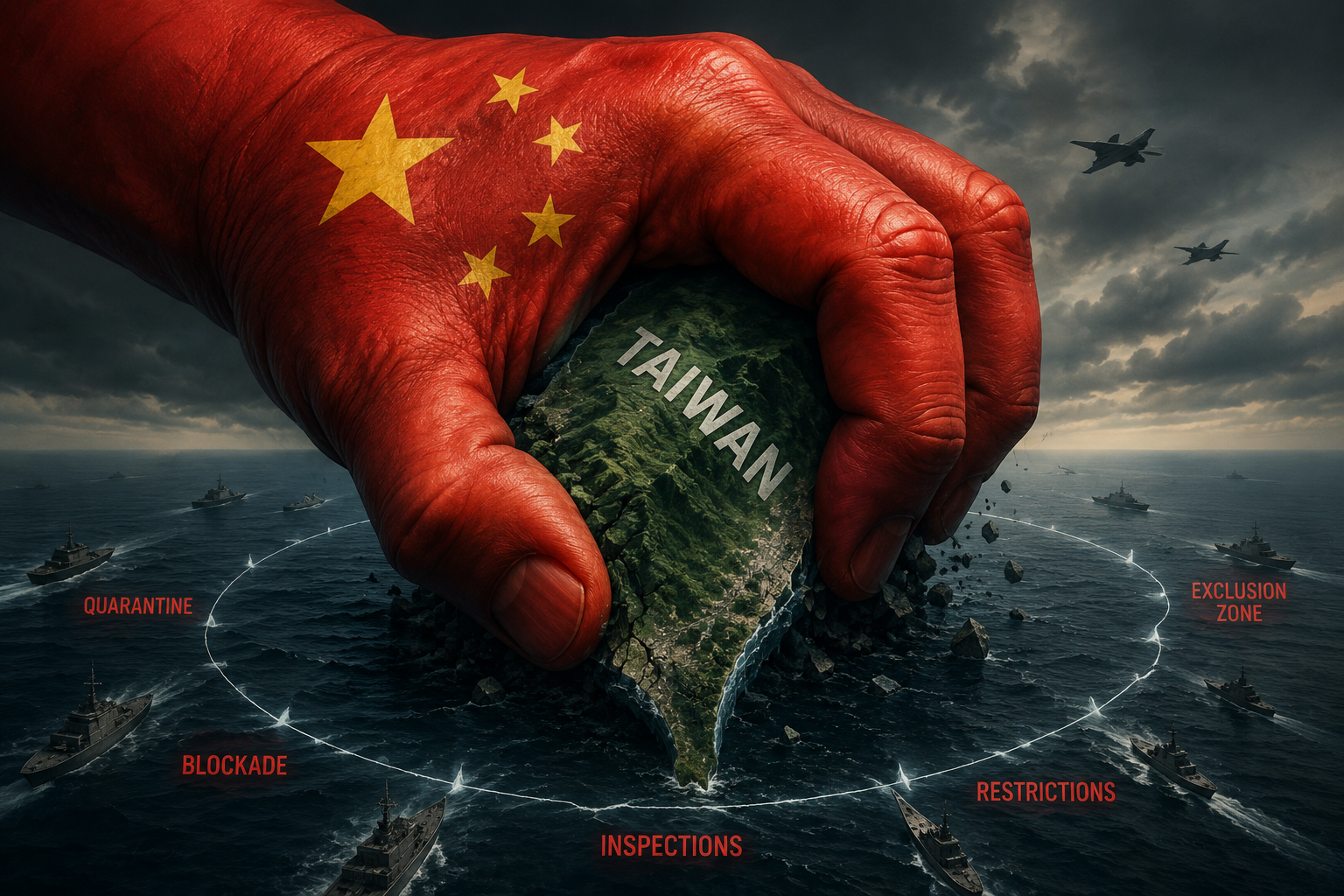
China already possesses an instrument particularly suited to such a strategy: the China Coast Guard.
In recent years, Beijing has increasingly combined military exercises with law-enforcement activity around Taiwan. Analysts have identified a potential Chinese “quarantine” as a scenario in which the China Coast Guard, rather than the PLA Navy, would play the leading role. Such an operation could seek to control maritime traffic without initially presenting itself as a conventional military blockade.
The distinction is fundamental.
A Chinese quarantine could involve inspections, customs requirements, maritime warnings, temporary exclusion zones or demands that commercial vessels comply with Chinese regulations. Beijing would not necessarily need to stop every ship. It could attempt to convince shipping companies, insurers and foreign governments that ignoring Chinese requirements carries unacceptable risks.
If enough international actors complied voluntarily, China would acquire something strategically valuable: de facto control without formal occupation.
That would transform the problem from military conquest into political coercion.
CHINA’S ADVANTAGE IS ALSO ITS DILEMMA
There is, however, a major obstacle.
Taiwan is not economically isolated from China alone. It is embedded in the global economy. Any serious blockade would therefore affect international trade and potentially China’s own economy.
A military blockade would also be far more provocative than a law-enforcement quarantine. If Chinese forces physically prevented American or Japanese vessels from reaching Taiwan, Washington and Tokyo would face an extraordinary strategic decision.
Accept China’s restrictions, and Taiwan could gradually become isolated.
Challenge them, and the crisis could escalate into a major war between nuclear-armed powers.
This is the central strategic dilemma.
FROM QUARANTINE TO BLOCKADE — AND FROM BLOCKADE TO WAR
The most dangerous moment would not necessarily be the beginning of a Chinese operation.
It would be the moment when ambiguity disappeared.
A quarantine could remain below the threshold of open warfare as long as China relied primarily on law-enforcement mechanisms and selective restrictions. But if Chinese forces began firing on foreign vessels, systematically closing Taiwanese ports or preventing military resupply, the operation would increasingly resemble a conventional blockade.
At that point, the historical lessons of 1917 and 1962 would converge.
Germany discovered that maritime coercion could provoke outside intervention.
Kennedy discovered that maritime coercion could provide an alternative to immediate military attack.
China would have to attempt both simultaneously: coerce Taiwan while preventing the United States and its allies from turning the quarantine into a war.
THE ISLAND THAT DOES NOT NEED TO BE INVADED
The history of maritime warfare does not establish that China will blockade Taiwan. Nor does it demonstrate that a blockade would necessarily succeed.
It demonstrates something more important.
The strategic vulnerability of an island is not determined solely by the strength of its army. It depends upon the resilience of the networks that connect it to the outside world.
Britain survived because its maritime lifelines ultimately remained open. Germany’s submarine campaign failed and helped bring the United States into the war. Japan’s ability to continue organized resistance was progressively undermined as its maritime logistics collapsed. Cuba demonstrated that naval coercion could be conducted below the formal threshold of war. Berlin demonstrated that isolation could be defeated if an alternative supply route existed.
Taiwan combines elements of all these cases.
It is difficult to invade, but dependent upon external connections. It is economically powerful, but vulnerable to disruption. It is geographically close to China, but strategically connected to the United States, Japan and the global economy.
That makes an invasion only one possible form of Chinese coercion.
The more subtle strategy would be to make Taiwan increasingly isolated while avoiding the single act that would automatically unite its external supporters.
China might therefore not need to ask whether it can conquer Taiwan.
It might ask a different question:
Can it make the world hesitate before supplying it?
If the answer were ever yes, the most dangerous Chinese operation against Taiwan might not begin with an amphibious landing.
It could begin with a customs announcement.
And the blockade might never be called a blockade.
You May Also Like
What If the People’s Republic of China Is the Rebel Province, Not Taiwan?