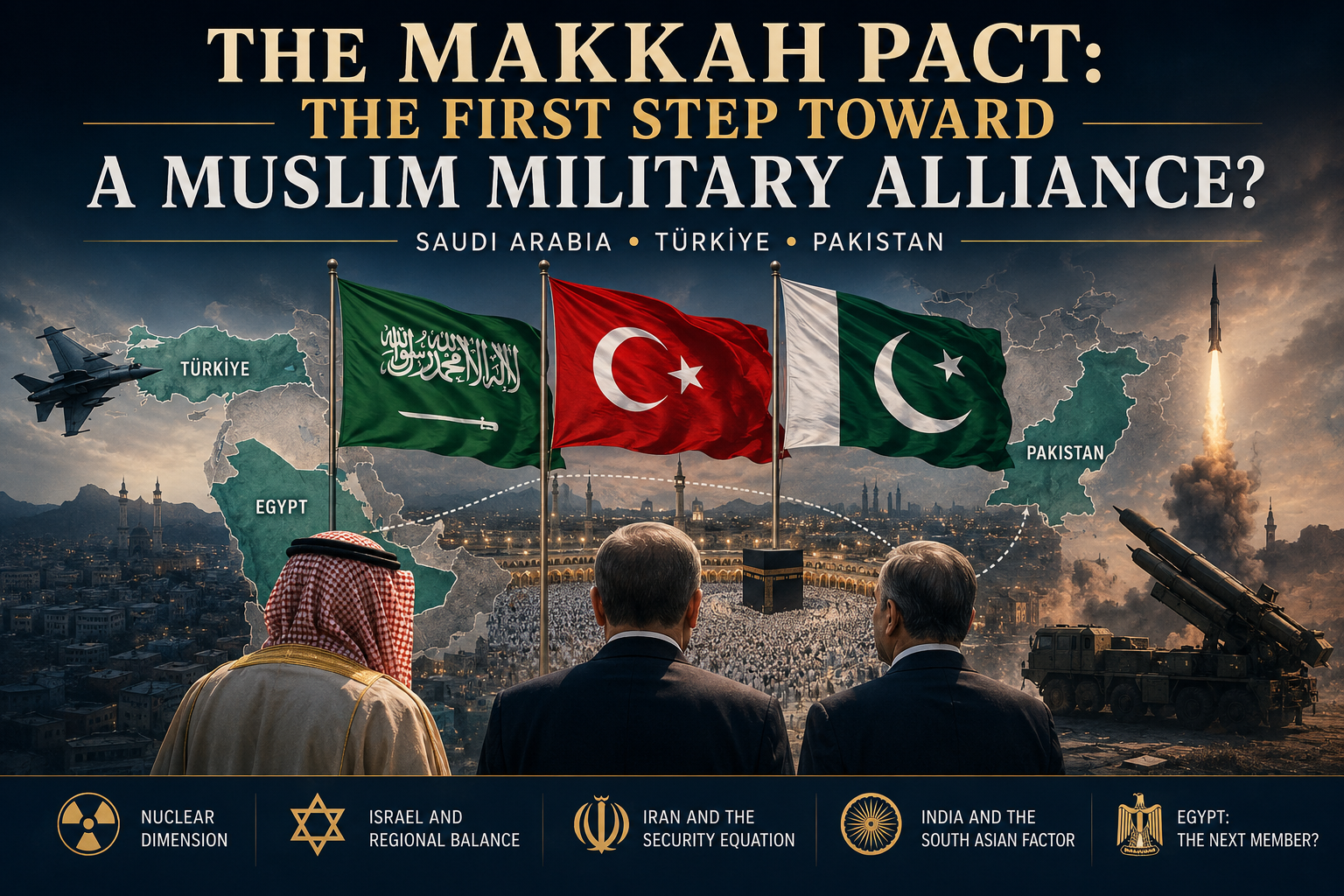
On 7 August 2026, Saudi Arabia, Türkiye and Pakistan signed the Makkah Joint Defence Agreement, establishing a collective-defence framework at a moment when the security architecture of the Middle East is undergoing profound change. The agreement states that an armed attack against any one of the three signatories will be regarded as an attack against all three. Turkish Foreign Minister Hakan Fidan has described the arrangement as technically comparable to NATO’s Article 5, although the Makkah Pact does not possess NATO’s integrated command structure, permanent military institutions or decades-long system of interoperability.
The immediate significance of the Makkah Pact is therefore straightforward: three major Muslim-majority states have created a formal mutual-defence commitment. Its long-term significance, however, is much harder to determine. The agreement could remain a limited trilateral security arrangement. Alternatively, it could become the nucleus of a broader Muslim military alliance, particularly if Egypt and other states eventually decide to join.
Stay ahead of global events.
Get clear geopolitical analysis in your inbox.
That possibility deserves attention because the Muslim world has never developed a collective-security organisation comparable to NATO. The Arab League established a collective-defence framework in 1950, but political divisions repeatedly prevented the emergence of an integrated Arab military force. The Makkah Pact follows a different geographical and political logic. It is not based on Arab identity. Its founding members combine an Arab Gulf power, a major non-Arab regional military power and a nuclear-armed South Asian state.
That combination is what makes the agreement strategically unusual.
Why Saudi Arabia, Türkiye and Pakistan?
Each of the three founding members contributes a different form of strategic power. Saudi Arabia brings enormous financial resources, energy importance and a geographical position connecting the Gulf, the Red Sea and the wider Middle East. Türkiye possesses one of the region’s most capable conventional armed forces, extensive NATO experience and a rapidly expanding defence industry. Pakistan contributes substantial military capabilities, a large armed force and, most importantly, an established nuclear deterrent.
The result is a partnership in which economic power, conventional military power and nuclear deterrence coexist within the same security framework.
The Makkah Pact also did not emerge from nowhere. Saudi Arabia and Pakistan had already signed a Strategic Mutual Defence Agreement in September 2025 under which aggression against either country would be treated as aggression against both. The 2026 agreement expands that bilateral security relationship by incorporating Türkiye.
The development suggests that Riyadh, Ankara and Islamabad are not simply reacting to a single crisis. They are also exploring whether regional powers can construct security mechanisms that give them greater strategic autonomy.
The Nuclear Dimension
The presence of Pakistan gives the Makkah Pact a dimension that distinguishes it from most regional defence arrangements.
Pakistan is the only nuclear-armed member of the agreement. This does not mean that the pact automatically creates a Pakistani nuclear umbrella for Saudi Arabia or Türkiye. No public provision establishes nuclear sharing or transfers nuclear weapons to another member. Such an interpretation would therefore go beyond the available evidence.
Nevertheless, the nuclear dimension cannot be ignored.
A collective-defence agreement that includes a nuclear-armed state inevitably affects deterrence calculations. Saudi Arabia’s security environment is shaped by the military capabilities of Iran, while Pakistan’s nuclear arsenal is primarily associated with its strategic competition with India. Bringing Pakistan into a formal defence arrangement with Saudi Arabia creates a connection between two previously distinct strategic theatres.
This does not transform the Makkah Pact into a nuclear alliance. It does, however, give the agreement a strategic weight that would not exist if all three members possessed only conventional forces.
The question is therefore not whether Pakistan has formally extended its nuclear deterrent to Saudi Arabia. It has not been publicly established that it has. The more important question is whether the existence of a nuclear power inside the alliance will influence the strategic calculations of potential adversaries and future members.
Iran and the New Regional Security Equation
Iran is perhaps the most obvious country whose strategic calculations will be affected by the emergence of the Makkah Pact, even though the three signatories insist that the agreement is not directed against Tehran.
Turkish officials have explicitly stated that the pact is not aimed at Iran or any other particular country. Iran’s response has also been notably cautious. On 10 August, an Iranian Foreign Ministry spokesman said there was no reason for Tehran to fear the agreement and presented regional security cooperation as potentially positive if it was inclusive and addressed the actual sources of insecurity.
Yet declarations of intent are only one part of international politics. Capabilities and alliances matter as well.
A security framework connecting Saudi Arabia, Türkiye and Pakistan creates a new potential mechanism for military coordination in a region where Iran has traditionally been one of the principal strategic powers. It does not necessarily constitute an anti-Iranian bloc, but Tehran cannot ignore the possibility that the arrangement could eventually become more institutionalised or attract additional members.
The future relationship between Iran and the Makkah Pact may therefore depend heavily on whether the agreement remains narrowly defensive or develops into a wider regional security structure.
Israel and the Makkah Pact
Israel represents another important dimension of the emerging security equation.
The Makkah Pact is not formally an anti-Israeli alliance, and there is no evidence that the agreement defines Israel as an adversary. Nevertheless, the three members have increasingly important positions in the regional debate over Israel, Gaza and the future of the Palestinian territories.
Türkiye has adopted one of the region’s most critical positions toward Israel. Pakistan does not recognise Israel. Saudi Arabia, meanwhile, has maintained that Palestinian statehood remains central to any broader regional settlement while its own relationship with Israel has become increasingly complicated by the wider regional conflict.
Consequently, Israel has strong reasons to study the development of the Makkah Pact even if it is not its formal target. The strategic concern is not necessarily that Saudi Arabia, Türkiye and Pakistan have created an anti-Israeli alliance. Rather, it is that a new military coordination mechanism could eventually give several major Muslim states greater collective strategic weight. Recent analysis has already linked the agreement to the changing regional balance involving both Iran and Israel.
The distinction between intention and capability is important. Alliances can change regional calculations even when they are established for defensive purposes.
India and the South Asian Dimension
The Makkah Pact also extends beyond the Middle East because of Pakistan’s participation.
Pakistan’s principal long-term strategic rival is India. The two nuclear-armed states have a history of military confrontation, and their rivalry remains one of the most consequential security problems in South Asia.
The Makkah Pact does not oblige Saudi Arabia or Türkiye automatically to enter a future India-Pakistan conflict. Nor does it indicate that Riyadh or Ankara would treat every confrontation between the two South Asian powers as a collective-defence crisis.
Nevertheless, the possibility that a future conflict could acquire wider diplomatic or military dimensions cannot be ignored.
For India, the development creates an additional strategic variable. Pakistan now belongs to a formal defence framework involving two major powers outside South Asia. If that framework were eventually expanded, institutionalised and given permanent military mechanisms, New Delhi would have to assess not only Pakistan’s bilateral capabilities but also the wider network of security relationships surrounding it.
This is one reason why the future development of the Makkah Pact matters far beyond the Middle East.
Could Egypt Join the Makkah Pact?
The most important question concerning the possible expansion of the Makkah Pact is whether Egypt will join.
Egypt did not participate in the signing of the agreement on 7 August, and recent reporting indicates that Cairo had reservations about joining a Saudi-led security bloc. At the same time, Turkish officials have indicated that Egypt could potentially join the arrangement after the necessary technical and institutional issues are resolved.
Egypt would be a transformative addition.
It possesses one of the largest armed forces in the Arab world, controls the Suez Canal and occupies a strategically critical position between North Africa, the Mediterranean, the Red Sea and the Middle East. It is also one of the central political and military powers of the Arab world.
A future structure comprising Saudi Arabia, Türkiye, Pakistan and Egypt would therefore be qualitatively different from the current trilateral pact.
It would also create a remarkable historical parallel with the Arab League. The Arab League attempted to create mechanisms for collective defence among Arab states. A successful Makkah framework could move beyond that model by bringing together major Muslim states regardless of their ethnic or linguistic identities.
The question would then become whether the Makkah Pact could evolve from a trilateral agreement into the nucleus of a broader Muslim security organisation.
From the Makkah Pact to a Muslim Military Alliance?
For that transformation to occur, the agreement would need to acquire institutions rather than remain a political declaration.
A genuine military alliance would require permanent mechanisms for intelligence sharing, joint exercises, defence planning, interoperability, air and missile defence cooperation, military procurement and possibly a permanent command structure.
NATO provides the obvious comparison, but the differences are substantial. NATO’s strength rests not simply on its collective-defence clause but on decades of institutional development, integrated military planning and interoperability.
The Makkah Pact is at a much earlier stage.
Its future could nevertheless follow several paths.
The first would be a limited trilateral arrangement focused primarily on political deterrence and bilateral military cooperation.
The second would be an increasingly institutionalised Saudi-Türkiye-Pakistan security partnership, with joint exercises, intelligence cooperation and defence-industrial projects.
The third would be much more ambitious: the accession of Egypt and potentially other Muslim-majority states, followed by the creation of permanent collective-defence institutions.
Only the third scenario would justify describing the Makkah Pact as the foundation of a genuine Muslim military alliance.
The Limits of a Muslim NATO
The greatest obstacle to such an outcome is not military capability but political diversity.
The potential members of a wider Muslim security organisation have very different relationships with the United States, China, Russia, Iran and Israel. Their strategic priorities also diverge considerably.
Pakistan’s principal security concerns are centred on India and its relationship with China. Saudi Arabia’s priorities are concentrated on Gulf security, Iran, energy infrastructure and regional stability. Türkiye has interests stretching across the Middle East, the Caucasus, the Black Sea and Europe. Egypt’s strategic concerns include Libya, Sudan, the Red Sea, the Suez Canal and regional Arab politics.
There is also the question of Iran.
A genuinely pan-Islamic security organisation that included Iran would have a very different character from one built primarily around Saudi Arabia, Türkiye, Pakistan and Egypt. Excluding Iran, meanwhile, could lead observers to interpret the organisation as predominantly Sunni, regardless of its formal language.
These contradictions would make institutional integration difficult.
A New Muslim Security Architecture?
The Makkah Pact is therefore best understood as a beginning rather than a finished alliance.
It is not yet a Muslim NATO. Nor is there sufficient evidence to conclude that its founders have decided to create one. What the agreement demonstrates is something more limited but potentially significant: three major Muslim states have decided to establish a formal collective-defence mechanism outside the traditional framework of the Arab League and without relying exclusively on an external security guarantor.
Its future importance will depend on what happens next.
If Saudi Arabia, Türkiye and Pakistan develop permanent military structures, expand intelligence cooperation and conduct increasingly sophisticated joint exercises, the pact will acquire greater strategic substance. If Egypt joins, the balance will shift further. If additional Muslim-majority states eventually enter, the agreement could evolve into a genuinely new regional security architecture.
The nuclear dimension would make such a development strategically significant. Iran would have to reassess its regional position. Israel would have to consider the emergence of a larger Muslim defence network. India would have to account for the possibility that Pakistan’s security partnerships could acquire a broader regional dimension. The United States, meanwhile, would face a more complicated Middle Eastern environment in which its traditional security partnerships coexist with an increasingly autonomous regional framework.
The central question is therefore not whether the Makkah Pact is already a Muslim NATO. It clearly is not.
The more important question is whether it can become the institutional seed of one.
If Egypt joins, if other Muslim-majority states follow, and if the founding members transform their political commitment into permanent military cooperation, the agreement signed in Makkah on 7 August 2026 may eventually be remembered as the first step toward a new Muslim collective-defence system.
For now, however, the Makkah Pact remains an experiment in regional strategic autonomy—and its ultimate significance will be determined not by the ceremony that created it, but by the institutions that may follow.
You May Also Like
Trump vs. Iran – Did the United States Win the War but Lose the Peace?