The American Empire That Is Not Quite an Empire
The United States is rarely described as a colonial power. Unlike Britain, France, Spain or Portugal, modern America does not possess a conventional overseas empire governed through a large network of colonies. Yet the United States does possess territories outside the fifty states, and their political relationships with Washington are remarkably diverse.
Today, the United States has five permanently inhabited territories: Puerto Rico, Guam, American Samoa, the U.S. Virgin Islands and the Commonwealth of the Northern Mariana Islands. The U.S. Department of the Interior distinguishes these territories from the freely associated states of the Federated States of Micronesia, the Republic of the Marshall Islands and Palau, which are sovereign states linked to Washington through Compacts of Free Association.
The distinction matters. Calling every U.S. territory a “colony” is historically and legally imprecise. Some territories possess substantial self-government; their inhabitants may hold U.S. citizenship; and their political futures remain subject to democratic debate. Yet another fact is equally difficult to ignore: throughout American history, strategically valuable islands have sometimes been treated primarily as military assets, while the interests of their inhabitants have been subordinated to larger strategic objectives.
Stay ahead of global events.
Get clear geopolitical analysis in your inbox.
This history deserves particular attention today because Washington’s interest in Greenland has once again placed the relationship between American strategic power and small island societies under international scrutiny.
The question is not whether Greenland would inevitably become another Puerto Rico, Guam or Bikini. History cannot prove that. The more serious question is whether the experience of America’s overseas territories provides Greenlanders with legitimate reasons to examine carefully what U.S. sovereignty could mean for their political autonomy, land, resources, environment and strategic importance.
1898: When America Became an Overseas Power
The turning point was the Spanish-American War.
The conflict transformed the United States from a continental power with growing overseas interests into a major imperial and naval actor. Spain relinquished Puerto Rico and Guam to the United States, while the Philippines also came under American sovereignty. Cuba, although formally independent after the war, remained deeply subject to American influence.
The United States did not simply reproduce the European colonial model. American officials frequently presented expansion as a combination of strategic necessity, commercial opportunity and a supposedly civilizing mission. Yet the result was unmistakably territorial expansion beyond the continental United States.
The Philippines provides the clearest historical example of the contradiction. American rule was accompanied by the development of institutions and infrastructure, but also by a brutal war against Filipino forces resisting U.S. sovereignty. The Philippines eventually became independent in 1946.
Puerto Rico and Guam followed very different trajectories.
That diversity is important because there has never been a single “American colonial model.” Washington has developed several different constitutional arrangements for territories depending on geography, history, strategic importance and local political circumstances.
The modern debate therefore should not ask simply whether America has colonies.
It should ask a more precise question:
What happens when a powerful state exercises sovereignty over a population that is not incorporated into the political system on exactly the same terms as its mainland population?
Puerto Rico: Citizenship Without Full Representation
Puerto Rico is perhaps the most important case.
Acquired from Spain in 1898, Puerto Rico remains a U.S. territory rather than a state. People born there are U.S. citizens and may freely move between Puerto Rico and the mainland. Yet residents of the island do not participate in presidential elections while residing there, and Puerto Rico does not have voting representation in the Senate. Its Resident Commissioner in the House can participate in congressional proceedings but does not possess a vote on final passage of legislation on the House floor.
The arrangement is neither classical colonialism nor full political integration.
It is something in between.
The ambiguity has generated a debate lasting generations. Puerto Ricans have repeatedly debated statehood, independence, free association and continuation or modification of the existing territorial relationship. The U.S. Government Accountability Office has explicitly examined these alternatives as questions involving political rights, economic development, federal powers and the future relationship between Puerto Rico and Washington.
There is an important argument on the other side. Puerto Rico receives substantial federal assistance, its residents possess American citizenship, and its economy and institutions are deeply integrated with those of the United States. The territorial relationship therefore cannot be reduced to a simple model of exploitation.
But the central political problem remains:
Citizenship does not necessarily equal political equality.
Puerto Rico demonstrates that a population can be closely connected to a powerful state without possessing the same constitutional status as the citizens of that state’s constituent states.
For Greenland, this is a question worth remembering.
Guam: The Island as a Military Asset
Guam presents a different version of the same problem.
The United States acquired Guam from Spain in 1898. The island was initially administered by the U.S. Navy, and the Guam Organic Act of 1950 established civilian government and conferred U.S. citizenship on Guamanians. Elections followed, and Guam developed substantial institutions of self-government.
But geography made Guam exceptionally valuable to American military planners.
Located deep in the western Pacific, Guam became a major American military hub. Its strategic value is obvious: it lies close to East Asia while remaining sovereign U.S. territory. That combination makes it a crucial platform for projecting American military power across the Indo-Pacific.
This creates a recurring tension.
For Washington, Guam is a strategic fortress.
For its inhabitants, it is home.
The distinction is not semantic. Military installations require land. Strategic infrastructure can restrict civilian development. Decisions made thousands of kilometres away can determine how much territory is available for local economic and social purposes.
U.S. government and congressional records have repeatedly examined military landholdings on Guam and questions surrounding the release and use of land. Guam also has a non-voting delegate in the House of Representatives.
Again, the historical record is not simply one of oppression. Guam has benefited from enormous American military expenditure and from the security relationship with Washington.
But Guam illustrates a broader principle:
The strategic value of an island can sometimes become so great that its political relationship with the mainland is shaped disproportionately by military considerations.
That principle becomes particularly relevant when discussing Greenland.
American Samoa: A Different Kind of American Territory
American Samoa is an even more unusual case.
The territory became associated with the United States through deeds of cession beginning in 1900. Administration was initially placed under the U.S. Navy and remained there until 1951. Today, American Samoa has its own elected government and distinctive political institutions.
Its inhabitants are generally U.S. nationals rather than U.S. citizens at birth, an unusual status that distinguishes American Samoa from the other permanently inhabited U.S. territories.
The arrangement reflects a tension between American constitutional law and Samoan traditions, particularly communal landholding and the authority of traditional leaders.
Here the story becomes more complicated than a simple colonial narrative.
American sovereignty has provided a framework of security and financial assistance, while the territorial arrangement has also allowed distinctive local institutions and cultural practices to survive.
The lesson is therefore not that American control always destroys local autonomy.
It is that American sovereignty can take different forms, and those forms matter enormously to the people who live under them.
The Pacific as a Nuclear Laboratory
The most disturbing chapter of the American territorial story unfolded not in Puerto Rico or Guam, but in the Marshall Islands.
After the Second World War, the United States selected the Marshall Islands as a major site for nuclear weapons testing. The islands were then part of the Trust Territory of the Pacific Islands administered by the United States under a United Nations trusteeship. Nuclear testing began at Bikini Atoll in July 1946. The Bikinians were evacuated before the first tests.
Between 1946 and 1958, the United States conducted 67 atmospheric nuclear weapons tests in the Marshall Islands. Forty-three took place at Enewetak Atoll. The tests left extensive radioactive contamination, including cesium-137, strontium-90 and plutonium isotopes. The U.S. Department of Energy still maintains programs for environmental monitoring and medical care related to the legacy of the testing.
The scale was extraordinary.
At Bikini alone, the United States conducted 23 nuclear tests between 1946 and 1958. The combined yield of the Bikini tests was measured in tens of megatons.
The American nuclear programme was driven by an enormous strategic imperative: the United States was developing and testing weapons in the early Cold War competition with the Soviet Union.
But strategic necessity does not erase human consequences.
Bikini: When Strategic Convenience Has a Human Cost
Bikini became the symbol of that cost.
The population was removed from its homeland so that the United States could conduct nuclear experiments. The initial evacuation was presented as temporary. Yet returning proved extraordinarily difficult because radioactive contamination made the atoll unsafe for long-term habitation.
The problem extended beyond Bikini itself.
The 1954 Castle Bravo test produced an unexpectedly large nuclear yield and generated radioactive fallout that affected populations in other Marshall Islands. U.S. Department of Energy records document continuing medical monitoring of Marshallese exposed to the fallout.
The Marshallese experience therefore raises a profound question about the relationship between military power and small populations:
Who bears the cost when a strategically important great power decides that an isolated island is the safest place to conduct an operation whose consequences may extend far beyond the island itself?
The United States eventually accepted extensive responsibilities for monitoring, remediation and medical assistance. The Marshall Islands became independent under a Compact of Free Association in 1986.
That later relationship matters. The historical story is not one of uninterrupted American control.
But neither can the human cost of the nuclear era simply be erased by subsequent agreements.
Enewetak and the Permanent Shadow of the Bomb
Enewetak provides an equally important example.
The United States conducted 43 nuclear tests there between 1946 and 1958. The environmental consequences were substantial, and radioactive materials remain part of the legacy of the testing programme.
The Marshall Islands therefore offer something that Puerto Rico and Guam cannot: a direct demonstration of what can happen when an isolated territory becomes strategically convenient for a major military programme.
The lesson is not that the United States is uniquely capable of such behaviour. Other nuclear powers have also conducted tests in territories inhabited by populations with limited political power.
The lesson is more universal:
Great powers tend to view strategically useful territories differently from the people who inhabit them.
That is a recurring feature of geopolitics.
Thule: Greenland Has Already Experienced the Strategic Logic
Greenland is not entering this discussion as a complete stranger to American strategic power.
During the Cold War, the United States developed the Thule Air Base as a major strategic installation in northwestern Greenland. In 1953, Greenlandic Inuit residents of the Thule area were relocated to make way for the expansion of the American military presence.
The episode remains one of the most controversial chapters in Greenland’s modern history.
The strategic importance of Greenland was obvious to Washington. Its location between North America, the North Atlantic and the Arctic made it valuable for early warning, air operations and strategic defence.
The nuclear dimension became even more sensitive.
In January 1968, a U.S. B-52 carrying four thermonuclear weapons caught fire and crashed near Thule. The conventional explosives in the weapons detonated, scattering radioactive debris across the ice, but there was no nuclear detonation.
The accident triggered a major diplomatic crisis between Washington and Copenhagen. Declassified State Department documents reveal that the United States had previously considered storing nuclear weapons at Thule and that the issue had been discussed with Danish officials. After the 1968 accident, Washington and Copenhagen reached an understanding that the United States would not store nuclear weapons in Greenland or conduct nuclear-armed overflights without Danish consent.
The episode demonstrates something important.
Greenland was already being treated as a strategic asset long before today’s Arctic competition.
Greenland Is Not Puerto Rico, Guam or Bikini
The historical comparisons must nevertheless stop somewhere.
Greenland today has a political status radically different from that of most American territories. It is part of the Kingdom of Denmark but has extensive self-government under the 2009 Self-Government Act. Greenland has its own parliament and government and has assumed responsibility for numerous areas of domestic governance. The Self-Government Act explicitly recognizes the Greenlandic people as possessing a right to self-determination under international law and contains a pathway toward independence.
Foreign, defence and security policy remain within the Danish constitutional framework, although Greenlandic authorities have an important and growing role in matters directly affecting the island.
This means that any hypothetical transfer of sovereignty to the United States would not simply reproduce the history of Puerto Rico or Guam.
It would create an entirely new political arrangement.
And that is precisely why historical analogies should be used carefully.
Why Washington Wants Greenland
The strategic attraction of Greenland is difficult to dispute.
The island occupies an extraordinary position between North America and Europe and across the Arctic approaches. Its geography makes it relevant to missile-warning systems, space surveillance, air defence, maritime security and the monitoring of Russian activity in the Arctic and North Atlantic.
For the United States, greater control over Greenland could potentially mean greater strategic depth in the Arctic.
For Greenlanders, however, the question would be different.
Would American strategic investment produce better infrastructure, economic opportunities and security?
Or would the island increasingly become a military platform whose political and economic priorities were determined by Washington?
Both possibilities deserve serious consideration.
The Arctic Fortress
If Greenland ever came under U.S. sovereignty, the military transformation could be substantial.
The United States could expand radar and satellite infrastructure, improve airfields and ports, develop new communications networks, increase military logistics and strengthen its ability to monitor the Arctic and North Atlantic.
It could also bring enormous investment.
A wealthier Greenland with better transport infrastructure, energy systems, telecommunications and economic opportunities could emerge from such a relationship.
But the opposite question would have to be asked at exactly the same time:
Who would control the land on which that infrastructure was built?
Would Greenland retain substantial control over mineral resources?
Would military installations be negotiated with Greenlandic authorities?
Would environmental standards be stronger than those applied during the Cold War?
Would Greenlanders have meaningful political mechanisms to reject strategic projects they considered harmful?
These are not anti-American questions.
They are the basic questions any small society should ask before transferring sovereignty to a much larger power.
The Case Against the Colonial Interpretation
There is also a strong argument against describing the United States simply as a colonial power.
American territories possess elected governments, political institutions and varying degrees of autonomy. Washington provides financial assistance and public services. American citizens can move freely between territories and states in many cases. Some territorial populations have repeatedly chosen to maintain their existing relationships with the United States rather than seek independence.
The Marshall Islands and other freely associated states demonstrate another model: independence combined with extraordinarily close security and economic ties to Washington. The United States itself formally distinguishes these sovereign states from its territories.
The contemporary United States is also not the United States of 1898 or 1954. International law has changed. Human-rights standards have changed. Environmental regulation has changed. Indigenous rights have become much more prominent in international politics.
Historical analogy therefore cannot become historical determinism.
The fact that Washington once made decisions that imposed enormous costs on island populations does not prove that it would do the same today.
But it does make one conclusion reasonable:
Strategic promises should be accompanied by institutional guarantees.
No Great Power Gets a Free Pass
There is a broader lesson here.
China’s treatment of Tibet, Xinjiang and disputed maritime territories raises questions about sovereignty, coercion and the rights of local populations. Russia’s treatment of territories under its control raises similar questions. Britain, France, Spain and Portugal built much larger colonial systems in previous centuries.
The United States should not receive a special exemption from the historical scrutiny applied to other great powers.
But neither should it receive a predetermined verdict.
The relevant question is always the same:
What does a great power do with territories whose strategic importance exceeds their political weight?
That question can be asked of Washington, Beijing, Moscow, London or Paris.
The answer should depend on evidence rather than ideology.
Greenland’s Choice
The future of Greenland will ultimately depend on Greenlanders themselves and on the political and legal process governing the island’s status.
Today, Greenland has extensive self-government within the Kingdom of Denmark, and the current legal framework explicitly provides a route toward independence if the Greenlandic people choose it.
If Greenland were ever to consider a new relationship with the United States, the debate should therefore not be reduced to whether America would bring prosperity or whether America would bring colonialism.
The historical record suggests that both possibilities contain elements of truth and that neither is inevitable.
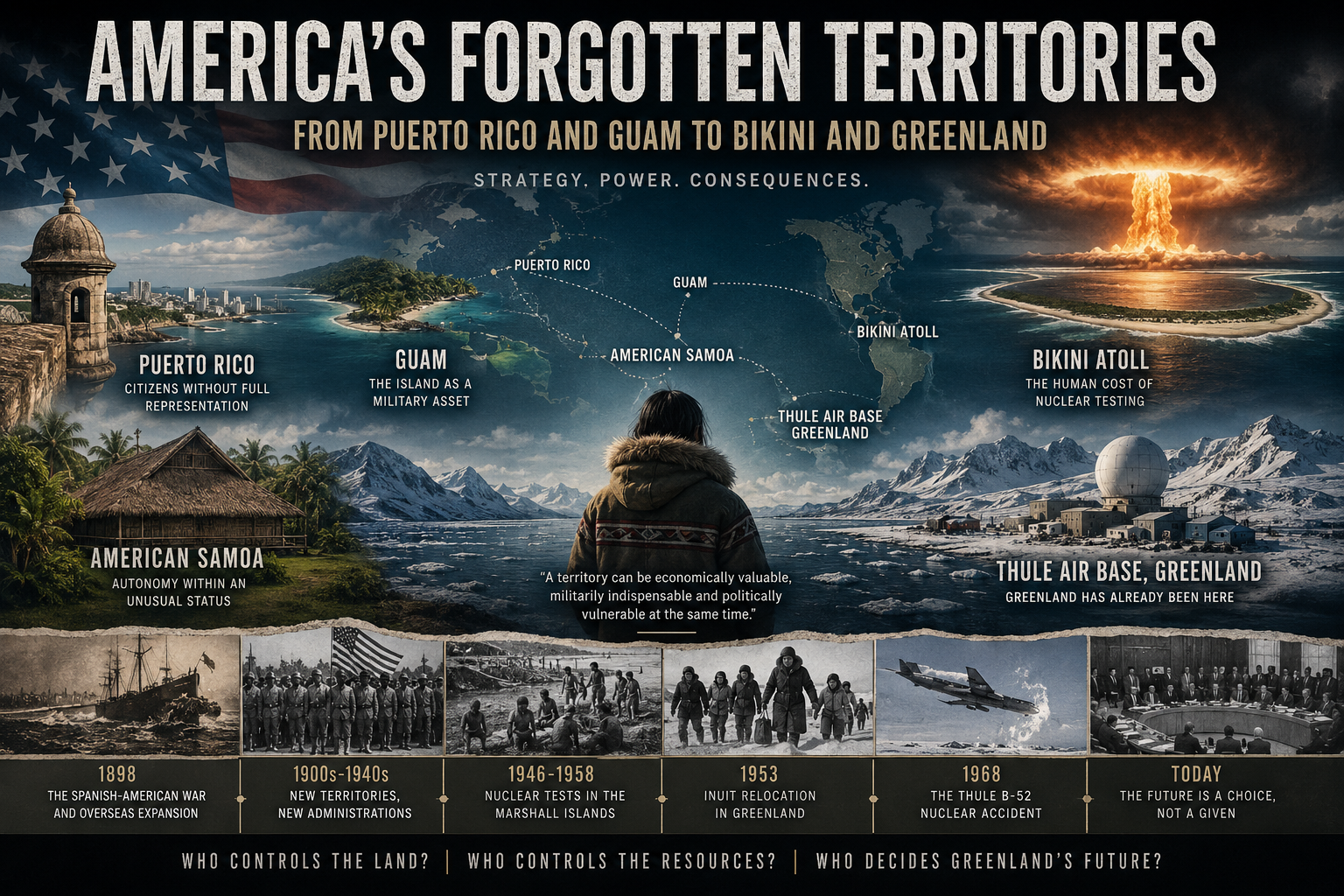
American sovereignty has brought security, investment and political institutions to some territories. It has also produced cases of political inequality, military land pressure, forced relocation and, in the Marshall Islands, an extraordinary nuclear legacy.
The Pacific experience demonstrates what can happen when strategic value overwhelms the political weight of a small population.
Puerto Rico demonstrates the ambiguity of citizenship without full statehood.
Guam demonstrates the tension between local interests and the requirements of a global military power.
American Samoa demonstrates that territorial arrangements can preserve substantial local institutions while remaining politically subordinate to Washington.
Bikini demonstrates the human cost that strategic decisions can impose on communities with limited power.
Thule demonstrates that Greenland itself has already experienced the logic of strategic necessity.
None of these cases tells us what America would do with Greenland in the future.
They tell us what Greenlanders would have every reason to ask.
Who controls the land?
Who controls the resources?
Who decides where military installations are built?
Who bears the environmental cost when strategic priorities change?
And ultimately:
Who decides Greenland’s future?
The answer to that final question may matter more than the question of which great power considers Greenland strategically valuable.
Because history offers a simple warning: a territory can be economically valuable, militarily indispensable and politically vulnerable at the same time.
Greenland may soon become one of the world’s most strategically important pieces of territory.
Its greatest challenge will be ensuring that it remains, above all, a homeland rather than merely a strategic asset.
You May Also Like