Introduction
For much of the twentieth century, Turkey occupied a unique position between Europe and the Middle East. Founded in the aftermath of the collapse of the Ottoman Empire, the Turkish Republic emerged under the leadership of Mustafa Kemal Atatürk as a secular, nationalist, and modernizing state. It was presented as proof that a predominantly Muslim society could embrace secular governance, Western institutions, and democratic development. Yet the Turkish political experiment always contained deep contradictions. The military repeatedly intervened in politics, nationalism often overshadowed pluralism, and democratic institutions remained fragile.
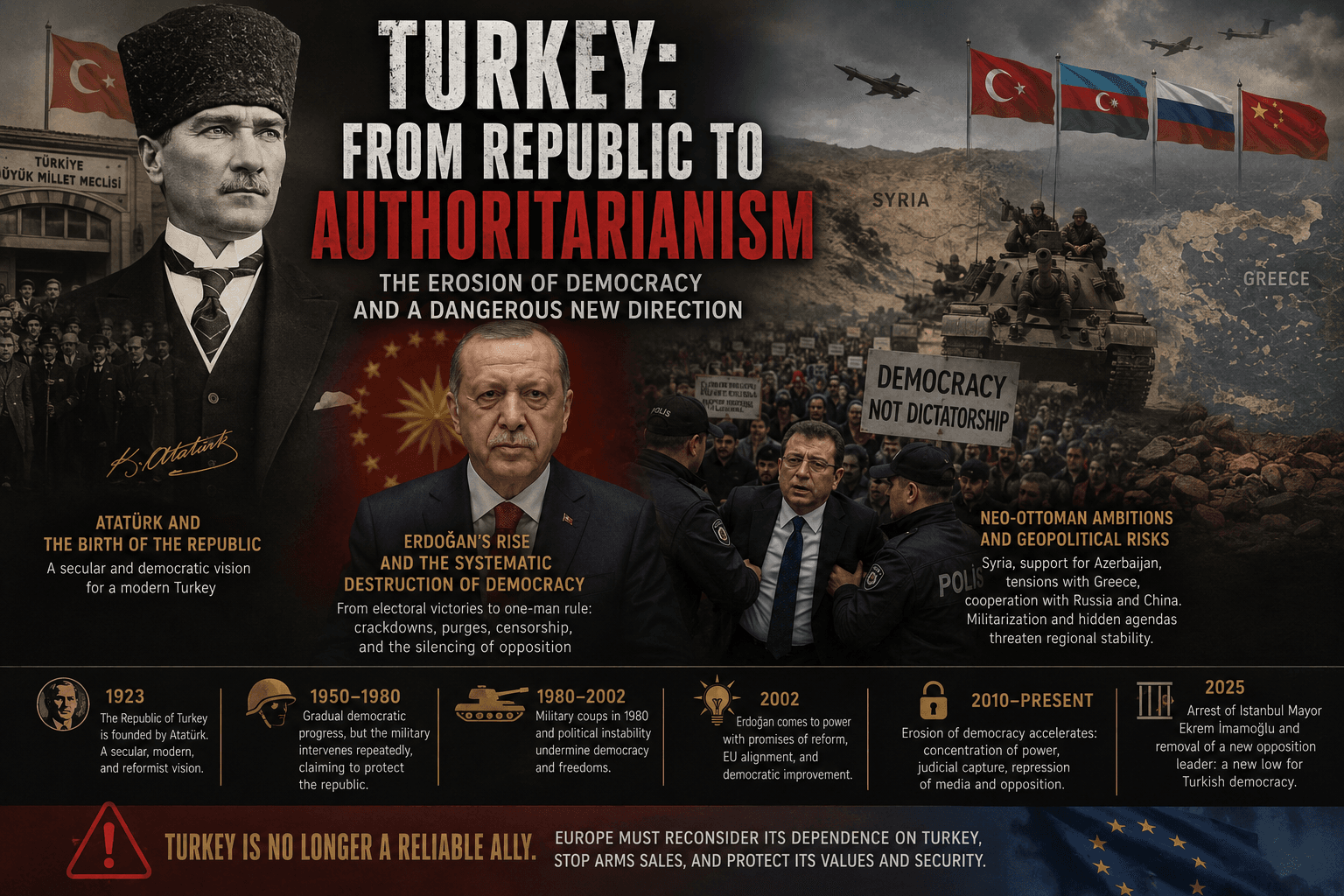
In the twenty‑first century, Turkey has entered a new and increasingly troubling phase. Under President Recep Tayyip Erdoğan and the Justice and Development Party (AKP), democratic institutions have steadily eroded. Political opposition faces mounting pressure, journalists are arrested, courts are accused of political subservience, and civil liberties have sharply deteriorated. At the same time, Turkey has pursued an increasingly assertive foreign policy marked by military intervention in Syria, tensions with Greece, support for Azerbaijan, and an ambitious regional agenda often described as “neo‑Ottomanism.”
This transformation raises important questions for Europe and the wider democratic world. Is Turkey still a functioning democracy, or has it become an electoral authoritarian state? Can a country that once aspired to join the European Union still be considered a reliable Western ally? And what are the implications of Turkey’s growing militarization and closer cooperation with Russia and China?
This article examines the historical roots of modern Turkey, the gradual erosion of secular democracy, Erdoğan’s rise to power, the systematic weakening of democratic institutions, and the geopolitical ambitions shaping Turkey’s increasingly confrontational role in international politics.
Stay ahead of global events.
Get clear geopolitical analysis in your inbox.
Atatürk and the Birth of the Turkish Republic
Modern Turkey was born from the ruins of the Ottoman Empire after the First World War. Defeated and partitioned by the victorious Allied powers, the Ottoman state seemed destined for dissolution. Mustafa Kemal Atatürk, a military officer and nationalist leader, organized resistance against foreign occupation and ultimately established the Republic of Turkey in 1923.
Atatürk’s revolution was radical. He abolished the Ottoman sultanate and later the Islamic caliphate, replacing centuries of imperial and religious authority with a secular republic. Inspired by European models of modernization, he introduced sweeping reforms intended to transform Turkish society into a modern nation‑state.
These reforms included:
- The adoption of the Latin alphabet.
- The secularization of education and the legal system.
- The granting of political rights to women.
- Restrictions on the political role of religion.
- The promotion of Turkish nationalism over Ottoman multicultural identity.
Atatürk envisioned Turkey as a sovereign, secular, and Western‑oriented state. His reforms profoundly reshaped the country and established the foundations of modern Turkish identity.
However, the republic was not democratic in the liberal sense. The early Turkish state functioned effectively as a one‑party system dominated by Atatürk’s Republican People’s Party (CHP). Political dissent was limited, opposition movements were suppressed, and the military became the guardian of Kemalist ideology.
Thus, the paradox at the heart of modern Turkey emerged early: secular modernization advanced, but democratic pluralism remained constrained.
The Slow Development of Turkish Democracy
After Atatürk’s death in 1938, Turkey gradually moved toward multiparty politics. In 1950, the Democratic Party won the country’s first genuinely competitive election, marking a historic peaceful transfer of power.
For several decades, Turkey experienced an uneven process of democratic development. Elections were held regularly, political parties competed for power, and civil society slowly expanded. Turkey also aligned itself firmly with the West during the Cold War, joining NATO in 1952.
Nevertheless, Turkish democracy remained unstable.
Several structural problems persisted:
- The military considered itself the ultimate protector of the republic.
- Political polarization was intense.
- Kurdish identity and minority rights were heavily restricted.
- Secular elites often distrusted religious conservatives.
- Nationalism overshadowed democratic tolerance.
Turkey’s democratic institutions were therefore never fully consolidated.
Military Coups and the Army’s Role in Politics
The Turkish military played a central role in shaping the republic. It viewed itself not merely as a defense institution but as the defender of Kemalism, secularism, and national unity.
This self‑appointed mission led to repeated military interventions.
The Coup of 1960
In 1960, the army overthrew Prime Minister Adnan Menderes, accusing his government of authoritarianism and threatening secularism. Menderes was later executed following a military trial.
The Memorandum Coup of 1971
In 1971, amid political instability and violence, the military forced the government to resign through what became known as a “memorandum coup.”
The Coup of 1980
The 1980 military coup represented one of the darkest moments in modern Turkish history. The army dissolved parliament, suspended political life, imprisoned thousands, and imposed a new constitution that strengthened the state at the expense of civil liberties.
The 1980 constitution increased the military’s institutional influence and weakened democratic safeguards.
The “Postmodern Coup” of 1997
In 1997, the military pressured the Islamist‑leaning government of Necmettin Erbakan to resign without deploying tanks in the streets. This intervention demonstrated that the army remained deeply suspicious of political Islam.
These repeated interventions damaged Turkish democracy profoundly. Although the military claimed to defend secularism and stability, it normalized the idea that elected governments could be removed by unelected institutions.
Ironically, the military’s dominance also created the conditions for Erdoğan’s later rise. Many conservative Turks came to see secular elites and the army as authoritarian forces hostile to religious citizens.
Erdoğan’s Rise to Power
Recep Tayyip Erdoğan emerged from the tradition of political Islam associated with Necmettin Erbakan. However, unlike earlier Islamist politicians, Erdoğan initially presented himself as a moderate conservative democrat.
In 2001, Erdoğan and his allies founded the Justice and Development Party (AKP). The party combined religious conservatism with promises of economic reform, democratic liberalization, and closer ties with Europe.
The AKP won a landslide victory in 2002.
At first, Erdoğan appeared to embody democratic renewal.
His government:
- Reduced military influence.
- Advanced negotiations with the European Union.
- Expanded economic growth.
- Increased infrastructure investment.
- Improved healthcare and public services.
- Opened limited discussions on Kurdish rights.
During Erdoğan’s first decade in power, many Western observers regarded Turkey as a model demonstrating compatibility between Islam and democracy.
Yet beneath the surface, a different political transformation was unfolding.
The Gradual Erosion of Democratic Institutions
As Erdoğan consolidated power, the AKP increasingly centralized authority.
Several developments accelerated democratic decline:
Control of the Judiciary
The government gradually expanded influence over courts and prosecutors. Judicial independence weakened as loyalists gained key positions.
Critics argued that corruption investigations and legal proceedings increasingly targeted political opponents while protecting government allies.
Pressure on the Media
Independent journalism came under growing pressure.
Turkey became one of the world’s leading jailers of journalists. Media outlets critical of the government faced:
- Heavy fines.
- Ownership takeovers.
- Advertising restrictions.
- Arrests of reporters.
- Criminal investigations.
Large sections of the Turkish media landscape eventually became aligned with the government.
Restrictions on Civil Society
Activists, academics, and NGOs increasingly faced surveillance and legal pressure.
Public criticism of the president became legally dangerous under laws criminalizing “insulting the president.”
Electoral Advantages
Although elections continued, opposition parties faced unequal conditions.
The government benefited from:
- Dominant media access.
- State resources.
- Judicial pressure against opponents.
- Restrictions on demonstrations.
- Political prosecutions.
Turkey gradually evolved into what many scholars describe as a competitive authoritarian system: elections still occurred, but the playing field was heavily tilted in favor of the ruling party.
The Gezi Park Protests and Authoritarian Consolidation
A major turning point occurred in 2013 during the Gezi Park protests.
Initially triggered by opposition to an urban redevelopment project in Istanbul, the protests rapidly evolved into a nationwide movement against Erdoğan’s increasingly authoritarian style.
Millions of Turks protested against:
- Police brutality.
- Restrictions on civil liberties.
- Government interference in personal lifestyles.
- Media censorship.
- Centralization of power.
The government responded with harsh repression.
Police used tear gas, water cannons, and mass arrests. Erdoğan portrayed protesters as foreign‑backed conspirators seeking to destabilize Turkey.
The Gezi protests marked the moment when Erdoğan increasingly abandoned the language of democratic reform and embraced a more openly confrontational and nationalist political strategy.
The 2016 Coup Attempt and the State of Emergency
On July 15, 2016, elements within the Turkish military attempted to overthrow Erdoğan’s government.
The coup failed after loyalist forces and civilians resisted.
The coup attempt traumatized Turkish society and gave Erdoğan an extraordinary opportunity to reshape the state.
The government blamed the movement of exiled cleric Fethullah Gülen for orchestrating the coup.
In the aftermath:
- Tens of thousands were arrested.
- More than 100,000 public employees were dismissed.
- Universities, media outlets, and NGOs were shut down.
- Judges, military officers, teachers, and journalists were purged.
A prolonged state of emergency allowed the government to rule by decree.
While the coup attempt was real and violent, critics argued that Erdoğan used the crisis to eliminate not only coup participants but also broader political opposition.
The failed coup accelerated Turkey’s transition toward a highly centralized presidential system.
The Presidential System and One‑Man Rule
In 2017, Turkey held a constitutional referendum narrowly approving a new presidential system.
The reform abolished the parliamentary system and concentrated executive authority in Erdoğan’s hands.
Under the new structure, the president gained sweeping powers over:
- The judiciary.
- Cabinet appointments.
- State institutions.
- Emergency decrees.
- Budgetary authority.
Critics described the new system as institutionalizing one‑man rule.
Checks and balances weakened dramatically.
The Turkish parliament lost significant influence, while the presidency became the dominant center of political power.
The Arrest of Ekrem İmamoğlu and the Pressure on the Opposition
One of the clearest signs of democratic backsliding in Turkey has been the growing pressure against opposition figures.
Ekrem İmamoğlu, the mayor of Istanbul and one of Erdoğan’s strongest political rivals, emerged as a major opposition leader after defeating the AKP in Istanbul’s mayoral election in 2019.
The government initially annulled the election results, forcing a rerun. İmamoğlu won again by an even larger margin.
His popularity transformed him into a potential future presidential challenger.
In 2025, Turkish authorities arrested İmamoğlu on corruption and terrorism‑related allegations, accusations that opposition figures and international observers widely viewed as politically motivated. His detention triggered mass protests and intensified concerns about the collapse of judicial independence in Turkey.
The crackdown extended beyond İmamoğlu himself. Opposition municipalities and CHP officials increasingly faced legal investigations, detentions, and political pressure.
In 2026, a Turkish court removed CHP leader Özgür Özel from party leadership and reinstated his predecessor Kemal Kılıçdaroğlu, a move widely criticized by opposition supporters as judicial interference in democratic party politics.
For many critics, these developments demonstrated a systematic attempt to weaken all credible electoral alternatives to Erdoğan.
The Kurdish Question and Democratic Limits
The Kurdish issue remains one of the deepest challenges facing Turkish democracy.
Kurds constitute a substantial minority within Turkey, yet Kurdish political expression has historically faced repression.
While Erdoğan initially pursued peace talks with Kurdish groups, relations later deteriorated sharply.
The collapse of the peace process led to:
- Renewed conflict.
- Arrests of Kurdish politicians.
- Removal of elected Kurdish mayors.
- Restrictions on pro‑Kurdish parties.
The Turkish state continues to frame many Kurdish political movements as linked to terrorism.
Critics argue that anti‑terror laws have often been used broadly to suppress dissent.
Militarization and the Rise of Turkish Hard Power
As democratic institutions weakened domestically, Turkey simultaneously expanded its military capabilities abroad.
The Turkish defense industry has grown rapidly under Erdoğan.
Turkey invested heavily in:
- Drone warfare.
- Domestic arms production.
- Naval expansion.
- Missile technology.
- Regional military operations.
Turkish Bayraktar drones gained international attention in conflicts ranging from Libya to Ukraine.
The government increasingly promoted military strength as a central element of national pride and geopolitical influence.
This militarization coincided with a more aggressive foreign policy.
Turkey’s Intervention in Syria
The Syrian Civil War became a major arena for Turkish geopolitical ambitions.
Turkey initially supported opposition forces seeking to overthrow Bashar al‑Assad.
Over time, Ankara launched direct military operations in northern Syria.
Turkey justified these operations primarily as necessary to prevent Kurdish militias linked to the PKK from establishing autonomous regions near the Turkish border.
However, critics argued that Turkey’s Syrian policy also reflected broader regional ambitions.
The intervention produced several consequences:
- Long‑term Turkish military presence in northern Syria.
- Tensions with the United States over Kurdish allies.
- Large refugee flows into Turkey.
- Greater Turkish regional influence.
The Syrian conflict also deepened Turkey’s complicated relationship with Russia.
Although Ankara and Moscow backed opposing sides in parts of the Syrian war, they simultaneously developed pragmatic cooperation.
Turkey, Azerbaijan, and Regional Nationalism
Turkey strongly supported Azerbaijan during the Nagorno‑Karabakh conflict with Armenia.
Ankara provided:
- Diplomatic backing.
- Military assistance.
- Drone technology.
- Strategic coordination.
The Azerbaijani victory significantly boosted Turkey’s prestige in the Turkic world.
For Erdoğan, support for Azerbaijan reinforced a broader vision of Turkey as the leading power among Turkic nations.
This policy combined nationalism, military strength, and historical symbolism.
Critics warned that such rhetoric increasingly reflected neo‑Ottoman and pan‑Turkic ambitions extending beyond traditional republican foreign policy.
Tensions with Greece and the Eastern Mediterranean
Turkey’s relationship with Greece has deteriorated repeatedly in recent years.
Disputes involve:
- Maritime boundaries.
- Energy exploration rights.
- Airspace violations.
- Cyprus.
- Military activity in the Aegean Sea.
Turkish officials have frequently used confrontational rhetoric toward Greece.
Military incidents and naval standoffs in the Eastern Mediterranean raised fears of escalation between two NATO members.
From a European perspective, these tensions are particularly alarming because they involve challenges to regional stability within Europe’s immediate neighborhood.
Critics argue that Erdoğan has often used nationalist foreign policy crises to strengthen domestic political support.
Neo‑Ottomanism and Erdoğan’s Ideological Vision
The term “neo‑Ottomanism” is often used to describe Turkey’s evolving geopolitical posture under Erdoğan.
While definitions vary, neo‑Ottomanism generally refers to efforts to expand Turkish influence across territories formerly connected to the Ottoman Empire.
This vision includes:
- Greater influence in the Balkans.
- Expanded presence in the Middle East.
- Cultural and religious diplomacy.
- Military projection.
- Appeals to Ottoman historical memory.
Supporters argue that Turkey is merely reclaiming regional influence appropriate for a major power.
Critics, however, warn that neo‑Ottomanism encourages expansionist thinking, nationalism, and authoritarian governance.
The transformation of Hagia Sophia from a museum back into a mosque symbolized this ideological shift.
For secular Turks, such moves represented a departure from Atatürk’s republican legacy.
Cooperation with Russia and China
Turkey remains formally a NATO member, yet its relations with Western allies have grown increasingly strained.
At the same time, Ankara has pursued closer cooperation with Russia and China.
Relations with Russia
Despite historical rivalry, Erdoğan and Vladimir Putin developed a pragmatic partnership.
Turkey purchased the Russian S‑400 missile defense system despite strong objections from NATO allies.
This decision triggered:
- U.S. sanctions.
- Turkey’s exclusion from the F‑35 fighter program.
- Increased distrust within NATO.
Turkey and Russia also cooperated in:
- Energy projects.
- Nuclear power development.
- Syrian diplomacy.
- Trade relations.
Although Ankara and Moscow remain competitors in several regions, Erdoğan demonstrated willingness to balance between East and West.
Relations with China
Turkey also expanded economic and diplomatic ties with China.
Chinese investment became increasingly important for Turkey’s struggling economy.
Ankara showed reduced willingness to criticize Beijing over the treatment of Uyghur Muslims despite historical cultural connections between Turks and Uyghurs.
For critics, this reflected Erdoğan’s prioritization of geopolitical and economic interests over democratic values or ideological consistency.
Europe’s Dilemma: Can Turkey Still Be Considered a Reliable Ally?
Turkey’s strategic importance remains undeniable.
The country controls access to the Black Sea through the Bosporus and Dardanelles, possesses NATO’s second‑largest military, and plays a key role in migration flows into Europe.
However, relations between Turkey and Europe have deteriorated substantially.
Major concerns include:
- Democratic backsliding.
- Human rights abuses.
- Aggressive regional policies.
- Tensions with Greece and Cyprus.
- Blackmail accusations involving refugee policy.
- Cooperation with Russia.
European leaders increasingly face a difficult dilemma.
On one hand, Turkey remains geopolitically indispensable.
On the other hand, many Europeans question whether Ankara still shares the democratic values expected of a genuine strategic partner.
Some critics argue that Europe should reduce dependence on Turkish defense cooperation and reconsider arms exports to Ankara.
These concerns intensified as Turkey expanded military operations abroad and adopted a more assertive nationalist posture.
Skeptics fear that Turkey’s long‑term strategic objectives may diverge fundamentally from European interests.
Is Turkey Still a Democracy?
Turkey still holds elections.
Opposition parties continue to exist.
Public debate remains vibrant in some sectors of society.
Yet democratic decline has become increasingly difficult to ignore.
Numerous international organizations and observers have documented:
- Judicial politicization.
- Media repression.
- Restrictions on protests.
- Arrests of opposition figures.
- Pressure on civil society.
- Concentration of executive power.
Many scholars now classify Turkey as a hybrid regime or competitive authoritarian system rather than a liberal democracy.
The erosion has not occurred suddenly.
Instead, it unfolded gradually through legal reforms, institutional capture, nationalist mobilization, and the weakening of checks and balances.
This gradual nature makes democratic backsliding particularly dangerous.
Institutions formally survive even as their independence disappears.
The Future of Turkey and the Regional Order
Turkey today stands at a crossroads.
It remains a powerful regional actor with enormous economic, military, and demographic potential.
At the same time, it faces serious internal and external challenges:
- Economic instability.
- Political polarization.
- Democratic erosion.
- Refugee pressures.
- Regional conflicts.
- Strategic tensions with the West.
The future direction of Turkey will profoundly affect Europe, the Middle East, the Caucasus, and the wider NATO alliance.
If democratic decline continues, Turkey may evolve further toward authoritarian nationalism combined with militarized regional ambitions.
Alternatively, future political change could restore stronger democratic institutions and revive Turkey’s earlier aspirations toward European integration.
Much will depend on the resilience of Turkish civil society, the opposition’s ability to remain united, and the willingness of Turkish voters to defend democratic norms.
Conclusion
The history of modern Turkey is a story of both remarkable transformation and deep contradiction.
Atatürk’s republic sought to create a secular and modern nation from the ruins of empire. Over time, Turkey achieved periods of democratic progress, economic modernization, and strategic importance within the Western alliance.
Yet democratic institutions were always fragile.
Military interventions repeatedly undermined civilian rule, while nationalism and political polarization limited democratic pluralism.
Under Recep Tayyip Erdoğan, Turkey has experienced an especially dramatic concentration of power. Judicial independence weakened, media freedom deteriorated, opposition figures faced increasing repression, and the political system became heavily centralized around presidential authority.
The arrests of opposition leaders such as Ekrem İmamoğlu, alongside judicial interventions affecting opposition parties, reinforced fears that Turkey’s democratic framework is being systematically dismantled.
At the same time, Turkey’s growing militarization, assertive regional policies, tensions with Greece, intervention in Syria, support for Azerbaijan, and expanding cooperation with Russia and China signal a broader geopolitical transformation.
The rise of neo‑Ottoman rhetoric and ambitions has raised concerns that Turkey increasingly views itself not as a democratic European partner but as an independent regional power pursuing its own strategic agenda.
For Europe, the challenge is profound.
Turkey remains too important to ignore, yet its democratic decline and increasingly confrontational foreign policy make trust increasingly difficult.
Whether Turkey ultimately returns to a more democratic path or continues toward deeper authoritarianism may become one of the defining geopolitical questions of the twenty‑first century.
You May Also Like
Soft Power vs Hard Power: What’s the Difference and Why It Matters
What Is Geopolitics? Meaning, Examples, and Why It Matters Today
Hybrid Warfare: A Misleading Label for an Enduring Reality
Naval Blockade: History and Strategic Utility