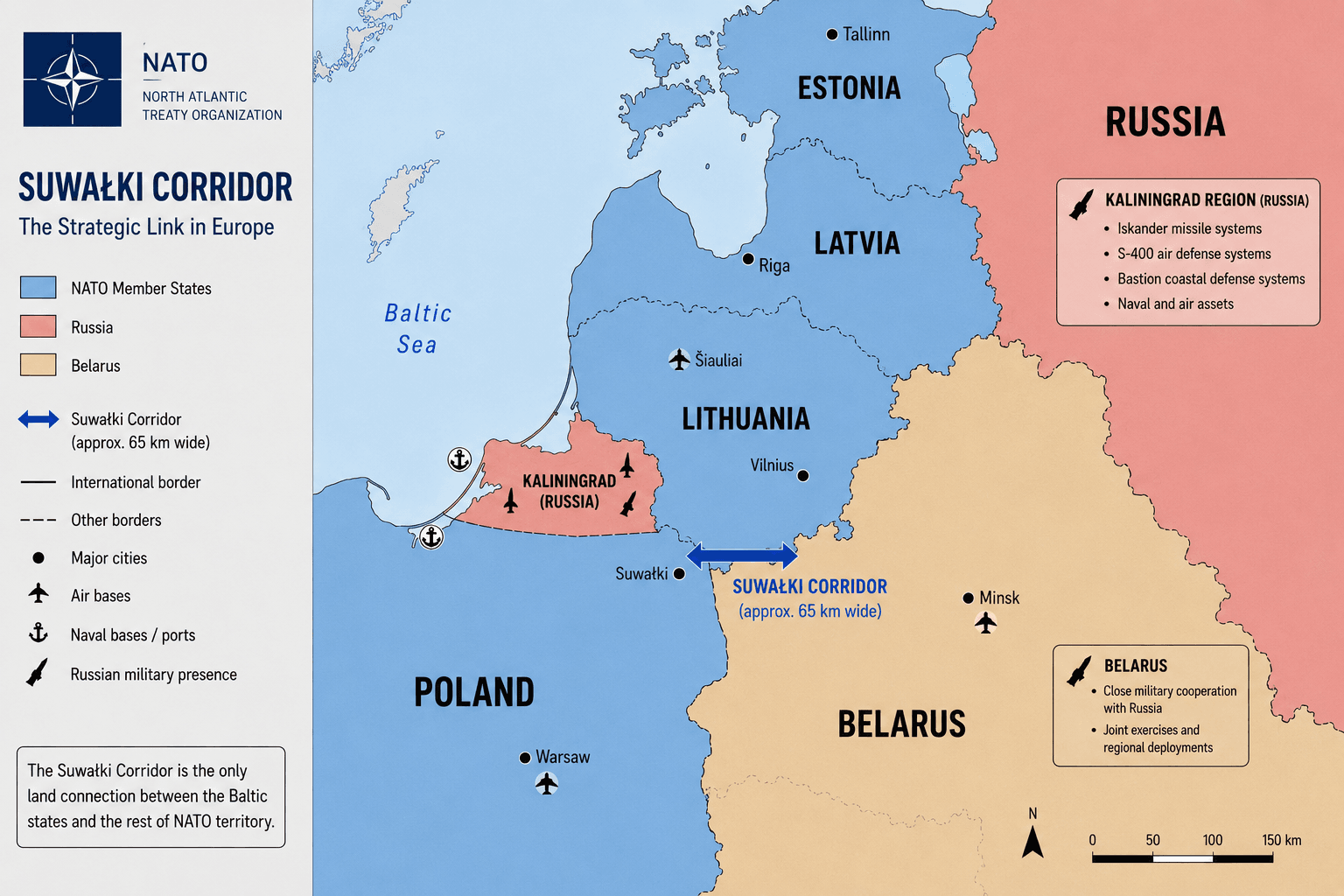
The Suwałki Corridor has become one of the most strategically important regions in Europe. Often described by military analysts as NATO’s most vulnerable geographic point on the alliance’s eastern flank, the corridor connects the Baltic states to the rest of NATO territory while separating Russia’s Kaliningrad exclave from Belarus. In recent years, rising tensions between NATO and Russia have transformed the Suwałki Corridor from a relatively obscure border region into a focal point of European security discussions.
What Is the Suwałki Corridor?
The Suwałki Corridor, sometimes referred to as the Suwałki Gap, is a narrow stretch of land approximately 65 kilometers wide located along the border between Poland and Lithuania. It lies between Russia’s heavily militarized Kaliningrad region to the west and Belarus to the east.
The corridor serves as the only direct land connection between the Baltic states — Lithuania, Latvia, and Estonia — and the rest of NATO territory. Because of this, military planners consider it a critical logistical and strategic route for reinforcement operations during a crisis or armed conflict.
The region takes its name from the Polish town of Suwałki, located in northeastern Poland near the Lithuanian border.
Stay ahead of global events.
Get clear geopolitical analysis in your inbox.
Why the Suwałki Corridor Is Important for NATO
The strategic significance of the Suwałki Corridor stems primarily from geography. If hostile forces were to gain control of the corridor, the Baltic states could potentially become isolated from NATO ground support coming from Central and Western Europe.
This vulnerability has been discussed extensively since Russia’s annexation of Crimea in 2014 and especially after the full-scale Russian invasion of Ukraine in 2022. NATO officials and defense analysts increasingly view the corridor as one of the alliance’s key deterrence challenges.
A Potential Bottleneck
The corridor is relatively narrow and surrounded by areas with strong Russian military influence. Kaliningrad hosts advanced Russian missile systems, air defenses, and naval assets, while Belarus has deep military cooperation with Moscow.
In a hypothetical conflict scenario, simultaneous pressure from Kaliningrad and Belarus could threaten NATO supply routes and troop movements through the area. Even temporary disruption could complicate reinforcement efforts for the Baltic region.
For this reason, NATO has significantly increased its military presence in Eastern Europe over the past decade.
NATO’s Response and Military Presence
Since 2016, NATO has expanded its forward presence in the Baltic states and Poland through multinational battlegroups and increased military exercises. The alliance has also invested in improving infrastructure, mobility, and interoperability among member states.
Large-scale exercises such as “Defender Europe” and “Steadfast Defender” have included scenarios involving rapid reinforcement of the Baltic region through the Suwałki Corridor. These exercises are designed to test logistics, coordination, and readiness in the event of a regional crisis.
NATO has emphasized that collective defense under Article 5 applies fully to the Baltic states, and alliance officials regularly stress the importance of deterrence and rapid deployment capabilities in the region.
Meanwhile, Poland has continued to expand its defense spending and military modernization programs, positioning itself as one of NATO’s leading military powers on the eastern flank.
The Role of Kaliningrad
Russia’s Kaliningrad exclave plays a central role in discussions surrounding the Suwałki Corridor. Located on the Baltic Sea between Poland and Lithuania, Kaliningrad hosts significant Russian military assets, including missile systems capable of reaching much of Central Europe.
Military analysts often refer to the region as an “anti-access/area denial” zone, meaning that advanced missile and air defense systems could complicate NATO air and naval operations during a conflict.
The presence of these capabilities increases the strategic sensitivity of the Suwałki Corridor and explains why NATO closely monitors military developments in both Kaliningrad and Belarus.
Geography and Infrastructure Challenges
The terrain of the Suwałki Corridor also presents operational difficulties. The area contains forests, lakes, and limited transportation routes, reducing the number of available paths for large-scale troop movements.
Infrastructure modernization has therefore become a priority. Poland and Lithuania have invested in roads, railways, and military mobility projects intended to improve rapid reinforcement capabilities. The European Union has also supported some infrastructure initiatives connected to military mobility and regional resilience.
Could the Suwałki Corridor Become a Flashpoint?
Although the Suwałki Corridor is frequently mentioned in geopolitical discussions, most analysts stress that NATO’s strengthened military presence serves primarily as a deterrent. The alliance’s objective is to prevent conflict rather than prepare for offensive operations.
At the same time, the corridor remains symbolically important because it highlights broader tensions between NATO and Russia. The region represents the intersection of geography, military strategy, and alliance credibility.
Security experts generally agree that maintaining stability in the Suwałki Corridor depends on strong deterrence, coordination among NATO members, and continued investment in defense infrastructure.
Conclusion
The Suwałki Corridor has evolved into one of Europe’s most strategically sensitive regions. Its importance lies not in its size, but in its geographic position connecting the Baltic states to the rest of NATO territory.
As tensions between Russia and NATO continue to shape European security policy, the corridor will likely remain a major focus for military planners and geopolitical analysts. For NATO, protecting the Suwałki Corridor is closely tied to the credibility of collective defense and the security of the alliance’s eastern members.
You May Also Like
The Virtues of the Paper Tiger: NATO in a Changing World
What Would a NATO Without the United States Look Like?
What Happens if Russia Wins the War in Ukraine?