Introduction
In discussions about global geopolitics, organizations such as NATO, the European Union, or BRICS often dominate headlines. Yet one of the world’s most important regional organizations operates with far less publicity. The Association of Southeast Asian Nations, better known as ASEAN, has quietly become a major economic and geopolitical actor in the Indo-Pacific region.
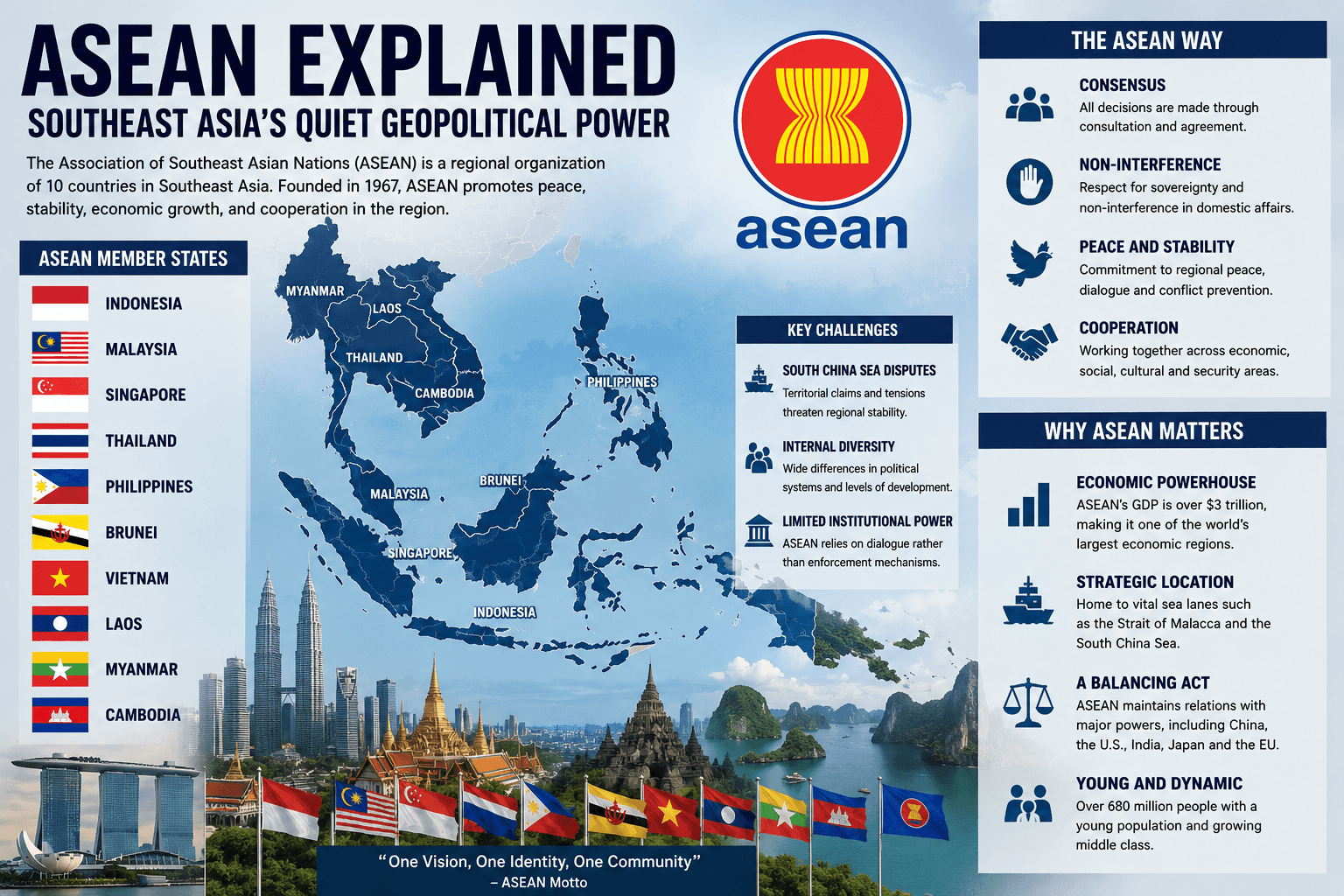
Founded during the Cold War, ASEAN has evolved from a small anti-communist regional grouping into a powerful diplomatic and economic organization representing more than 680 million people. Today, ASEAN sits at the center of some of the world’s most important geopolitical tensions, including the rivalry between the United States and China, disputes in the South China Sea, global supply chain competition, and the future of the Indo-Pacific.
Despite criticism regarding its slow decision-making and limited military coordination, ASEAN remains one of the most successful regional organizations outside Europe. Its influence continues to grow as Southeast Asia becomes increasingly important to the global economy.
Stay ahead of global events.
Get clear geopolitical analysis in your inbox.
What Is ASEAN?
ASEAN was officially established on August 8, 1967, through the Bangkok Declaration. The five founding members were Indonesia, Malaysia, the Philippines, Singapore, and Thailand. The organization later expanded to include Brunei, Vietnam, Laos, Myanmar, and Cambodia.
Today, ASEAN consists of ten member states:
- Indonesia
- Malaysia
- Singapore
- Thailand
- Philippines
- Brunei
- Vietnam
- Laos
- Myanmar
- Cambodia
The organization’s headquarters are located in Jakarta, Indonesia.
ASEAN was initially created to promote regional stability during a highly tense period of the Cold War. Southeast Asia faced communist insurgencies, political instability, and fears of foreign intervention. The Vietnam War further increased regional insecurity.
The founders hoped that closer cooperation would reduce conflict between neighboring states and strengthen economic development. Over time, ASEAN gradually expanded its goals beyond security and anti-communism toward trade, diplomacy, infrastructure, and regional integration.
ASEAN and the Cold War
The Cold War strongly shaped ASEAN’s early development. During the 1960s and 1970s, Southeast Asia became one of the main battlegrounds between communist and capitalist influence.
Several ASEAN states feared the spread of communism following the rise of communist governments in China, North Vietnam, and later Cambodia under the Khmer Rouge. Regional governments also worried about internal insurgencies supported by communist movements.
ASEAN therefore emerged partly as a defensive political framework aimed at preserving regional independence and limiting superpower interference. Unlike NATO, however, ASEAN was never designed as a military alliance. Instead, it emphasized diplomacy, consensus, and non-interference in domestic affairs.
This principle of non-interference became one of ASEAN’s defining characteristics. Member states agreed to avoid direct criticism of each other’s internal political systems. While this approach helped maintain unity among very different governments, it has also generated criticism, especially regarding human rights and democratic backsliding.
ASEAN’s Economic Rise
Although ASEAN began primarily as a political organization, economics eventually became its greatest success story.
Southeast Asia experienced rapid industrialization during the late twentieth century. Countries such as Singapore, Malaysia, Thailand, and later Vietnam transformed themselves into major manufacturing and export centers. Foreign investment flowed into the region due to relatively low labor costs, strategic geographic position, and expanding consumer markets.
Today, ASEAN represents one of the world’s largest economic blocs. Collectively, its economies generate more than 3 trillion dollars in GDP, making ASEAN one of the largest economic regions globally.
The organization has promoted economic integration through agreements such as the ASEAN Free Trade Area (AFTA), which reduced tariffs and encouraged regional trade. ASEAN also plays an important role in larger international trade frameworks, including the Regional Comprehensive Economic Partnership (RCEP), the world’s largest free trade agreement.
ASEAN’s economic importance continues to grow because Southeast Asia occupies a crucial position in global supply chains. Major industries include:
- electronics;
- semiconductors;
- shipping;
- automotive manufacturing;
- energy;
- palm oil production;
- tourism.
Many multinational companies increasingly view Southeast Asia as an alternative manufacturing base to China, particularly amid rising geopolitical tensions between Beijing and Washington.
ASEAN and China
One of ASEAN’s greatest geopolitical challenges involves managing relations with China.
China has become ASEAN’s largest trading partner and a major source of investment. Beijing’s Belt and Road Initiative has financed infrastructure projects throughout Southeast Asia, including railways, ports, and energy networks.
At the same time, China’s growing power creates serious security concerns for several ASEAN members, particularly regarding the South China Sea.
China claims large portions of the South China Sea through its controversial “Nine-Dash Line,” overlapping with the territorial claims of Vietnam, the Philippines, Malaysia, and Brunei. The region contains important shipping lanes, fishing grounds, and potentially large energy reserves.
Tensions periodically escalate due to military patrols, artificial island construction, and confrontations between coast guards and fishing vessels.
ASEAN has struggled to formulate a unified response because member states hold different positions regarding China. Some governments prioritize economic cooperation with Beijing, while others seek stronger security ties with the United States and its allies.
This internal division often limits ASEAN’s ability to act decisively on major geopolitical disputes.
ASEAN and the United States
The United States also views ASEAN as strategically important. Washington considers Southeast Asia a key region in maintaining balance within the Indo-Pacific.
American administrations have strengthened diplomatic, military, and economic engagement with ASEAN countries in recent years. The United States conducts military exercises with several regional partners and supports freedom of navigation operations in the South China Sea.
For ASEAN members, the United States serves as an important counterbalance to China’s growing influence. However, most Southeast Asian governments prefer not to choose sides openly between the two superpowers.
Instead, ASEAN generally pursues a strategy of strategic balancing. Regional states attempt to maintain economic relations with China while simultaneously preserving security cooperation with the United States and other partners such as Japan, India, and Australia.
This diplomatic flexibility has become one of ASEAN’s key survival strategies in an increasingly polarized international environment.
The ASEAN Way: Consensus and Non-Interference
ASEAN operates according to a distinctive diplomatic culture often called the “ASEAN Way.”
This approach emphasizes:
- consensus-based decision-making;
- gradual diplomacy;
- non-confrontation;
- respect for sovereignty;
- non-interference in domestic affairs.
Unlike the European Union, ASEAN does not seek deep political integration or supranational authority. Decisions are typically made slowly because all member states must broadly agree before major actions are adopted.
Supporters argue that this flexible model has helped maintain peace in a highly diverse region containing monarchies, communist states, democracies, and military regimes.
Critics, however, claim that ASEAN’s consensus system often produces weak responses during crises.
The Myanmar crisis illustrates this limitation clearly. After the 2021 military coup in Myanmar, ASEAN struggled to pressure the junta effectively despite widespread violence and international criticism. Internal disagreements prevented stronger collective action.
This situation raised broader questions about whether ASEAN can remain relevant in an era of intensifying geopolitical competition and regional instability.
ASEAN’s Contemporary Relevance
Despite its weaknesses, ASEAN remains extremely important in global politics.
First, Southeast Asia occupies one of the world’s most strategically valuable locations. Major maritime trade routes pass through the region, including the Strait of Malacca, one of the busiest shipping corridors on Earth.
Second, ASEAN represents a rapidly growing consumer market with a young population and expanding middle class. This makes the region economically attractive to global investors and multinational corporations.
Third, ASEAN has become central to the geopolitical architecture of the Indo-Pacific. Major powers including China, the United States, Japan, India, and Australia all compete for influence in Southeast Asia.
ASEAN-led forums such as the East Asia Summit and the ASEAN Regional Forum provide important diplomatic platforms where rival powers can engage in dialogue.
In many ways, ASEAN’s greatest strength lies precisely in its neutrality. Unlike military alliances or ideological blocs, ASEAN attempts to maintain open relations with multiple competing powers simultaneously.
Conclusion
ASEAN may not dominate global headlines in the same way as NATO, the European Union, or BRICS, but its geopolitical importance continues to increase.
From its origins as a Cold War regional grouping, ASEAN has evolved into one of the world’s most influential economic and diplomatic organizations. It has helped maintain relative stability in a highly diverse and historically fragmented region while supporting remarkable economic growth across Southeast Asia.
Yet ASEAN also faces major challenges. Rivalries between China and the United States, disputes in the South China Sea, democratic backsliding, and internal divisions all test the organization’s unity and effectiveness.
The future of ASEAN will likely depend on its ability to balance economic integration with political cohesion while navigating intensifying great-power competition in the Indo-Pacific.
Even so, ASEAN’s quiet diplomacy and flexible regionalism have already achieved something remarkable: transforming Southeast Asia from a region once associated with war and instability into one of the most dynamic centers of global economic and geopolitical activity.
You May Also Like
OPEC’s Rise and Decline: How the Oil Cartel Shaped the Modern World
BRICS: What It Is and What It Wants to Become
Soft Power vs Hard Power: What’s the Difference and Why It Matters
What Is Geopolitics? Meaning, Examples, and Why It Matters Today
The Thucydides Trap Is a Myth: What Athens, Sparta, and History Actually Reveal