Introduction
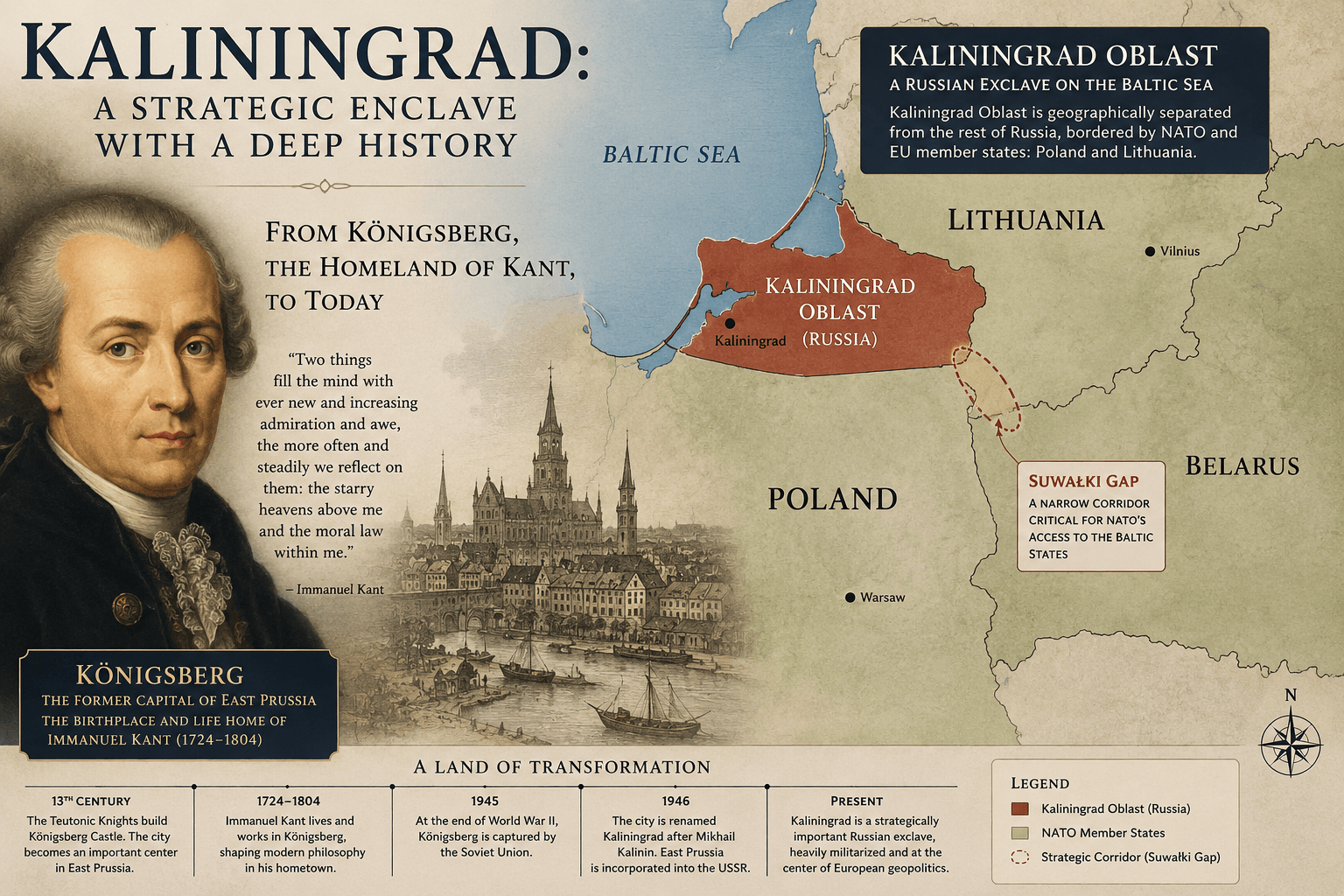
Kaliningrad is one of the most strategically important and politically sensitive territories in Europe. Located on the Baltic Sea between Poland and Lithuania, the Russian exclave is geographically separated from mainland Russia, yet it plays a central role in European security, NATO planning, and Russian military strategy. Despite its relatively small size, Kaliningrad has become a focal point in discussions about deterrence, military balance in the Baltic region, and the future of East-West relations.
The territory also possesses a long and complex historical identity. Before becoming Soviet and later Russian territory, Kaliningrad was known as Königsberg, a major city of East Prussia and one of the intellectual and cultural centers of the German-speaking world. The philosopher Immanuel Kant spent his entire life in Königsberg, making the city one of the most famous locations in European intellectual history.
Today, Kaliningrad represents a unique combination of historical transformation, geopolitical competition, and military significance.
Stay ahead of global events.
Get clear geopolitical analysis in your inbox.
From Königsberg to Kaliningrad
The origins of modern Kaliningrad are deeply connected to the history of the Teutonic Knights and the rise of Prussia. Königsberg was founded in the 13th century and gradually became one of the most important cities in the Baltic region. Over centuries, it evolved into a center of trade, administration, and learning.
By the 18th and 19th centuries, Königsberg had become a major city of Prussia and later the German Unification German Empire. The city was known for its universities, military traditions, and maritime connections. Most importantly, it became forever associated with Immanuel Kant, whose philosophical works transformed modern European thought. Kant’s tomb still remains one of the most recognizable historical landmarks in present-day Kaliningrad.
The city suffered enormous destruction during the final stages of World War II. British bombing raids in 1944 heavily damaged Königsberg, while Soviet forces captured the city in 1945 after intense fighting. Under the decisions made at the Potsdam Conference, northern East Prussia was transferred to the Soviet Union.
The German population was largely expelled after the war, while Soviet citizens from different parts of the USSR settled in the region. Königsberg was renamed Kaliningrad in 1946 after Soviet politician Mikhail Kalinin. This marked a complete political and demographic transformation of the territory.
Under Soviet rule, Kaliningrad became a closed military zone with limited access for foreigners. The region’s strategic importance increased significantly during the Cold War because of its position on the Baltic Sea and its proximity to NATO member states.
Why Kaliningrad Matters Strategically
Kaliningrad’s geopolitical importance comes primarily from geography. The exclave gives Russia direct access to the Baltic Sea without relying on the Gulf of Finland or routes near Saint Petersburg. This allows Moscow to maintain a permanent naval presence in the region through the Baltic Fleet.
The territory has also become heavily militarized. Russia has deployed advanced missile systems, air-defense networks, and military infrastructure in Kaliningrad. Western analysts frequently describe the region as an Anti-Access/Area Denial (A2/AD) zone designed to complicate NATO military operations in the Baltic region.
Particular attention is often given to Russian Iskander missile systems stationed in the exclave. Their range potentially allows coverage of large parts of Central and Eastern Europe. Kaliningrad therefore serves not only as a defensive outpost but also as a strategic pressure point in the broader NATO-Russia relationship.
The region is especially significant because of the so-called Suwałki Gap, a narrow corridor between Poland and Lithuania connecting the Baltic states to the rest of NATO territory. In military planning, this corridor is viewed as one of the alliance’s most vulnerable areas. Kaliningrad lies directly adjacent to this zone, increasing its importance during any discussion about European security or potential regional conflict.
Kaliningrad and NATO
Since the enlargement of NATO after the Cold War, Kaliningrad has become increasingly surrounded by alliance territory. Poland and Lithuania both joined NATO in 1999 and 2004 respectively, transforming the exclave into a geographically isolated Russian military position inside the broader Euro-Atlantic sphere.
The deterioration of relations between Russia and the West after 2014 further increased Kaliningrad’s strategic profile. Military exercises, sanctions, air patrols, and naval activities in the Baltic region intensified considerably. Following the Russian invasion of Ukraine in 2022, attention toward Kaliningrad expanded even further.
For NATO planners, the exclave represents both a challenge and a potential source of instability. For Russia, however, Kaliningrad serves as an essential forward position that demonstrates Moscow’s ability to project power into the Baltic region and maintain influence near NATO’s eastern flank.
Despite recurring tensions, the existence of Kaliningrad also creates a degree of strategic caution on all sides. Its location means that any major confrontation in the Baltic region could escalate rapidly, making deterrence and crisis management particularly important.
Historical Identity and Modern Reality
Although Kaliningrad is firmly integrated into the Russian Federation today, traces of its German and Prussian past remain visible. Kant’s legacy continues to attract international attention, while remnants of Königsberg’s architecture still survive despite wartime destruction and Soviet reconstruction.
The region occupies a unique place in European history because it symbolizes several major transformations of the 20th century: the collapse of Nazi Germany, Soviet expansion, Cold War militarization, and the post-Soviet geopolitical order.
At the same time, Kaliningrad demonstrates how geography can shape international politics long after historical borders disappear. The territory’s importance today is not only historical but also strategic, economic, and military.
Conclusion
Kaliningrad is far more than a remote Russian exclave on the Baltic Sea. It is a territory where history, military strategy, and geopolitics intersect. Once known as Königsberg, the city of Immanuel Kant and a center of East Prussia, the region was fundamentally transformed by the outcome of World War II and Soviet expansion into Eastern Europe.
Today, Kaliningrad remains one of the most important strategic locations in Europe. Its military role, proximity to NATO territory, and symbolic significance in Russia-West relations ensure that it will continue to occupy a central place in discussions about European security and Baltic geopolitics for years to come.
You May Also Like
BRICS: What It Is and What It Wants to Become
Soft Power vs Hard Power: What’s the Difference and Why It Matters
What Is Geopolitics? Meaning, Examples, and Why It Matters Today
Geography Does Not Disappear: How Maps Still Shape Global Politics
What Would a NATO Without the United States Look Like?