Power in international relations is not exercised through a single instrument but through a spectrum of capabilities that range from coercion to attraction. The distinction between soft power and hard power captures this spectrum and provides a framework for understanding how states influence outcomes beyond their borders. While hard power relies on military force and economic pressure to compel behavior, soft power operates through persuasion, legitimacy, and cultural appeal. The interaction between the two shapes global order, determines strategic success, and increasingly defines how major actors project influence in a complex, interconnected world.
The concept of soft power is most closely associated with Joseph Nye, who argued that states can achieve desired outcomes not only by forcing others to act but by making them want to act in alignment with their interests. This idea did not replace traditional power; rather, it expanded the analytical toolkit of international relations by recognizing that attraction can be as consequential as coercion. In practice, the effectiveness of any state’s strategy depends on how it calibrates both forms of power in response to specific geopolitical conditions.
Stay ahead of global events.
Get clear geopolitical analysis in your inbox.
What Is Soft Power?
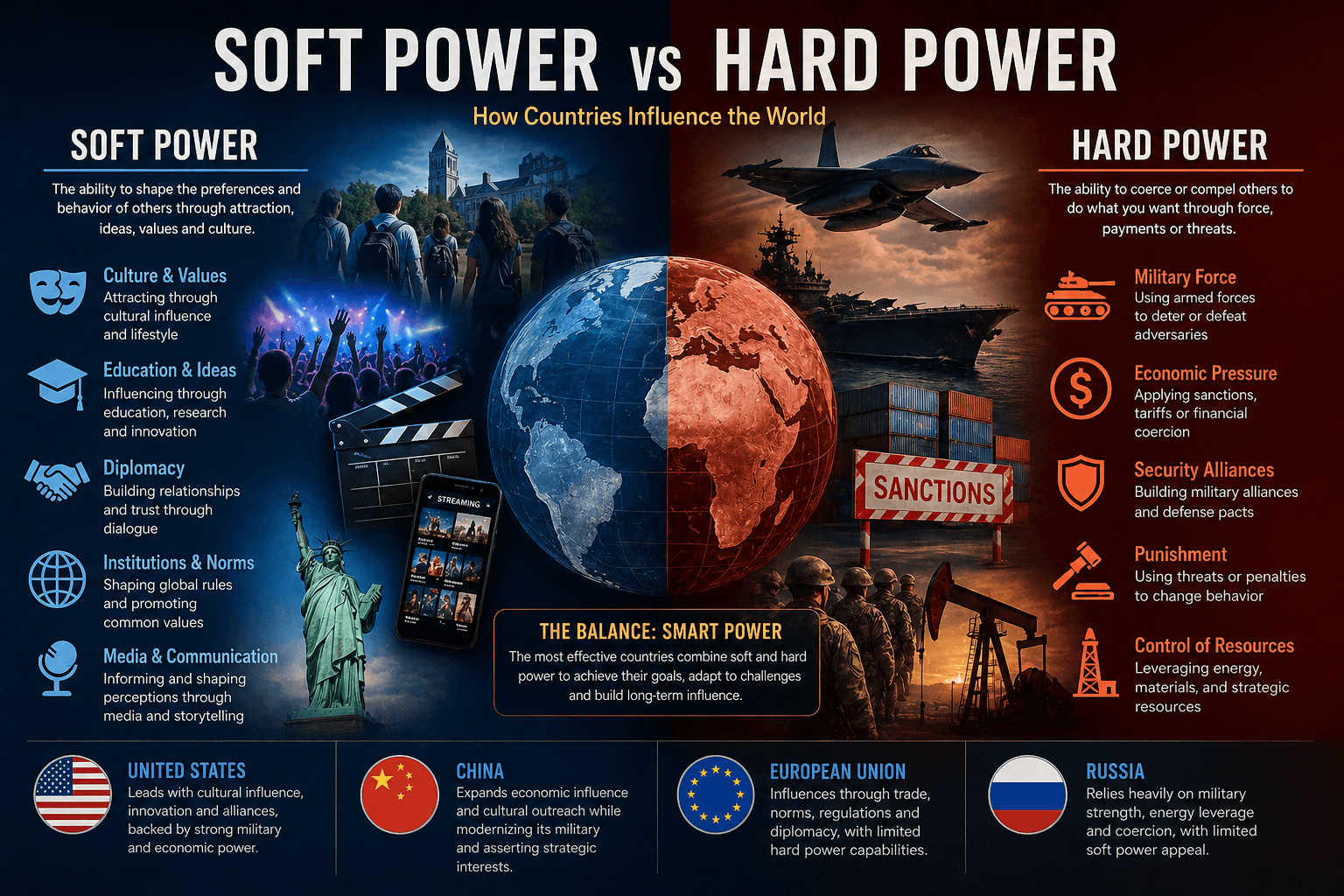
Soft power refers to the ability of a country to shape the preferences and behavior of other actors through appeal and legitimacy rather than force. It is rooted in three primary sources: culture, political values, and foreign policy credibility. When a state’s culture is widely admired, when its political system is perceived as legitimate, and when its external actions are seen as consistent and principled, it generates influence without overt pressure.
Unlike hard power, soft power is indirect and often long-term in its effects. It operates through media, education, diplomacy, and global institutions, gradually shaping perceptions and aligning interests. Universities, cultural exports, international broadcasting, and participation in multilateral frameworks all contribute to a state’s soft power profile. Importantly, soft power cannot be deployed instantaneously; it must be cultivated over time and sustained through consistency between rhetoric and action.
What Is Hard Power?
Hard power is the capacity to coerce or compel other actors through tangible means, primarily military force and economic instruments. It is the most visible and immediate form of power in international relations, often employed in situations where vital interests are perceived to be at stake or where rapid outcomes are required.
Military interventions, defense posturing, economic sanctions, and trade restrictions all fall within the domain of hard power. Unlike soft power, which depends on perception, hard power produces direct and measurable effects. However, its use carries significant costs—financial, political, and reputational—and can generate resistance or long-term instability if not carefully managed.
The persistence of hard power reflects a fundamental reality: despite globalization and interdependence, the international system remains anarchic, and states retain the capacity to use force to secure their interests.
Soft Power vs Hard Power: Key Differences
The distinction between soft and hard power is not merely theoretical; it reflects different mechanisms of influence, time horizons, and strategic outcomes.
Soft power is based on attraction, while hard power relies on coercion. Soft power seeks to align interests by shaping preferences, whereas hard power imposes outcomes through pressure or force. In terms of temporal dynamics, soft power tends to produce gradual, durable influence, while hard power generates immediate but often short-lived results. Cost structures also differ: soft power is generally less resource-intensive in the short term but requires sustained investment, whereas hard power demands significant financial and operational resources upfront.
Crucially, these forms of power are not mutually exclusive. Most states employ a combination of both, adjusting their balance depending on context. This combination is often referred to as “smart power,” a strategic synthesis that seeks to maximize effectiveness while minimizing costs and unintended consequences.
Real-World Applications: United States, China, European Union, and Russia
United States: Hybrid Influence Through Culture and Force
The United States represents one of the most comprehensive examples of combined soft and hard power. Its hard power capabilities are unmatched in scale, with a global network of military bases, advanced technological systems, and significant defense spending. This enables rapid power projection and deterrence across multiple regions.
Simultaneously, the United States possesses extensive soft power assets. Its cultural industries—film, music, technology—have global reach, while its universities attract international students and elites. The appeal of democratic governance and individual freedoms further enhances its influence, although this dimension fluctuates depending on domestic and foreign policy consistency.
The interaction between these elements defines U.S. global strategy. Military alliances, such as NATO, combine security guarantees with shared values, illustrating how soft and hard power reinforce each other. However, when military interventions are perceived as inconsistent with stated principles, soft power can erode, reducing long-term influence.
China: Expanding Soft Power Under Strategic Constraints
China’s rise has been accompanied by a deliberate effort to expand its soft power while maintaining substantial hard power capabilities. Economically, China leverages infrastructure investment, trade networks, and development financing to build influence, particularly across Asia, Africa, and parts of Europe. These initiatives function as both economic tools and geopolitical instruments, creating dependency and alignment without direct coercion.
Culturally, China promotes its language, heritage, and media presence through global institutions and exchanges. However, its soft power faces structural limitations due to concerns about political transparency, governance, and foreign policy assertiveness.
In parallel, China continues to strengthen its military capabilities and assert territorial claims, particularly in strategically important regions such as the South China Sea. This dual approach reflects a broader strategy: expand influence through attraction where possible, but rely on hard power to secure core interests.
European Union: Soft Power as a Primary Instrument
The European Union represents a distinctive model in which soft power constitutes the primary mode of influence. Lacking a unified military structure comparable to traditional great powers, the EU relies on regulatory standards, economic integration, and normative appeal to shape international behavior.
Its influence is often described as “normative power,” reflecting its ability to set standards in areas such as trade, environmental policy, and human rights. Countries seeking access to European markets or membership in EU structures frequently adopt these standards, demonstrating the indirect yet significant impact of soft power.
However, the EU’s limited hard power capabilities can constrain its effectiveness in high-intensity geopolitical environments, where military deterrence or rapid response is required. This creates a structural imbalance that the Union continues to address through evolving security and defense initiatives.
Russia: Predominance of Hard Power
Russia’s approach to international influence is more heavily weighted toward hard power, reflecting both strategic priorities and structural constraints. Military capability remains central to its global posture, enabling intervention and influence in neighboring regions and beyond.
The Russian invasion of Ukraine illustrates the application of hard power in pursuit of strategic objectives tied to geography, security, and regional influence. While effective in producing immediate territorial and military outcomes, such actions often incur significant economic costs and reduce soft power by affecting international perceptions.
Russia does engage in soft power efforts, including media outreach and cultural diplomacy, but these are generally secondary to its reliance on coercive instruments. This imbalance shapes both its strengths and its limitations within the global system.
Why the Balance Between Soft and Hard Power Matters
The effectiveness of a state’s foreign policy increasingly depends on its ability to balance soft and hard power rather than relying exclusively on one. Overreliance on hard power can generate resistance, alliances against the actor, and long-term instability. Conversely, exclusive reliance on soft power may prove insufficient in situations requiring deterrence or rapid response.
In a global environment characterized by interdependence, information flows, and complex networks of influence, soft power has gained importance. Public perception, legitimacy, and credibility now play a larger role in shaping outcomes than in previous eras. However, the continued relevance of military and economic coercion ensures that hard power remains indispensable.
The Emergence of Smart Power
The concept of smart power integrates soft and hard power into a coherent strategy. Rather than treating them as separate tools, smart power emphasizes their complementary nature. Effective states deploy hard power to secure immediate objectives and soft power to consolidate and legitimize those outcomes over time.
This approach recognizes that influence is multidimensional. Military strength without legitimacy can provoke resistance, while attractiveness without capability may lack credibility. The most successful strategies align both dimensions, ensuring that actions are both effective and sustainable.
Conclusion
The distinction between soft power and hard power provides a foundational lens for analyzing international relations. It reveals that influence is not solely a function of force but also of perception, legitimacy, and long-term engagement. States that understand and effectively combine these dimensions are better positioned to navigate the complexities of the modern international system.
In practice, no major actor relies exclusively on one form of power. The United States integrates both extensively, China blends economic attraction with strategic assertiveness, the European Union emphasizes normative influence, and Russia prioritizes coercive capabilities. These variations illustrate that geopolitics is not defined by a single model but by the strategic choices states make within the constraints of their geography, resources, and political systems.
Understanding soft power and hard power, therefore, is not merely an academic exercise—it is essential for interpreting how influence is constructed, contested, and transformed in the contemporary world.
You May Also Like
What Is Geopolitics? Meaning, Examples, and Why It Matters Today
Hybrid Warfare: A Misleading Label for an Enduring Reality