The North Korean Issue on the International Agenda
We may safely say that the North Korean nuclear issue has returned to the forefront of the international agenda in the context of the second term of Donald Trump. The reemergence of this challenge highlights the persistence of a problem that has preoccupied successive White House administrations for decades. The renewed emphasis on demonstrating U.S. military superiority and applying coercive pressure reflects a continuity in strategic thinking. However, past experience suggests that such an approach is unlikely to produce decisive results, while economic sanctions have repeatedly failed to alter North Korea’s strategic calculus. In light of these realities, a fundamental question remains: can the North Korean nuclear crisis be resolved in the way the United States intends?
The Logic of Dictatorial Regimes
Before speculating on the evolution of the North Korean nuclear crisis, we should briefly examine the reasons that have produced it. The main purpose of a dictatorial regime is to maintain its power despite any internal or external opposition. This is also the case of Kim Jong Un, who should not be regarded as an eccentric character or as an individual who belongs in the hands of psychiatrists, but as a totalitarian dictator who does everything in his power to prolong the life of his regime.
His behavior may seem irrational to us, but it fits perfectly within the logic of dictatorship. A dictatorial regime is based on force, and the Pyongyang leader operates on two fronts—against his own people and against the United States and its allies—in order to strengthen his image as the leader of an impregnable regime. Viewed from the perspective of survival, his actions are not irrational but highly rational. He pursues, step by step, the preservation of his authority over North Korea and is willing to do anything necessary to achieve this vital objective.
Stay ahead of global events.
Get clear geopolitical analysis in your inbox.
Deterrence and Strategic Rationality
We must clearly understand that Kim Jong Un is not planning to launch a nuclear attack. He will not be the first to strike because he has no interest in doing so. The North Korean leader knows that if he attacks first, this will lead to the end of his regime.
It is beyond doubt that the United States has the military capability to defeat North Korea rapidly and completely. However, the less visible issue is this: how can North Korea be defeated without it attacking South Korea, Japan, or the United States? If a single North Korean nuclear missile reaches any of these countries, the consequences would be far greater than those of Hiroshima or Nagasaki in 1945.
In fact, Kim Jong Un’s goal is to demonstrate that, in the case of a preventive attack, the United States would lose far more than it would gain—resulting in a Pyrrhic victory. He does not imagine that he could win a war against America; he seeks only to prove that such a war would be a futile enterprise.
Escalation and Historical Lessons
That being said, we must identify a way out of the spiral of political and military escalation between the United States and North Korea. As during the Cold War, tensions accumulate and the risk of war remains high. However, it must be emphasized once again that the North Korean state does not seek war; its nuclear arsenal has been developed to prevent a war it cannot win.
The leadership in Pyongyang has drawn lessons from recent history. The fate of dictators such as Saddam Hussein and Muammar Gaddafi demonstrates that their downfall was due, in part, to the absence of solid security guarantees. This lesson was also understood by Iran, although it ultimately proved unable to resist economic pressure and agreed to limit its nuclear program.
North Korea, on the other hand, can withstand economic sanctions with relative ease because the regime shows little concern for its population. Economic sanctions primarily affect the people, not the leadership. No matter how severe these sanctions may be, they are unlikely to convince Kim Jong Un to give up his nuclear arsenal.
Sanctions and Geopolitical Constraints
On December 22, 2017, the UN Security Council adopted new economic sanctions against North Korea. Although these measures were among the most comprehensive imposed on Pyongyang, they have not fundamentally altered the regime’s trajectory. In the years that followed, no significant new UN sanctions were adopted, largely due to divisions among major powers such as the United States, China, and Russia.
At the same time, the United States and its allies have expanded unilateral sanctions, targeting North Korea’s financial networks, illicit trade, and cyber activities. Nevertheless, these measures continue to affect primarily the North Korean population, while the leadership and its inner circle remain largely insulated from their impact.
Moreover, illicit networks involving actors from China and Russia continue to provide North Korea with the materials necessary to develop its ballistic program. The authorities of these states have little interest in completely suppressing such activities.
China and Russia have no interest in supporting the collapse of North Korea. Although they formally support UN decisions, their strategic interests differ significantly from those of the United States. The disappearance of North Korea would likely lead to the reunification of the Korean Peninsula under South Korea.
In the long term, this would result in a strong state on China’s borders, closely aligned with the United States. For China, this scenario is far more concerning than the behavior of the North Korean regime itself. Therefore, it is unrealistic to expect Beijing to act against its own interests.
The Military Option
The second option would be military. The United States, together with South Korea, could attack Kim Jong Un’s regime. The victory would likely be swift and predictable, but it would also be unnecessary and potentially catastrophic.
The success of such an operation would depend on ensuring that no North Korean nuclear missile reaches its target. However, this cannot be guaranteed. Missile defense systems are not infallible, and even a limited failure would have devastating consequences.
Over time, North Korea’s missile capabilities are expected to improve, further reducing the feasibility of a preventive attack. Therefore, the idea of a military solution becomes increasingly unrealistic, despite occasional bellicose rhetoric.
Security Guarantees and Their Limits
A third option would involve offering North Korea strong security guarantees in exchange for denuclearization. However, such guarantees lack credibility. From Pyongyang’s perspective, they cannot ensure regime survival.
The example of the Budapest Memorandum is particularly relevant. Ukraine relinquished its nuclear arsenal in exchange for guarantees of territorial integrity, yet these guarantees proved ineffective when confronted with geopolitical realities.
Consequently, it is extremely difficult to provide security guarantees strong enough to persuade North Korea to abandon its nuclear arsenal.
Chinese guarantees might appear more credible, but they would transform North Korea into a dependent satellite of Beijing. This is an outcome that Kim Jong Un is unlikely to accept, as it would significantly limit his autonomy.
A Prolonged Strategic Stalemate
From the above considerations, it becomes clear that economic sanctions, military intervention, and security guarantees cannot resolve the crisis in the Korean Peninsula. This suggests that there is no rapid solution and that the situation may resemble the prolonged strategic competition of the Cold War.
At the same time, the North Korean regime may become even more dangerous. It could evolve into a supplier of nuclear weapons or technology to other states. Such a development would significantly increase the risks of proliferation and global instability.
Russia–North Korea Alignment: A New Strategic Variable
In recent years, the deepening alignment between Vladimir Putin and Kim Jong Un has introduced a new and significant variable into the strategic equation. Following Russia’s war against Ukraine, Moscow has sought closer ties with Pyongyang, culminating in high-level meetings and, in 2024, a comprehensive strategic partnership agreement. This cooperation has included military, technological, and economic dimensions, with North Korea reportedly supplying artillery ammunition and other military support to Russia, while receiving in return food aid, energy resources, and potentially sensitive military technologies.
This evolving partnership undermines the effectiveness of the sanctions regime and reduces North Korea’s dependence on China alone, thereby increasing Pyongyang’s strategic autonomy. At the same time, it complicates any coordinated international response, as Russia—once a participant in multilateral pressure efforts—now has incentives to shield North Korea from additional constraints. As a result, the crisis on the Korean Peninsula is no longer shaped solely by U.S.–China dynamics, but increasingly by a broader alignment of revisionist powers, which further diminishes the prospects for a rapid and negotiated resolution.
The Role of China
The resolution of the crisis ultimately depends on cooperation with China. Beijing has the capacity to exert pressure on North Korea, but it lacks the incentive to do so decisively.
China could, in theory, take stronger measures—such as limiting economic support, increasing pressure along the border, or influencing internal dynamics within North Korea. However, such actions would only be taken if they aligned with China’s strategic interests.
The Taiwanese Gambit
The People’s Republic of China considers Taiwan a renegade province. Reunification is a central objective for any Chinese leader, including Xi Jinping.
Taiwan is a functioning democracy, while China remains a one-party state. The only factor preventing Taiwan from falling under Beijing’s control is U.S. support. This creates a strategic symmetry: just as North Korea relies on China, Taiwan relies on the United States.
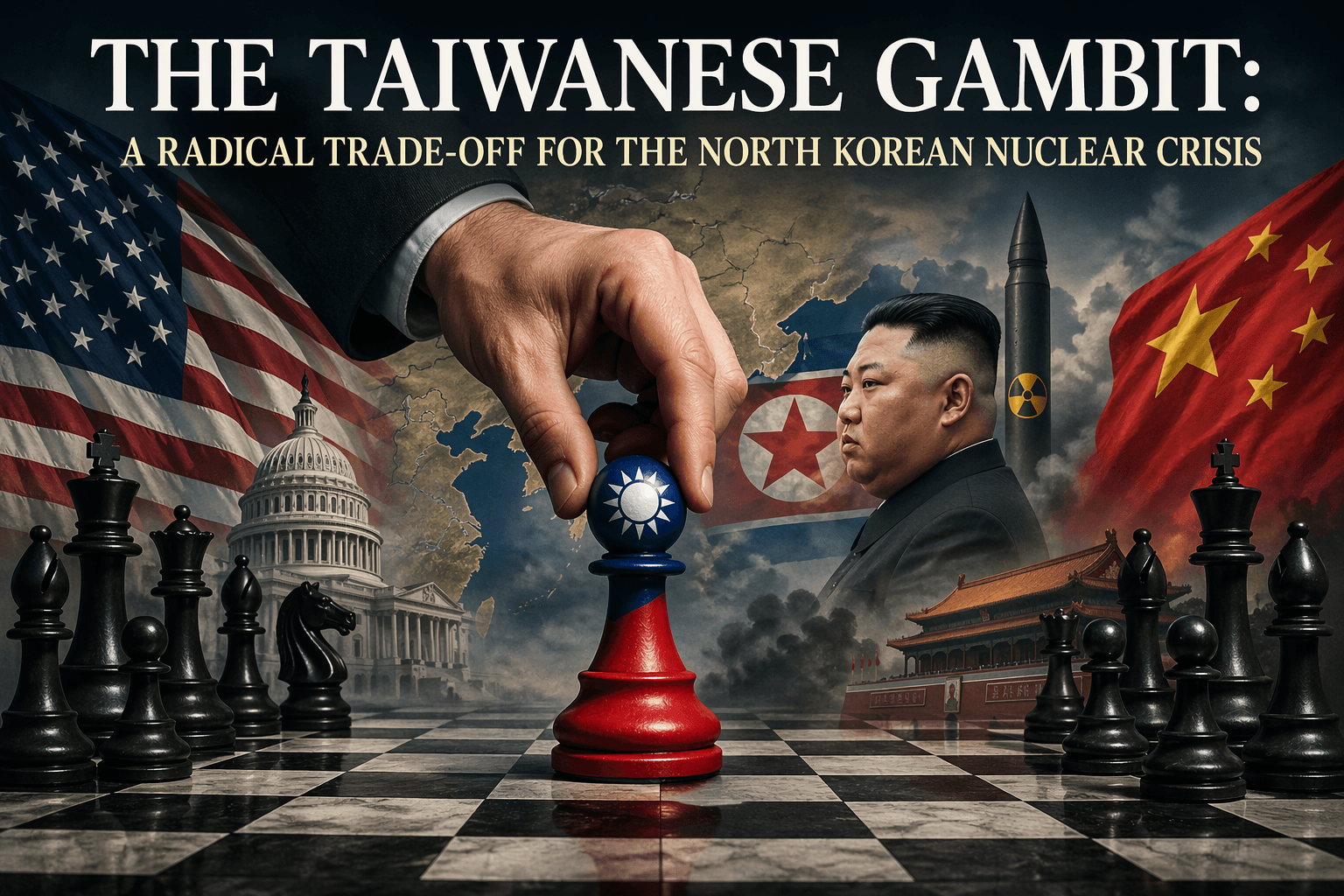
The “Taiwanese Gambit” is based on this reality. It suggests that the United States could reconsider its support for Taiwan in exchange for decisive Chinese action against North Korea. Such a trade-off could potentially resolve the crisis.
Conclusion: A Radical but Costly Solution
Gambit is a term used in chess to designate a move that involves the sacrifice of a piece in order to obtain a decisive advantage. The “Taiwanese Gambit” represents such a strategic choice. It is, arguably, the only option that could lead to a rapid and definitive resolution of the North Korean nuclear crisis. If it seeks such an outcome, the administration of Donald Trump would have to consider playing this gambit on the grand chessboard of Eurasia, in its strategic confrontation with Kim Jong Un.
Absent such a move, the United States must prepare for the prospect of a prolonged strategic rivalry—one that increasingly resembles a new Cold War with a small but highly resilient nuclear-armed state determined to ensure its survival at any cost. This argument does not imply that the gambit should necessarily be played, but rather that it highlights the scale of the trade-off required for a rapid and complete resolution.
The option exists, but it carries a price that may prove politically and strategically prohibitive. Ultimately, the crisis cannot be resolved through military superiority alone, nor through economic sanctions, which have repeatedly failed to alter Pyongyang’s behavior. Nor can it be expected that Russia and China will cooperate with the United States out of a shared commitment to international stability.
The United States opposes North Korea because it perceives a direct threat to its security; China acts according to its own strategic interests; and North Korea, above all, seeks regime survival. The clearer these motivations become, the more evident it is that only a fundamentally realist approach—one that acknowledges competing interests rather than ignoring them—offers any chance of bringing this crisis to an end.
You May Also Like
Why a Palestinian State May Pose Strategic Risks for Israel
The Case Against a Nuclear-Armed Iran
From “America First” to “America Alone”: What the Strait of Hormuz Reveals
What Happens if Russia Wins the War in Ukraine?
The Case for a Unified European Army: Strategic Autonomy, Security, and the Future of EU Power