Introduction
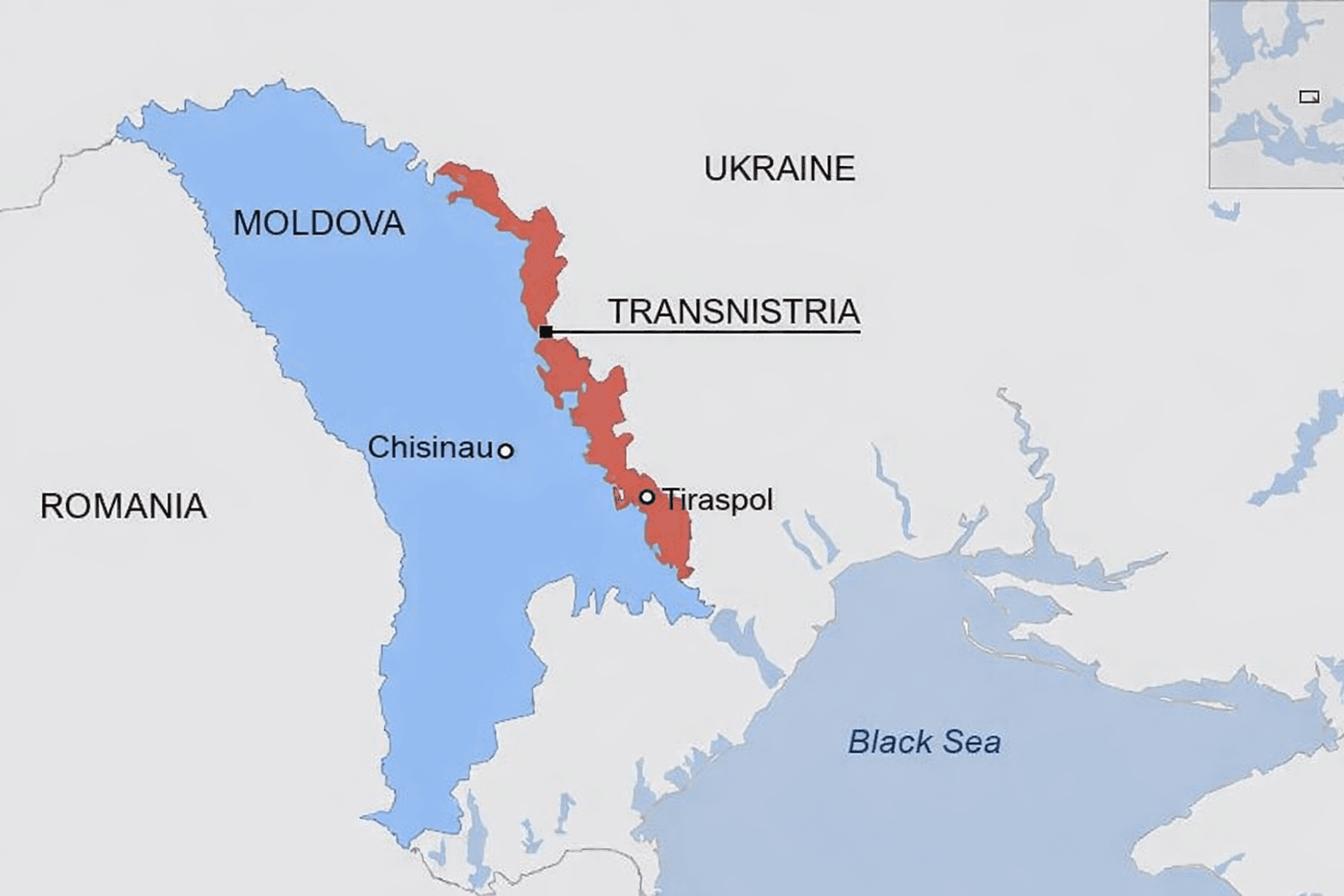
More than three decades after the collapse of the Soviet Union, the conflict in Transnistria remains one of Europe’s most enduring “frozen conflicts.” Situated along the eastern border of the Republic of Moldova, this narrow strip of land has functioned as a de facto state since the early 1990s, supported politically, economically, and militarily by Russia. Understanding how this situation emerged—and why it persists—requires examining Moldova’s independence, the 1992 war, and the geopolitical calculations that continue to shape the region.
Moldova’s Independence from the Soviet Union
The Republic of Moldova declared independence on August 27, 1991, amid the broader disintegration of the Soviet Union. The process was driven by a national revival movement that emphasized Romanian language, culture, and historical identity. Reforms such as the adoption of the Latin alphabet and the recognition of Romanian (officially “Moldovan” at the time) as the state language heightened tensions with minority populations, particularly in the industrialized eastern region of Transnistria.
Transnistria, with its large Russian-speaking population and strong Soviet-era industrial base, opposed these changes. Local elites feared marginalization and potential unification between Moldova and Romania. In 1990, before Moldova’s formal independence, Transnistrian authorities proclaimed the “Pridnestrovian Moldavian Republic” (PMR), setting the stage for confrontation.
Stay ahead of global events.
Get clear geopolitical analysis in your inbox.
The War in Transnistria (1992): Causes, Course, and Responsibility
The armed conflict erupted in March 1992 and lasted until July of the same year. The central issue was Moldova’s attempt to assert sovereignty over the breakaway region, while Transnistrian forces, backed by elements of the former Soviet 14th Army stationed in the region, resisted reintegration.
Objectives:
- Moldova aimed to restore territorial integrity and prevent secession.
- Transnistrian authorities, supported by Russia, sought independence or, at minimum, autonomy outside Chişinău’s control.
Course of the conflict:
Fighting was concentrated around key urban centers such as Bender (Tighina) and Dubăsari. The Moldovan army, newly formed and poorly equipped, faced not only local separatist militias but also experienced officers and matériel from the 14th Army. Russian involvement, although initially ambiguous, became decisive. By mid-1992, Russian General Alexander Lebed intervened directly, effectively halting Moldovan advances.
Who initiated the conflict?
While tensions escalated gradually, the decisive militarization of the conflict cannot be separated from Russian involvement. Transnistrian forces alone lacked the capacity to sustain large-scale operations. The intervention of the 14th Army—under Russian command—tilted the balance and ensured the survival of the separatist regime. In this sense, the conflict’s transformation into a full-scale war was closely tied to Russia’s strategic decision to intervene.
The Freezing of the Conflict
The ceasefire agreement signed in July 1992 established a security zone monitored by a tripartite peacekeeping force (Russia, Moldova, Transnistria). Rather than resolving the dispute, the agreement institutionalized the division.
Transnistria developed all the features of a state—government, army, currency—without international recognition. Moldova retained nominal sovereignty, but lacked effective control over the region. This “frozen” status has endured, largely because it serves the strategic interests of external actors, particularly Russia.
The Role of Organization for Security and Co-operation in Europe
The Organization for Security and Co-operation in Europe has been involved in mediation efforts since the 1990s. It helped establish the “5+2 format” negotiations, which include Moldova, Transnistria, Russia, Ukraine, the OSCE, plus the EU and the United States as observers.
Despite numerous rounds of talks, progress has been limited. The OSCE has succeeded in facilitating confidence-building measures—such as agreements on transportation and education—but has failed to achieve a comprehensive political settlement. The main obstacle remains the divergence between Moldova’s territorial integrity and Russia’s interest in maintaining leverage over the region.
Chişinău’s Attempts at Resolution
Moldovan authorities have pursued multiple strategies:
- Autonomy proposals: Various plans offered Transnistria a high degree of autonomy within Moldova. These were consistently rejected or undermined.
- Federalization attempts: The 2003 Kozak Memorandum, proposed by Russia, suggested a federal structure that would have granted Transnistria veto power over national decisions. Moldova ultimately rejected it, viewing it as a mechanism for long-term Russian influence.
- European integration: In recent years, Moldova has focused on aligning with the European Union, hoping that economic integration and reforms will gradually attract Transnistria.
While these efforts demonstrate persistence, they have not altered the fundamental power dynamics on the ground.
Russia’s Position and Strategic Interests
Russia’s involvement in Transnistria is not incidental—it is strategic. Several key interests can be identified:
- Geopolitical leverage: Transnistria provides Russia with influence over Moldova’s foreign policy, particularly regarding EU and NATO integration.
- Military presence: Russian troops stationed in the region serve as a forward position in Eastern Europe.
- Preventing Western expansion: By maintaining a frozen conflict, Russia effectively blocks Moldova’s full integration into Western institutions.
The narrative promoted by Moscow often frames its role as peacekeeping. In reality, its continued military presence and political backing of Transnistrian authorities sustain the status quo.
Russian Troops: Current Situation
Approximately 1,500 Russian troops remain in Transnistria under two designations: peacekeepers and members of the Operational Group of Russian Forces (OGRF). The latter guards large Soviet-era ammunition depots at Cobasna.
Despite repeated commitments—most notably at the 1999 Istanbul OSCE Summit—to withdraw these forces, Russia has not done so. Moldova considers their presence illegal and a violation of its sovereignty. The continued stationing of Russian troops underscores the occupation-like nature of the situation.
Possible Solutions to the Conflict
Resolving the Transnistrian conflict is challenging but not impossible. Several scenarios are discussed in policy circles:
1. Reintegration with autonomy
This remains Moldova’s official position. It would involve granting Transnistria substantial self-governance while preserving national unity. However, it requires Russian cooperation, which is unlikely under current conditions.
2. Status quo continuation
The most probable short-term outcome is the persistence of the frozen conflict. It is stable, predictable, and—crucially—serves Russian interests.
3. Internationalization of the conflict
Greater involvement by the EU and the United States could shift the balance, particularly through economic incentives and diplomatic pressure.
4. Renunciation of the region
A more controversial option is Moldova formally relinquishing Transnistria. This could remove a major obstacle to EU accession or even open the path toward unification with Romania. However, such a move would raise legal, political, and ethical questions, including the fate of Moldovan citizens in the region.
5. Gradual integration through economics
Some analysts argue that economic interdependence—especially with the EU—could slowly draw Transnistria closer to Moldova, reducing the appeal of separation.
Bessarabia: Between Empires and National Identity
The historical region of Bessarabia—roughly corresponding to today’s Republic of Moldova—was long part of the medieval Principality of Moldavia, sharing language, culture, and political traditions with the broader Romanian space. In 1812, following the Russo-Turkish War, the Russian Empire annexed Bessarabia, beginning a century of imperial rule marked by gradual administrative integration and policies of Russification. The collapse of the Russian Empire in 1917 created a power vacuum, allowing local elites to proclaim autonomy through the Sfatul Țării (National Council), which soon advanced toward full independence. In 1918, amid regional instability and the threat of Bolshevik expansion, Bessarabia declared independence and subsequently voted for union with Romania, formalizing its reintegration into the Romanian state. This situation lasted until 1940, when the Soviet Union issued an ultimatum to Romania and annexed Bessarabia, incorporating it into the Moldavian Soviet Socialist Republic. Although Romania briefly regained the territory during World War II, the Red Army reoccupied it in 1944, reestablishing Soviet control that lasted until 1991. Throughout these upheavals, the region preserved a predominantly Romanian linguistic and cultural identity, despite decades of external domination and political reconfiguration.
Conclusion
The Transnistrian conflict is not merely a local dispute; it is a reflection of broader geopolitical competition in Eastern Europe. While Moldova seeks sovereignty and European integration, Russia uses Transnistria as a strategic tool to maintain influence.
Any durable solution will require addressing this imbalance. Without a shift in Russia’s position—or a significant change in the regional security environment—the conflict is likely to remain frozen. Yet history shows that frozen conflicts are not permanent. Under the right conditions, even entrenched disputes can move toward resolution.
For Moldova, the challenge is to navigate between principle and pragmatism—defending its territorial integrity while adapting to geopolitical realities.
You May Also Like
Kashmir Dispute Explained: History, Power, and the Stakes of a Divided Region
Does NATO Automatically Go to War? Article 5 Explained