Where Geography Becomes Power: Understanding the Forces That Shape Global Politics
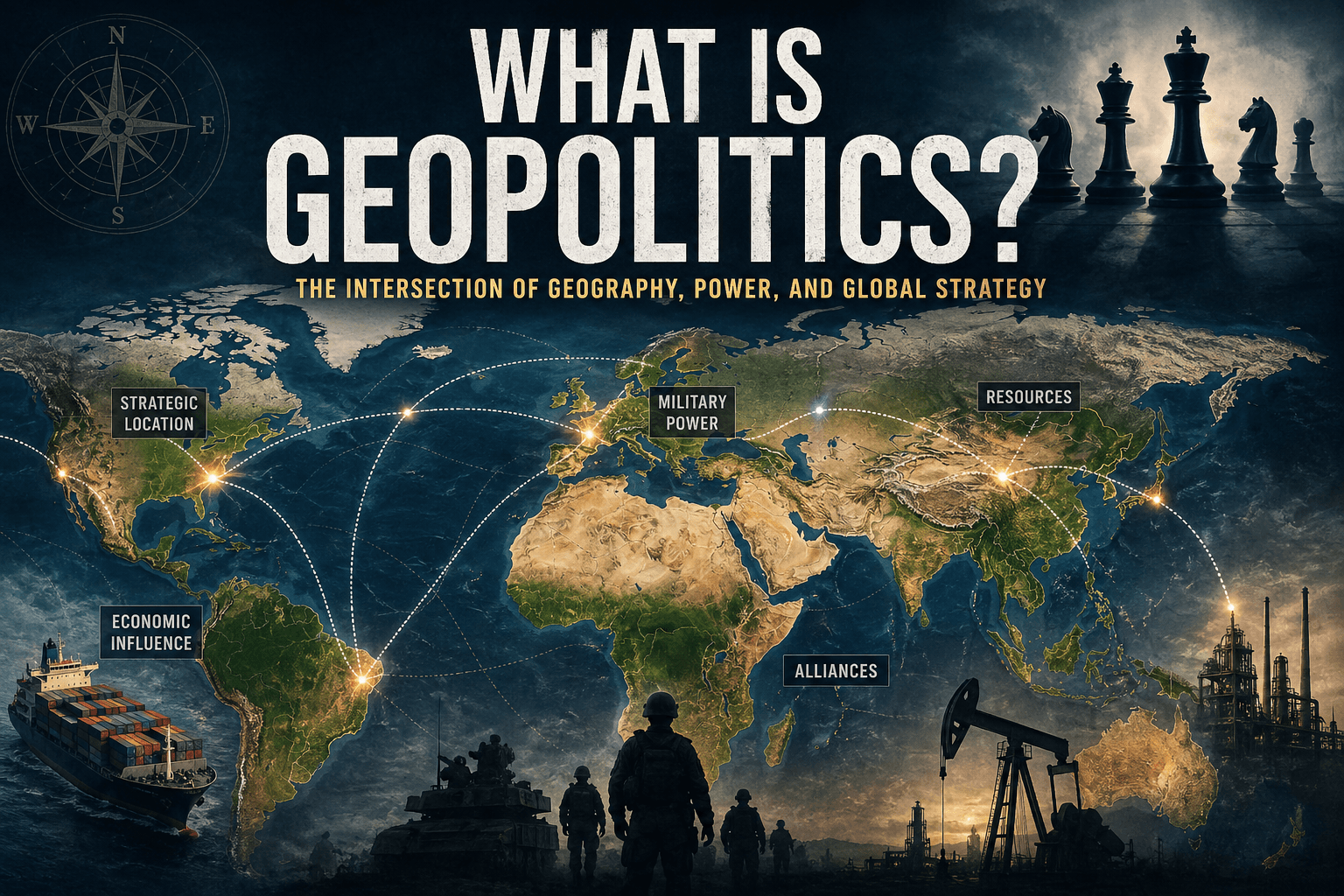
Geopolitics is the analytical framework that explains how geography conditions political power, state behavior, and the structure of international order. In its simplest formulation, geopolitics studies the interaction between space and power—how territory, location, resources, and physical constraints shape strategic choices, alliances, conflicts, and long-term national trajectories. Far from being an abstract academic concept, geopolitics operates as an underlying logic that makes global events intelligible: it clarifies why certain regions are persistently contested, why some states project influence far beyond their borders, and why others remain constrained despite economic or demographic potential.
The Origins of Geopolitics
The modern articulation of geopolitics is closely associated with Halford Mackinder, whose early 20th-century work formalized the idea that control over key geographic zones could translate into global dominance. His famous Heartland Theory argued that the central Eurasian landmass constituted the strategic “pivot” of world power, a proposition that, while debated, continues to echo in contemporary strategic thinking. The endurance of such ideas underscores a central reality: while technologies evolve and political systems change, geography remains a constant constraint that states must navigate rather than ignore.
Stay ahead of global events.
Get clear geopolitical analysis in your inbox.
Key Elements of Geopolitics
At a conceptual level, geopolitics integrates multiple dimensions of power. Physical geography determines access—whether a state is landlocked or maritime, exposed or protected, centrally located or peripheral. Natural resources shape economic resilience and strategic autonomy, as energy dependence or abundance can significantly alter a country’s external behavior. Demographics influence both economic capacity and military potential, while technological development can amplify or partially offset geographic disadvantages. Crucially, these factors do not operate in isolation; geopolitics emerges from their interaction, producing a complex and dynamic system in which states continuously adapt to both opportunities and constraints.
Real-World Examples of Geopolitics
A clear illustration of geopolitics in action can be observed in the ongoing repercussions of the Russian invasion of Ukraine. This conflict cannot be fully understood through ideology or leadership decisions alone; it is deeply rooted in spatial considerations. Ukraine’s geographic position—situated between Russia and the Euro-Atlantic sphere—renders it a strategic buffer zone, a transit corridor, and a contested frontier of influence. For Russia, control or influence over Ukraine mitigates perceived strategic vulnerability by pushing potential adversarial presence further from its core territories. For Western actors, Ukraine represents both a partner and a critical component in maintaining a balance of power in Eastern Europe. The war thus reflects a classical geopolitical struggle over space, security, and influence, rather than a purely isolated or accidental confrontation.
Similarly, the strategic tensions surrounding the South China Sea demonstrate how maritime geography can become a focal point of global competition. This region functions as a vital artery of international trade, with a substantial proportion of global shipping passing through its waters. Beyond its economic importance, it is also believed to contain significant hydrocarbon resources, further increasing its strategic value. Competing territorial claims, combined with the presence of major naval powers, transform the South China Sea into a geopolitical hotspot where control over sea lanes translates directly into economic leverage and military advantage. The situation illustrates a broader principle: in geopolitics, control over key nodes—whether land corridors, maritime chokepoints, or resource-rich zones—can disproportionately influence global dynamics.
The role of alliances further reinforces the geopolitical structure of international relations. Organizations such as NATO exemplify how states seek to mitigate geographic vulnerabilities through collective security arrangements. NATO’s expansion, often interpreted through a geopolitical lens, reflects an attempt to extend a security perimeter, thereby reshaping the strategic map of Europe. From this perspective, alliances are not merely political agreements but spatial strategies designed to project stability, deter adversaries, and manage regional balances of power. The reactions such expansions provoke—whether cooperative or confrontational—highlight the enduring sensitivity of geographic proximity in shaping threat perceptions.
Geopolitics also provides a critical framework for understanding economic competition in the contemporary world. The rivalry between major powers, particularly the United States and China, extends beyond trade disputes into a broader contest over technological dominance, supply chains, and strategic infrastructure. Control over critical technologies, access to rare earth minerals, and influence over key transportation routes—such as ports, rail corridors, and digital networks—constitute a new layer of geopolitical competition. While the tools have evolved, the underlying logic remains consistent: states seek to secure advantageous positions within the global system in order to maximize autonomy and influence.
Importantly, geopolitics is not confined to state actors alone. Non-state dynamics, including multinational corporations, energy markets, and transnational challenges such as climate change, increasingly intersect with traditional geopolitical considerations. Climate change, in particular, is emerging as a transformative factor, altering resource distribution, opening new maritime routes in the Arctic, and intensifying competition over water and arable land. These developments suggest that geopolitics is not static but adaptive, continuously incorporating new variables while retaining its core focus on the relationship between space and power.
Why Geopolitics Matters Today
Despite the growing interconnectedness of the modern world, the relevance of geopolitics has not diminished—if anything, it has intensified. Globalization has increased interdependence, but it has not eliminated competition. On the contrary, it has created new arenas in which geopolitical rivalries unfold, from cyberspace to outer space. The persistence of territorial disputes, the strategic importance of energy corridors, and the centrality of military positioning all point to a fundamental continuity: geography still matters, and it continues to structure the possibilities and limitations of political action.
Common Misconceptions About Geopolitics
A common misconception is that geopolitics is synonymous with conflict or militarism. While conflict is a visible manifestation, geopolitics encompasses a broader spectrum of interactions, including diplomacy, economic strategy, and long-term planning. It is less about predicting specific events and more about understanding patterns—identifying why certain outcomes are more likely than others given the spatial and structural conditions in which states operate. In this sense, geopolitics functions as a lens rather than a doctrine, offering a way to interpret complexity rather than a rigid set of prescriptions.
Conclusion
In conclusion, geopolitics remains an indispensable tool for understanding the contemporary world. It bridges the gap between physical reality and political behavior, revealing the structural forces that shape global events. By examining how geography influences power, geopolitics allows for a deeper comprehension of international dynamics—one that goes beyond surface-level explanations and engages with the underlying logic of state interaction. In an era marked by uncertainty, competition, and rapid change, this perspective is not merely useful; it is essential.
You May Also Like
Geography Does Not Disappear: How Maps Still Shape Global Politics
7 Unspoken Rules of Geopolitics That Great Powers Never Admit