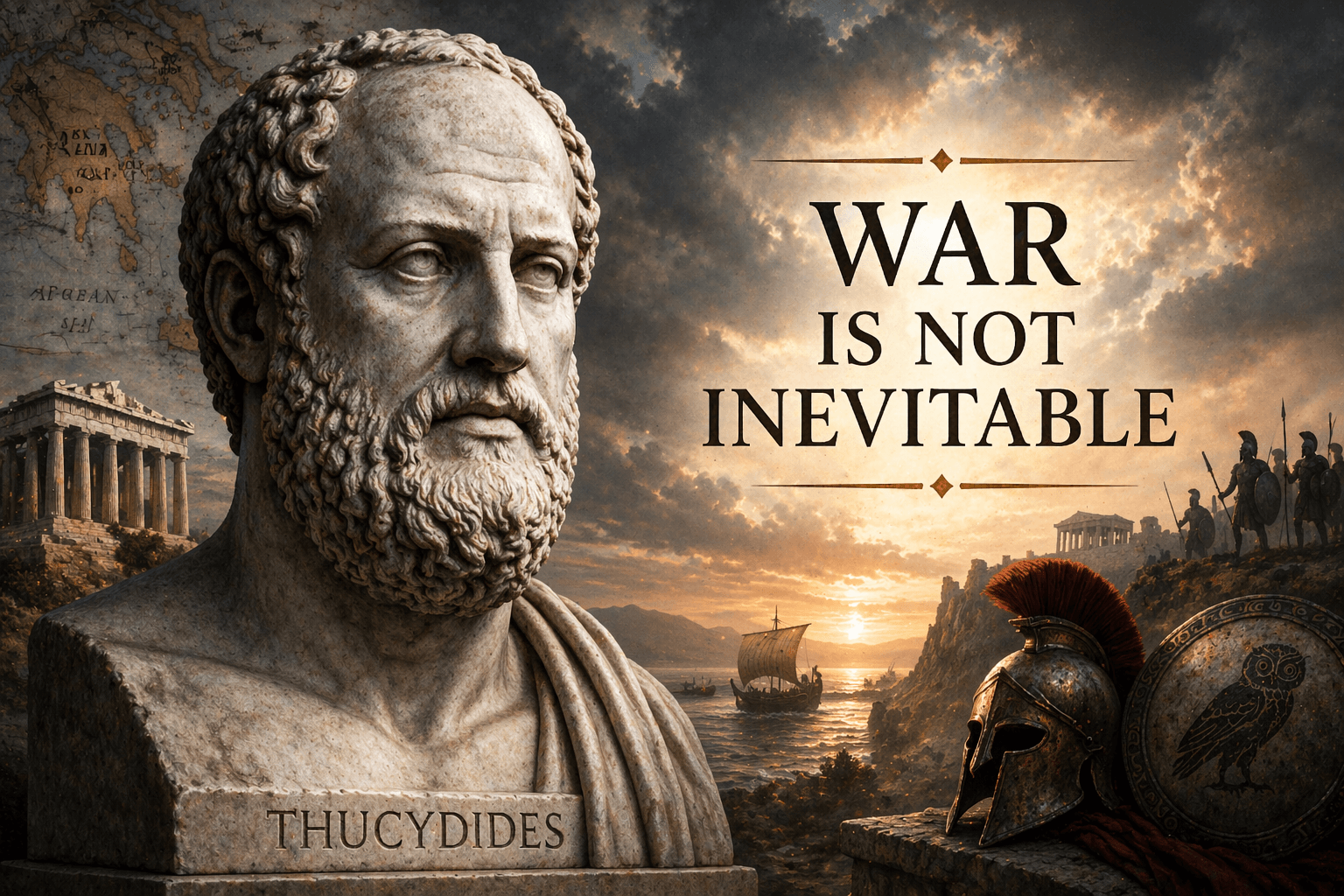
The concept of the “Thucydides Trap” has become a central reference point in contemporary geopolitical analysis, particularly in debates about the trajectory of U.S.–China relations. Popularized by Graham Allison, the term suggests that when a rising power challenges an established one, war is not just possible but likely — perhaps even inevitable. The idea draws on a famous line from Thucydides, who observed that the growth of Athenian power and the fear it inspired in Sparta made the Peloponnesian War unavoidable.
The appeal of this argument is obvious. It compresses complex historical dynamics into a single, intuitive formula. Yet this clarity can be misleading. When examined closely — both in its original context and against broader historical evidence — the “Thucydides Trap” appears less like a law of history and more like a retrospective interpretation that oversimplifies reality.
Stay ahead of global events.
Get clear geopolitical analysis in your inbox.
What Thucydides Actually Said — and What He Didn’t
Thucydides’ work is often cited as the foundation of realist thinking in international relations, but his analysis is far more nuanced than the modern “trap” formulation suggests. His reference to fear as a driving force is not a deterministic claim; it is part of a layered explanation that integrates structural pressures with human agency.
Throughout his account, Thucydides emphasizes how decisions were shaped by competing motivations: fear, certainly, but also honor, interest, prestige, and domestic political pressures. Leaders in both Athens and Sparta debated their options, misjudged each other’s intentions, and responded to events in ways that were neither automatic nor inevitable.
Importantly, Thucydides does not argue that war must follow from a power shift. Instead, he shows how a changing balance of power creates a tense environment in which poor decisions become more likely. The distinction is crucial. One describes a probability shaped by context; the other implies inevitability. Thucydides clearly leans toward the former.
The Real Causes of the Peloponnesian War
The outbreak of the Peloponnesian War was not a single moment of structural collision, but the result of a series of escalating crises over several years. Each episode contributed to rising tensions, but none made war unavoidable on its own.
The Corcyra affair is a telling example. Athens chose to support Corcyra against Corinth, a Spartan ally, transforming a regional dispute into a broader strategic issue. This was a deliberate intervention, not a predetermined response.
Similarly, the revolt of Potidaea — a Corinthian colony under Athenian control — deepened mistrust. Athens’ actions were perceived as aggressive, while Corinth pushed Sparta toward a firmer stance.
The Megarian Decree added an economic dimension to the conflict. By excluding Megara from Athenian markets and ports, Athens imposed what we might today call sanctions. These measures intensified grievances and hardened positions.
Perhaps most revealing is the internal debate within Sparta. Spartan leaders did not unanimously support war. Some argued for caution, recognizing the risks of confrontation. The final decision to go to war was the outcome of deliberation, persuasion, and strategic calculation.
Taken together, these events demonstrate that the war resulted from cumulative choices. At multiple points, different decisions could have altered the trajectory.
The Problem with the “Trap” Narrative
The “Thucydides Trap” is attractive because it offers a clean explanation for complex phenomena. However, this simplicity obscures more than it reveals.
First, it reduces multi-causal processes to a single structural factor: the interaction between rising and established powers. In doing so, it sidelines the role of diplomacy, leadership, and contingency.
Second, it relies on selective historical evidence. Cases that fit the model are highlighted, while those that contradict it are often ignored or reinterpreted.
Third, and most importantly, it encourages deterministic thinking. If policymakers believe that conflict is unavoidable, they may act in ways that increase the likelihood of war — for example, by adopting more aggressive postures or abandoning diplomatic efforts prematurely.
In this sense, the “trap” is not just analytically weak; it can also be politically dangerous.
1914: When the Rising Power Escalated
The outbreak of World War I provides a critical test for the “Thucydides Trap” thesis. If war were driven primarily by the fear of established powers, one would expect the dominant state to initiate conflict in order to prevent a rival’s rise.
Yet in 1914, the dynamic was different. The German Empire, widely seen as a rising power, played a central role in escalating the July Crisis. By offering unconditional support to Austria-Hungary — the so-called “blank cheque” — Germany encouraged a confrontational approach toward Serbia.
At the same time, German military planning favored rapid offensive action. The Schlieffen Plan, which involved invading France through Belgium, reflected a strategic choice to initiate large-scale war under conditions perceived as advantageous.
By contrast, United Kingdom, the dominant naval power, did not immediately seek war. British leaders were initially divided and cautious. It was Germany’s violation of Belgian neutrality that ultimately triggered British intervention.
This sequence complicates the “trap” narrative. The war did not begin because an established power struck out of fear, but because a rising power made a series of high-risk decisions that escalated a crisis into a global conflict.
The 1930s: The Preventive War That Never Came
An equally important counterexample can be found in the years leading up to World War II. If the logic of the “Thucydides Trap” held consistently, France should have launched a preventive war against Nazi Germany during the 1930s, when Germany was rearming but not yet fully prepared for large-scale conflict.
This did not happen, and the reasons are revealing.
The memory of World War I weighed heavily on French society. The scale of human and material losses created a deep reluctance to initiate another war. Public opinion, political leadership, and military planning all reflected this caution.
France’s strategic doctrine was defensive. The construction of the Maginot Line symbolized a belief in deterrence and containment rather than offensive action. This approach limited the appeal of preventive war.
Equally important was the role of alliances. France did not operate in isolation; its strategy was closely tied to Britain. Without clear British support, a unilateral French attack on Germany appeared risky and potentially destabilizing.
Finally, uncertainty played a significant role. Decision-makers lacked perfect information about German intentions, capabilities, and timelines. Acting too early or too late carried its own dangers.
This case underscores a key point: even when conditions might seem to favor preemption, states do not automatically choose war. Strategic culture, domestic constraints, and uncertainty all shape outcomes.
When Power Transitions Do Not Lead to War
Broader historical patterns further weaken the deterministic interpretation of the “Thucydides Trap.” Not all power transitions end in conflict — in fact, many do not.
The shift in global power from the United Kingdom to the United States in the late nineteenth and early twentieth centuries did not result in war. Instead, the two countries developed a cooperative relationship that eventually became a cornerstone of the modern international order.
During the Cold War, the United States and the Soviet Union represented competing superpowers with incompatible ideologies. Despite intense rivalry and numerous crises, they avoided direct large-scale war. Nuclear deterrence, diplomatic engagement, and mutual caution all contributed to this outcome.
These examples demonstrate that structural tension does not dictate behavior. States can adapt, accommodate, and manage competition without resorting to war.
Fear, Misperception, and Decision-Making
A more accurate reading of Thucydides highlights the role of perception rather than inevitability. Fear can distort judgment, leading states to overestimate threats and underestimate opportunities for cooperation.
Misperception is often as important as material power. States act not only on what is objectively true, but on what they believe to be true. This creates space for both escalation and restraint.
Leadership matters as well. Decisions are made by individuals operating under pressure, with incomplete information and competing priorities. Their choices can amplify tensions or defuse them.
This perspective shifts the focus from structural determinism to human agency. It suggests that while certain conditions increase the risk of conflict, they do not make it unavoidable.
Implications for U.S.–China Relations
The “Thucydides Trap” is frequently invoked in discussions about the relationship between the United States and China. While the analogy is appealing, it is also problematic.
The modern international system differs fundamentally from the world of ancient Greece. Nuclear weapons raise the cost of war to unprecedented levels. Economic interdependence links major powers in ways that make conflict extraordinarily costly. International institutions provide mechanisms for managing disputes, even if imperfectly.
Moreover, contemporary leaders are aware of historical analogies like the “Thucydides Trap.” This awareness can serve as a warning rather than a prediction, encouraging efforts to avoid escalation.
The U.S.–China relationship is undoubtedly competitive, but it is not predetermined. Its future will depend on policy choices, strategic communication, and the ability to manage rivalry without allowing it to spiral into conflict.
Conclusion
The “Thucydides Trap” is best understood as a metaphor — and a potentially misleading one. The Peloponnesian War was not the inevitable result of a power transition. World War I did not begin because an established power struck out of fear. France did not launch a preventive war against Nazi Germany despite clear strategic concerns.
In each case, outcomes were shaped by decisions, not destiny.
History does not impose traps. It presents choices — and the consequences that follow from them.
You May Also Like
Geography Does Not Disappear: How Maps Still Shape Global Politics
The 10 Maritime Chokepoints That Control the Global Economy
The World’s Nuclear Powers: Capabilities, History, and Risks to Humanity
Does NATO Automatically Go to War? Article 5 Explained
OPEC’s Rise and Decline: How the Oil Cartel Shaped the Modern World