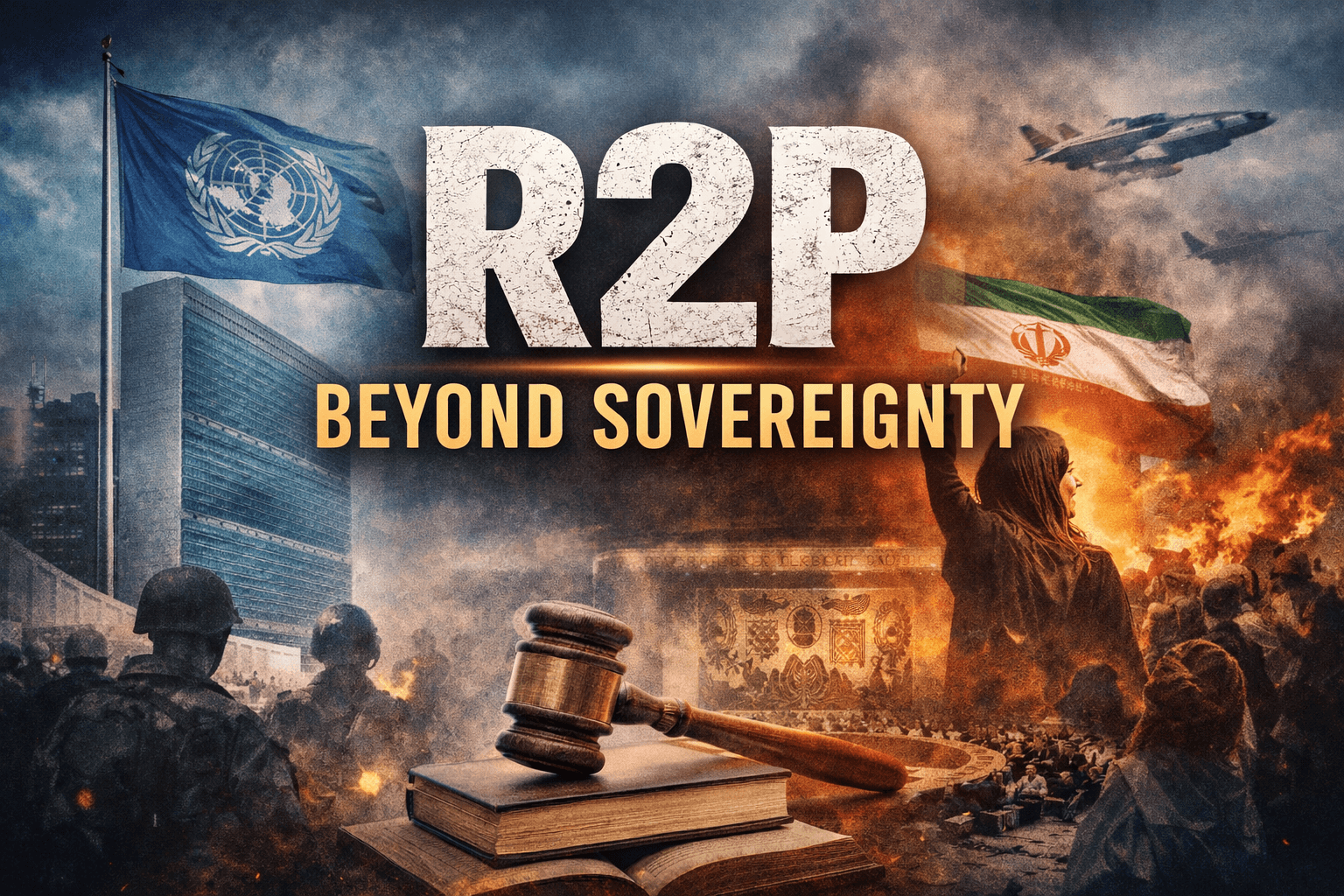
The doctrine of the Responsibility to Protect (R2P) stands as one of the most ambitious normative innovations in contemporary international law. Emerging from the moral and political failures of the international community in the late twentieth century, it seeks to reconcile two principles long considered irreconcilable: the sovereignty of states and the protection of individuals from mass atrocity crimes. In the context of sustained repression in Iran and recurring debates over external intervention, the applicability of R2P raises difficult questions—not only about legality, but also about feasibility and institutional credibility. This article analyzes the historical evolution of R2P, its operational logic, and its limits, while assessing whether the Iranian case meaningfully fits within its framework.
Stay ahead of global events.
Get clear geopolitical analysis in your inbox.
1. Historical Origins and the Redefinition of Sovereignty
The intellectual roots of R2P lie in the crises of the 1990s, particularly the genocide in Rwanda and the atrocities committed during the Yugoslav wars. These events exposed a fundamental contradiction in international law: while human rights norms had expanded significantly, enforcement mechanisms remained constrained by a strict interpretation of sovereignty and non-intervention.
In 2001, the International Commission on Intervention and State Sovereignty (ICISS) proposed a conceptual shift. Sovereignty, it argued, should no longer be understood as an absolute right, but as a responsibility. This reconceptualization was formally endorsed at the 2005 United Nations World Summit, where states accepted that they bear primary responsibility for protecting their populations from genocide, war crimes, ethnic cleansing, and crimes against humanity.
This marked the emergence of what is often termed “conditional sovereignty”—a framework in which legitimacy is tied not merely to territorial control, but to the protection of human life.
2. The Three Pillars and the Logic of Gradualism
R2P is structured around three pillars that reflect a deliberate hierarchy of responses. First, the state itself is responsible for protecting its population. Second, the international community should assist states in fulfilling this duty through non-coercive means such as diplomacy, mediation, and institutional support. Third, if a state manifestly fails, collective action may be undertaken.
Crucially, the doctrine is built on gradualism. Military intervention is not the default mechanism, but the final step in a sequence that prioritizes prevention and peaceful engagement. This structure was intended to differentiate R2P from earlier doctrines of humanitarian intervention, which were often criticized for enabling selective or unilateral uses of force.
3. Practice: Between Normative Ambition and Political Reality
The practical application of R2P has revealed a persistent gap between normative aspiration and political reality. The 2011 intervention in Libya is frequently presented as a textbook case of R2P implementation, yet its aftermath—marked by prolonged instability—has generated skepticism regarding both execution and intent.
In contrast, the Syrian conflict demonstrated the doctrine’s limitations with particular clarity. Despite overwhelming evidence of mass atrocities, the United Nations Security Council remained paralyzed by vetoes and geopolitical rivalries. This pattern has reinforced the perception that R2P is not applied consistently, but rather filtered through strategic interests.
4. Iran: Repression, Risk Factors, and Legal Qualification
Developments in Iran over the past decade have intensified scrutiny under the R2P framework. Reports by international observers point to systemic repression, including lethal force against protesters, arbitrary detention, and widespread allegations of torture. The suppression of movements such as “Women, Life, Freedom” illustrates a pattern of state violence directed at civilian populations.
From a legal standpoint, such conduct may meet the threshold of crimes against humanity, thereby activating the relevance of R2P. Moreover, several structural risk factors are present: entrenched impunity, centralized coercive apparatuses, and ideological governance structures that prioritize regime preservation over individual rights.
Iran is frequently characterized in political science literature as a theocratic authoritarian system with strong totalitarian features, in which religious authority and state power are deeply intertwined. This configuration complicates internal accountability mechanisms and reduces the likelihood of voluntary compliance with international human rights norms.
5. The Illusion of Authorization: R2P and the Security Council Constraint
A central legal requirement of R2P is that any coercive action, particularly military intervention, must be authorized by the United Nations Security Council. In theory, this ensures legitimacy and collective oversight. In practice, however, the structure of the Council raises serious doubts about the viability of this requirement.
The veto power held by permanent members effectively transforms the Council into a geopolitical arena rather than a neutral enforcement body. In cases involving strategically significant states—such as Iran—it is highly improbable that consensus could be achieved. Allies and partners of Iran would be expected to block any resolution authorizing force.
As a result, the formal requirement of Security Council authorization risks functioning less as a safeguard and more as a structural barrier. In certain interpretations, it can even serve as a diplomatic shield, allowing states accused of repression to invoke procedural legitimacy while avoiding substantive accountability.
6. War, Legality, and Strategic Consequences
The framing of a “war against Iran” under R2P is therefore deeply problematic. Legally, R2P does not authorize unilateral military action. Normatively, it emphasizes proportionality, necessity, and the exhaustion of peaceful alternatives. Strategically, the Iranian context introduces additional risks: regional escalation, disruption of global energy markets, and the potential for large-scale civilian harm.
Even if one assumes that the threshold for atrocity crimes is met, the question remains whether military intervention would achieve its stated objective—namely, the protection of civilians. Historical precedents suggest that external intervention often produces unintended consequences, including state fragmentation and prolonged instability.
7. Sovereignty Revisited: Between Erosion and Persistence
R2P undeniably challenges the traditional conception of sovereignty. By linking legitimacy to responsibility, it weakens the normative shield that states have historically used to resist external scrutiny. However, this transformation is neither complete nor uncontested.
Many states continue to view R2P with suspicion, arguing that it can be instrumentalized for political purposes. Concerns about selectivity, double standards, and hidden agendas remain central to debates within the United Nations system.
At the same time, the persistence of veto-based paralysis suggests that sovereignty, while formally redefined, retains substantial practical force. The result is a hybrid system in which norms evolve faster than enforcement mechanisms.
A persistent paradox in contemporary international relations lies in the fact that the most vocal defenders of classical sovereignty—understood as strict non-interference in domestic affairs—are often precisely those states whose internal governance raises the most serious human rights concerns. In such cases, sovereignty is not invoked as a neutral legal principle, but rather as a strategic shield against external scrutiny and accountability. For these regimes, the doctrine of non-intervention risks being transformed from a cornerstone of international order into a protective barrier behind which systematic abuses can occur with relative impunity. Consequently, national sovereignty, in its most rigid interpretation, may come to symbolize not merely independence, but the asserted prerogative of state authorities to exercise unchecked power over their own populations, free from meaningful international constraint.
Conclusion
The Responsibility to Protect represents a significant normative advance in international law, articulating a clear principle: states must not be allowed to commit mass atrocities against their own populations with impunity. In the case of Iran, there is credible evidence of sustained repression that may fall within the scope of R2P.
Yet the doctrine’s capacity to translate moral clarity into effective action remains limited. The structural constraints of the Security Council, combined with geopolitical realities, render the authorization of coercive measures highly unlikely. In this sense, R2P operates more as a framework for political pressure and normative condemnation than as a reliable mechanism for intervention.
The Iranian case thus highlights a broader paradox: while sovereignty is no longer absolute in theory, it remains resilient in practice. R2P narrows the moral space for inaction, but it does not eliminate the political barriers that continue to define the limits of international response.
You May Also Like
Naval Blockade: History and Strategic Utility
Hybrid Warfare: A Misleading Label for an Enduring Reality