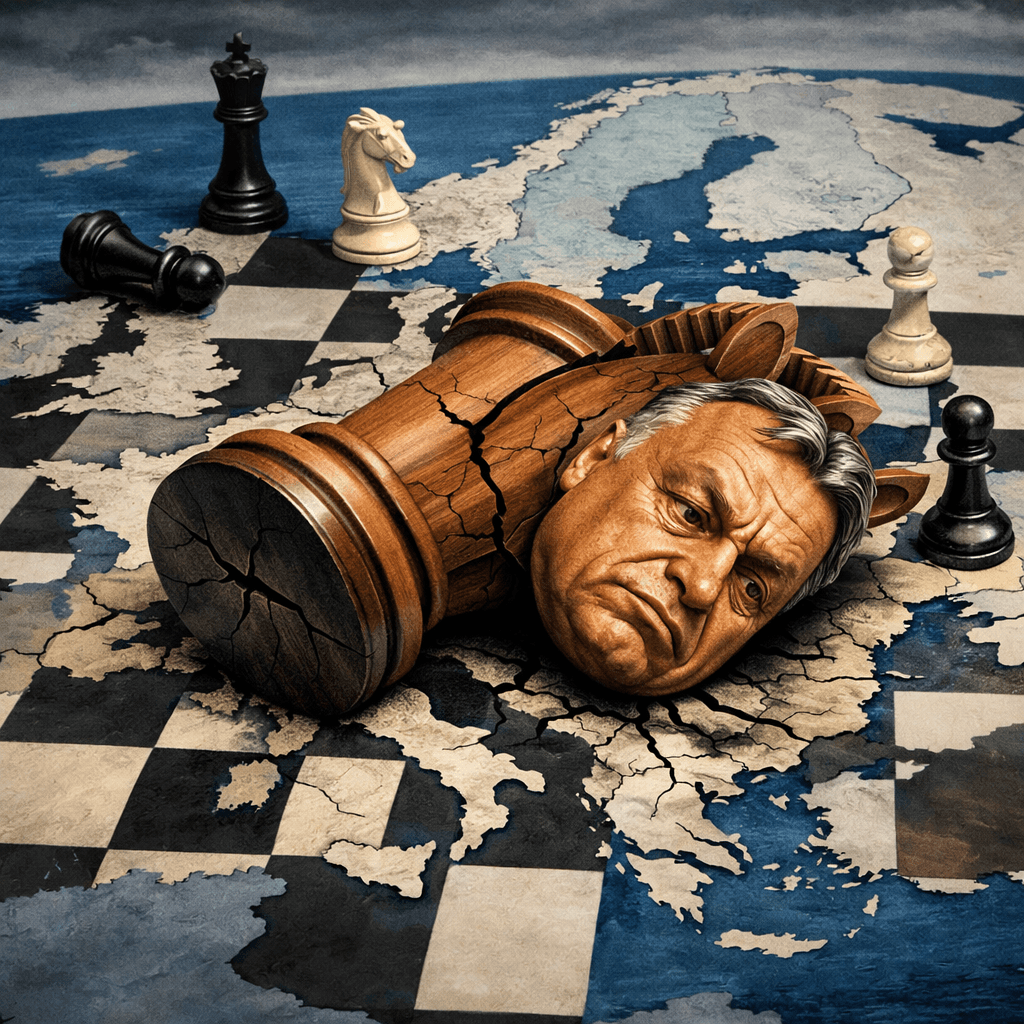
The electoral defeat of Viktor Orbán marks a turning point not only for Hungary, but for the broader European project. For more than a decade, Orbán positioned himself as a disruptive force inside the European Union—often described as a political “Trojan horse” aligned, rhetorically and strategically, with figures such as Donald Trump, Vladimir Putin, and Xi Jinping. His departure from power removes a persistent obstacle within EU decision-making structures and offers Europe a renewed opportunity to act with unity and purpose.
The End of an Internal Blockade
Orbán’s Hungary frequently used its veto power to stall or dilute key EU initiatives, particularly those involving sanctions on Russia or coordinated support for Ukraine. His government maintained ambiguous, often sympathetic relations with Moscow even after Russia’s full-scale invasion of Ukraine in 2022. This posture created friction within the EU, undermining its ability to respond decisively to one of the most significant security crises in post-Cold War Europe.
With Orbán no longer in power, this internal blockade effectively disappears. The European Union now has a clearer path to deliver stronger, faster, and more cohesive support to Ukraine, which has been resisting Russian aggression for over four years. This includes military aid, financial assistance, and long-term reconstruction commitments. A more unified EU response not only strengthens Ukraine’s position but also reinforces Europe’s credibility as a geopolitical actor.
Stay ahead of global events.
Get clear geopolitical analysis in your inbox.
Election Results: A Democratic Shift
The Hungarian elections that led to Orbán’s fall were closely watched across Europe. According to official results, the united opposition coalition secured approximately 52% of the vote, while Orbán’s Fidesz party received around 44%. Voter turnout exceeded 70%, reflecting high public engagement and a clear desire for political change.
Crucially, Orbán accepted the results and conceded defeat—an act that stands out in an era where democratic norms are increasingly tested. His decision to recognize the outcome allows him to exit the political stage with a degree of dignity. This contrasts sharply with the reaction of Donald Trump following the 2020 U.S. presidential election, when he refused to acknowledge the victory of Joe Biden and fueled institutional tensions.
A Pause in Europe’s Populist Wave
Orbán’s defeat comes after years in which populist and far-right movements gained ground across Europe. The United Kingdom’s exit from the EU, known as Brexit, marked a major geopolitical shift. In France, the National Rally (formerly Front National) has steadily increased its electoral strength. Italy saw the rise to power of Giorgia Meloni, while Germany witnessed strong performances from the Alternative for Germany (AfD). In Central Europe, Poland experienced years of tension with EU institutions under nationalist leadership, and Slovakia’s political direction under Robert Fico has raised similar concerns regarding democratic standards and alignment with European policies.
Against this backdrop, the outcome in Hungary offers Europe a moment of respite—a signal that the tide of extremism may not be unstoppable. It suggests that democratic systems, when functioning properly, still possess the capacity to correct course. The victory of the Hungarian opposition indicates that voters can and do reject narratives rooted in isolationism, authoritarianism, and anti-European rhetoric.
Testing the Trend: France’s Crucial Election
Whether this development represents a broader trend or an isolated case remains to be seen. The next major test will come in France’s upcoming presidential election. The strength of centrist and pro-European forces will be measured against the continued appeal of nationalist movements.
France, as one of the EU’s core members, plays a decisive role in shaping the bloc’s future direction. A reaffirmation of pro-European leadership would consolidate the momentum generated by events in Hungary. Conversely, a shift toward extremism could reverse these gains and reintroduce internal divisions.
External Pressure and Internal Vulnerabilities
The alignment—whether ideological or strategic—between Orbán and leaders like Vladimir Putin and Donald Trump reflects a broader pattern. Both Putin and Trump have demonstrated hostility toward the European Union, viewing it as a political, economic, and even military competitor. Weakening the EU from within has been a recurring objective, pursued through both direct and indirect means.
Orbán’s policies often mirrored this approach. By challenging EU institutions, resisting collective decisions, and promoting a nationalist agenda, he contributed to internal fragmentation. His removal from power reduces the effectiveness of such strategies and strengthens the EU’s institutional cohesion.
Democracy’s “Antivirus” at Work
The Hungarian electorate’s decision can be understood as a form of democratic self-correction. If populism and authoritarian tendencies function like a political “virus,” then free and fair elections serve as the system’s “antivirus.” In this case, that antivirus appears to have received a significant upgrade—through increased civic engagement, stronger opposition coordination, and heightened awareness of the stakes involved.
Voters rejected a model of governance characterized by centralized control, media influence, and anti-European messaging. Instead, they opted for a path that reaffirms Hungary’s place within the European mainstream.
The Limits of External Influence
Orbán’s political narrative often drew support from international figures critical of the EU, including Donald Trump and U.S. Vice President JD Vance. However, the Hungarian election results demonstrate the limited impact of such external endorsements.
Both Trump and Vance remain polarizing figures, facing significant criticism domestically and internationally. Their backing did not translate into electoral success for Orbán. This outcome underscores a broader point: European voters ultimately prioritize local realities and democratic accountability over imported political narratives.
A Renewed European Outlook
Orbán’s departure does not solve all of Europe’s challenges. Populist movements remain influential, economic pressures persist, and geopolitical tensions continue to shape the continent’s future. However, this moment represents a meaningful shift.
The European Union now has a clearer opportunity to act decisively in support of Ukraine, to reinforce democratic norms, and to counter both internal and external pressures. It also sends a signal that the European project—often criticized as fragile or divided—retains resilience.
Conclusion
The fall of Viktor Orbán is more than a national political event; it is a development with continental implications. By removing a key source of internal obstruction, the European Union gains a stronger capacity to respond to external threats and internal challenges alike.
At the same time, the peaceful transfer of power in Hungary reinforces the importance of democratic processes. Orbán’s decision to concede defeat contrasts with less constructive precedents and allows for a more stable political transition.
Europe does not emerge from this moment without challenges, but it does gain something valuable: a fighting chance. The trajectory of the continent will depend on whether this momentum is sustained in future elections and policy decisions. For now, however, the European project moves forward—with renewed clarity and cautious optimism.
You May Also Like
A Brief History of Greenland: Key Dates and Events
Viktor Orbán, the EU’s Trojan Horse: What’s at Stake in Hungary’s 2026 Elections
The Case for a Unified European Army: Strategic Autonomy, Security, and the Future of EU Power
Does NATO Automatically Go to War? Article 5 Explained