The expansion of Chinese political influence
China’s rise as a global power is no longer exclusively an economic or military phenomenon. Its growing influence increasingly extends into diplomacy, international institutions, business, sport, culture and the public interpretation of history. Under the leadership of the Chinese Communist Party (CCP), Beijing has sought not merely to defend its national interests, but also to persuade, pressure and, in certain circumstances, compel foreign governments, corporations and individuals to respect its political sensitivities and official narratives. This phenomenon may be described as the Sinification of the world: the gradual extension of China’s political expectations and ideological red lines beyond its national borders. It does not mean the global spread of Chinese civilisation, but rather the internationalisation of the political preferences of the Chinese Communist Party.
The Mbappé case: When economic power becomes political leverage
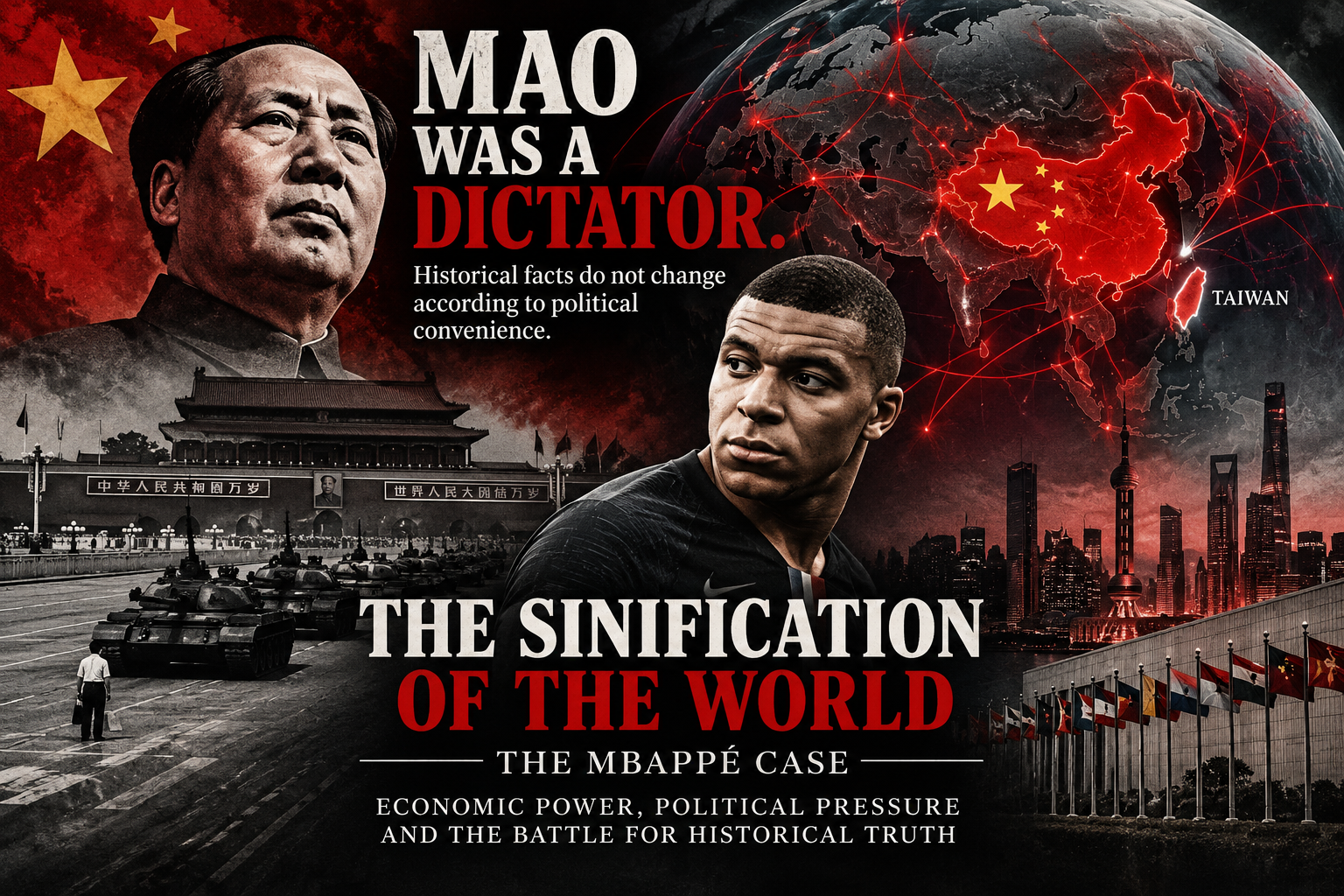
The controversy involving French footballer Kylian Mbappé in October 2026 illustrates this phenomenon. During an interview, the Real Madrid forward apparently referred to Mao Zedong as a Chinese dictator while discussing an internet meme depicting his own face superimposed on Mao’s image. Although the original video has not been independently authenticated by Reuters, the incident triggered a substantial reaction in China. Several Chinese companies terminated their commercial partnerships with the player, Chinese state television suspended broadcasts of Spanish La Liga matches, and the Chinese Football Association demanded a formal apology from both Mbappé and Real Madrid. The footballer subsequently apologised, describing his remarks as ill-judged.
The significance of the episode goes beyond a celebrity controversy. A private remark, apparently intended as humour, acquired international commercial and political consequences because it touched upon the historical legitimacy of the Chinese Communist Party. The important question is not whether individuals or companies in China are entitled to take offence. They are. The question is whether access to the Chinese market should depend on accepting political restrictions concerning historical figures and events. When commercial partnerships, television broadcasting and institutional relationships become instruments of pressure, economic interdependence risks turning into political dependence. The Mbappé case demonstrates how the boundaries of acceptable public expression can extend far beyond China’s territory.
Taiwan: The international cost of diplomatic recognition
Perhaps the clearest example of China’s efforts to shape the international behaviour of other states concerns Taiwan. Beijing maintains that there is only one China and that Taiwan is an inalienable part of its territory. It therefore expects countries maintaining diplomatic relations with the People’s Republic of China to refrain from establishing formal diplomatic relations with Taiwan. However, an important distinction must be made: the Chinese government’s One China principle is not identical to the various One China policies adopted by other governments. These policies differ in their wording and legal implications. Moreover, the People’s Republic of China has never exercised governmental control over Taiwan.
Beijing has nevertheless used diplomatic pressure and economic incentives to restrict Taiwan’s international participation. The experience of Lithuania is particularly revealing. In 2021, Lithuania allowed a Taiwanese representative office to open in Vilnius under the name Taiwan rather than Taipei. China responded with diplomatic hostility and economic coercion, creating serious difficulties for Lithuanian businesses and trade relations. The case demonstrated that even a European Union member state could face substantial economic consequences for a diplomatic decision considered unacceptable by Beijing.
The issue is not simply whether individual countries recognise Taiwan as an independent state. States are entitled to establish their own diplomatic positions. The deeper problem arises when a powerful country attempts to make its interpretation of sovereignty the compulsory framework for everyone else. Taiwan’s shrinking diplomatic recognition illustrates the effectiveness of this strategy: international decisions are increasingly influenced not only by legal considerations, but also by the economic costs of displeasing Beijing.
Mao Zedong: The dictatorship behind the political narrative
Any serious discussion of contemporary China’s political sensitivities must confront the historical legacy of Mao Zedong. Regardless of the official interpretation promoted by Beijing, Mao was a dictator who concentrated political power in his own hands, eliminated political opposition, encouraged a personality cult and presided over campaigns of extraordinary human destruction. His historical responsibility cannot be separated from the political system he created and the policies he imposed.
The Great Leap Forward (1958–1962), intended to accelerate China’s industrialisation and transform agricultural production through collectivisation and unrealistic production targets, resulted in one of the deadliest famines in recorded history. Scholarly estimates of excess deaths vary, generally ranging from approximately 30 million to 45 million. Historian Frank Dikötter has argued for the higher figure, while Chinese historian Yang Jisheng estimates approximately 35 million. These figures are not simple counts of directly executed victims: they include excess mortality resulting from famine, disease, forced collectivisation and state policies. Nevertheless, the scale of the catastrophe and the responsibility of the political leadership are beyond reasonable historical dispute.
The Cultural Revolution (1966–1976) further exposed the destructive nature of Mao’s rule. Political purges, persecution of intellectuals, public humiliations, arbitrary imprisonment and organised violence devastated millions of lives. Research by Stanford sociologist Andrew Walder estimates between 1.1 and 1.6 million deaths and between 22 and 30 million people subjected to political persecution.
Can Mao therefore be described as the greatest mass killer in history? In terms of the estimated absolute number of deaths attributable to his policies, he is frequently placed at or near the top of historical comparisons, with some broader estimates reaching 50–70 million. However, no universally accepted ranking exists, because historians disagree about attribution, indirect mortality and the periods included in such calculations. A rigorous assessment should acknowledge this uncertainty without diminishing the historical responsibility of Mao’s dictatorship.
Tiananmen 1989: The politics of historical silence
The events of June 1989 in Beijing provide another revealing example of the relationship between political power and historical memory. Students, workers and ordinary citizens gathered to demand political reform, greater accountability and an end to corruption. On 3–4 June, the People’s Liberation Army violently suppressed the demonstrations, killing hundreds and possibly thousands of civilians. The exact number remains unknown because the Chinese authorities have never provided a complete and independently verifiable account.
Yet the tragedy did not end with the military crackdown. It was followed by a systematic effort to control its historical interpretation. Public commemorations have been prohibited in mainland China, references to the massacre are censored online, and individuals attempting to preserve the memory of the victims have faced surveillance, detention and imprisonment. Human Rights Watch has repeatedly documented these practices.
The significance of Tiananmen extends beyond the events themselves. It demonstrates how an authoritarian political system can attempt to exercise control not only over public behaviour, but also over collective memory. A historical event becomes politically dangerous when acknowledging it challenges the legitimacy of those who exercise power. Silence is therefore not merely an absence of information; it becomes an instrument of political governance.
Conclusion: The limits of economic interdependence
China’s global influence should not be confused with the legitimate international expansion of its economy, culture or diplomatic presence. Every major power seeks influence, and China is no exception. The distinctive concern arises when economic dependence is used to impose political conformity, when diplomatic recognition becomes subject to coercion, and when historical facts are treated as unacceptable because they contradict the official narrative of a ruling party.
The Mbappé controversy, the diplomatic isolation of Taiwan, and the censorship surrounding Tiananmen and Mao’s legacy are different manifestations of a broader problem: the attempt to export domestic political red lines into international public life. The fundamental question for the twenty-first century is therefore not simply whether China will become the world’s most powerful state, but whether the rest of the world will retain the freedom to disagree with it. A global order in which economic opportunity requires historical silence and political conformity would represent something considerably more consequential than a shift in the balance of power. It would represent a challenge to the principles of intellectual freedom, national sovereignty and historical truth.