Table of Contents
Subtitle: A Democratic Blueprint for Reforming the European Union
Europe’s Real Problem Is Not Federalization
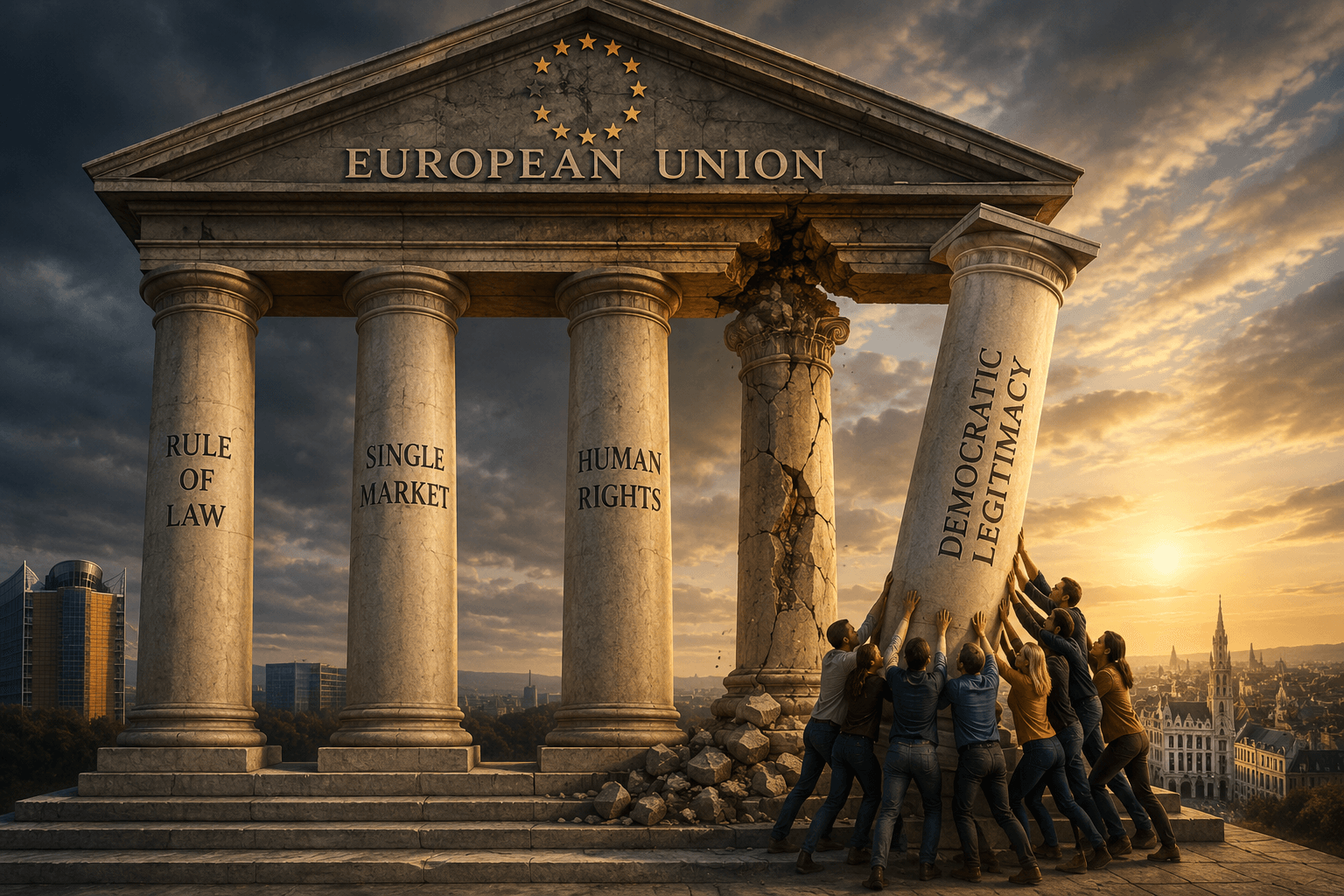
The debate surrounding the future of the European Union has long been dominated by a familiar question: should Europe become a federation, or should it remain primarily a union of sovereign states? While this discussion continues to shape political discourse across the continent, it overlooks what is arguably the Union’s most pressing structural weakness. The European Union does not primarily suffer from a lack of integration. It suffers from a lack of democratic legitimacy.
Over the past decades, the European Union has steadily expanded its influence over virtually every aspect of public policy. Decisions taken in Brussels now affect trade, agriculture, environmental regulation, digital markets, industrial policy, migration, competition law, monetary affairs and, increasingly, foreign policy and security. The Union has evolved from an economic community into a political actor whose decisions shape the daily lives of more than 450 million citizens.
Stay ahead of global events.
Get clear geopolitical analysis in your inbox.
Yet while its powers have expanded, the democratic foundations of its institutions have not evolved at the same pace.
This imbalance has produced what many scholars describe as the European Union’s democratic deficit. Although the term has become commonplace, the underlying problem remains unresolved. European citizens elect the European Parliament directly, but many of the Union’s most influential institutions derive their authority indirectly through negotiations among national governments. As the responsibilities of the European Union continue to increase, this institutional arrangement becomes progressively more difficult to justify.
The debate, therefore, should not begin with the question of whether Europe needs more federalization. It should begin with a more fundamental question: can a political union acquire greater powers without first acquiring greater democratic legitimacy?
The answer should be no.
Federalization without democratization would inevitably widen the gap between European institutions and European citizens. Any meaningful transfer of sovereignty to the European level should be accompanied by a corresponding transfer of democratic power to the electorate. The European project can only become stronger if its citizens are given a greater role in selecting those who govern it.
Institutional reform should therefore precede—or at the very least accompany—any future deepening of European integration.
The Democratic Deficit at the Heart of the European Union
The European Parliament is currently the only major European institution elected directly by citizens. While this represents an essential pillar of European democracy, it is insufficient for a political system whose executive authority continues to expand.
The President of the European Commission is selected through negotiations involving the European Council and subsequently approved by the European Parliament. European Commissioners are nominated by national governments before receiving parliamentary approval. Although this system reflects a balance between supranational and intergovernmental principles, it also creates a significant distance between European decision-makers and the citizens affected by their decisions.
Democratic legitimacy should not be viewed as an obstacle to efficient governance. On the contrary, democratic legitimacy strengthens political stability, increases public trust and reduces the perception that major decisions are taken by distant institutions insulated from electoral accountability.
The European Union has repeatedly demonstrated its ability to adapt its institutional architecture throughout its history. From the Single European Act to the Maastricht, Amsterdam, Nice and Lisbon Treaties, institutional reform has accompanied political integration. The next stage of this evolution should focus not primarily on expanding competences but on expanding democratic participation.
If Europe seeks to become a stronger political union, it must first become a more democratic one.
Directly Electing the President of the European Commission
The most important institutional reform should be the direct election of the President of the European Commission by all European citizens.
Today, the Commission functions as the Union’s executive engine. It proposes legislation, oversees the implementation of European law, negotiates international agreements in areas of Union competence and coordinates many of the EU’s long-term strategic priorities. Despite these extensive responsibilities, its President does not receive a direct electoral mandate from European voters.
A Union-wide election held every five years would fundamentally transform the relationship between European institutions and European citizens. Rather than emerging from negotiations among national leaders, the President of the Commission would derive political authority directly from the electorate.
Such a reform would encourage genuinely European political campaigns instead of twenty-seven parallel national debates. Candidates would be required to present coherent programmes addressing challenges shared by all Member States, including economic competitiveness, migration, defence, energy security and technological innovation.
More importantly, European citizens would finally know precisely who leads the Union’s executive branch and would possess the democratic power to reward or replace that leadership through elections.
Democratic accountability is one of the defining characteristics of every mature political system. There is little reason why the European Union should remain an exception.
Direct Elections for European Commissioners: Combining Democracy with Equality
Reforming the presidency of the European Commission would represent only the first step toward a more democratic European Union. Democratic legitimacy should also extend to the College of Commissioners itself.
At present, Commissioners are nominated by national governments through political negotiations before being approved by the European Parliament. Although this process seeks to balance national interests with supranational governance, it leaves European citizens with only an indirect influence over the individuals responsible for shaping many of the Union’s most important policies.
A more democratic alternative would preserve the principle of one Commissioner per Member State while fundamentally changing the method of selection.
Before each European election, the Commission’s portfolios should be allocated among Member States through a public lottery. Once the allocation is completed, each Member State would organize a direct election to choose the Commissioner responsible for the portfolio assigned to that country. The successful candidate would therefore receive a democratic mandate directly from the electorate rather than from national governments or political bargaining among European leaders.
This proposal may initially appear unconventional, yet its philosophical foundation is deeply rooted in the history of democratic governance.
Learning from Ancient Athens: Why Sortition Still Matters
Long before representative democracy emerged in its modern form, classical Athens developed institutional mechanisms designed to limit political monopolies and reinforce equality among citizens. One of the defining characteristics of Athenian democracy was the widespread use of sortition—the selection of public responsibilities through lottery.
The objective was not to eliminate democracy but to protect it. By reducing elite competition for prestigious offices and preventing the permanent concentration of political influence, sortition strengthened the perception that public institutions belonged to the entire political community rather than to a privileged governing class.
The European Union is, of course, fundamentally different from ancient Athens. No serious institutional reform should attempt to replicate the Athenian model. Nevertheless, one of its underlying principles remains remarkably relevant.
In this proposal, lottery would not determine who governs Europe. European citizens would still elect every Commissioner through competitive democratic elections. Sortition would merely determine which Member State receives each Commission portfolio before the electoral campaign begins.
Such a mechanism would produce several important advantages. It would eliminate lengthy political bargaining over influential portfolios, ensure equal opportunities for all Member States over time and prevent the emergence of permanent institutional hierarchies in which certain countries consistently occupy the most powerful positions.
Democratic legitimacy would therefore remain entirely electoral, while institutional equality among Member States would be guaranteed through an impartial and transparent allocation process.
Rather than weakening democracy, this combination of democratic elections and institutional sortition would strengthen both democratic accountability and political fairness.
A Bicameral European Parliament Inspired by the American Model
The legislative branch of the European Union should also undergo profound institutional reform.
As the Union continues to assume greater political responsibilities, a unicameral Parliament is increasingly insufficient to reconcile two democratic principles that coexist within every multinational political system: the equality of citizens and the equality of Member States.
The United States confronted this constitutional challenge more than two centuries ago. The solution adopted by the Philadelphia Convention remains one of the defining features of American constitutional architecture: a bicameral Congress composed of the House of Representatives, where representation reflects population, and the Senate, where every state enjoys equal representation regardless of size.
The European Union should adopt a comparable institutional model.
Rather than replacing the existing European Parliament, reform should transform it into a bicameral legislature capable of balancing the interests of Europe’s citizens with those of its Member States.
The European Assembly
The lower chamber should become the European Assembly.
Its composition would largely preserve the current electoral system. Representatives would continue to be elected according to population, ensuring that larger Member States receive proportionally greater representation while maintaining the principle of degressive proportionality where appropriate.
The Assembly would remain the principal legislative chamber for matters concerning the internal market, economic regulation, environmental policy, consumer protection, digital legislation, social policy and the Union’s annual budget.
In this way, the democratic principle of representation according to population would remain fully preserved.
The European Senate
Alongside the European Assembly, the European Union should establish a European Senate.
Following the American constitutional model, every Member State would elect exactly the same number of Senators, irrespective of population, territory or economic strength. Malta and Germany, Estonia and France, Luxembourg and Italy would all possess equal representation within the Senate.
This principle would recognize that the European Union is not merely a union of citizens but also a union of sovereign Member States whose political equality deserves institutional protection.
Unlike today’s Council of the European Union or European Council, Senators would derive their legitimacy directly from European voters rather than from national governments. Their democratic mandate would therefore be independent, allowing them to represent both the long-term interests of their Member States and the broader stability of the European Union.
Most importantly, the Senate should possess clearly defined constitutional responsibilities rather than simply duplicating the work of the European Assembly.
Its exclusive legislative competences should include foreign policy, European security and defence, enlargement of the European Union, treaty revisions and major institutional reforms. These are areas that directly affect the sovereignty of Member States and the long-term strategic direction of the Union.
Entrusting these responsibilities to a chamber representing Member States equally would strengthen political legitimacy while reducing fears that larger countries could dominate decisions concerning Europe’s constitutional future.
Such an institutional balance would mirror one of the greatest strengths of the American constitutional model: combining democratic representation of citizens with equal representation of states, thereby creating a more stable and resilient political system.
One Election Day for Europe
Institutional reform should also be accompanied by electoral reform. If the European Union seeks to foster a genuine European political community, it must move beyond the current system in which European elections are largely fought through twenty-seven national political agendas.
All major European elections should therefore be held simultaneously across the Union every five years.
On the same day, European citizens would elect the members of the European Assembly, the members of the European Senate, the President of the European Commission and the European Commissioners assigned to their respective Member States.
A single European election day would reinforce the idea that European democracy extends beyond national borders. Political campaigns would inevitably become more European in character, focusing on shared challenges such as economic competitiveness, technological innovation, defence, migration, energy security and the Union’s global role rather than being dominated almost exclusively by domestic political disputes.
Holding all elections simultaneously would also simplify the electoral calendar, increase public participation and strengthen the democratic legitimacy of every major European institution.
Most importantly, it would contribute to the gradual emergence of a truly European public sphere—a prerequisite for any political union aspiring to greater integration.
European Referendums on Fundamental Questions
Representative democracy should not exclude carefully designed instruments of direct democracy.
Some decisions are simply too important to be left exclusively to negotiations among governments or institutional elites. Constitutional questions affecting the future of the European Union deserve direct democratic endorsement from the citizens whose political community they reshape.
The European Union should therefore establish a legal framework allowing Union-wide referendums on matters of exceptional constitutional significance.
Such referendums could be held on issues including amendments to the European Treaties, the accession of new Member States, major transfers of competences from national governments to European institutions and comprehensive reforms of the Union’s institutional architecture.
To safeguard both democratic legitimacy and the equality of Member States, approval should require a double majority: a majority of votes cast across the European Union and a majority of Member States voting in favour.
This principle would ensure that constitutional change reflects both the democratic will of European citizens and the collective consent of the Union’s members.
Far from weakening representative democracy, such a mechanism would reinforce it by giving citizens the final word on decisions capable of fundamentally redefining the European project.
Reform Before Federalization
None of these proposals necessarily require the European Union to become a federation. They pursue a different objective: making European institutions more democratic before asking them to exercise even greater political authority.
For decades, debates about European integration have concentrated on the distribution of competences between Brussels and national capitals. Far less attention has been devoted to the equally important question of how those exercising European authority should be chosen and held accountable.
This imbalance should now be corrected.
A European Union endowed with stronger democratic legitimacy would also enjoy greater political stability, higher public trust and increased resilience against populism and Euroscepticism. Citizens are far more likely to support ambitious European policies when they know that those responsible for implementing them owe their positions directly to the electorate.
Federal systems throughout history have demonstrated that institutional legitimacy does not arise merely from constitutional design. It depends upon the continuous accountability of political leaders to the citizens they serve.
The European Union should embrace the same principle.
The future of European integration should not be measured solely by the number of competences transferred to Brussels. It should be measured by the extent to which European citizens participate in governing the Union.
Europe’s greatest institutional challenge is therefore not federalization but democratization.
Before Europe transfers more powers to its institutions, it should transfer more power to its citizens.
Only then will deeper integration rest upon the strongest possible foundation: democratic legitimacy.
You May Also Like
Why Now Is the Moment for the United States of Europe?