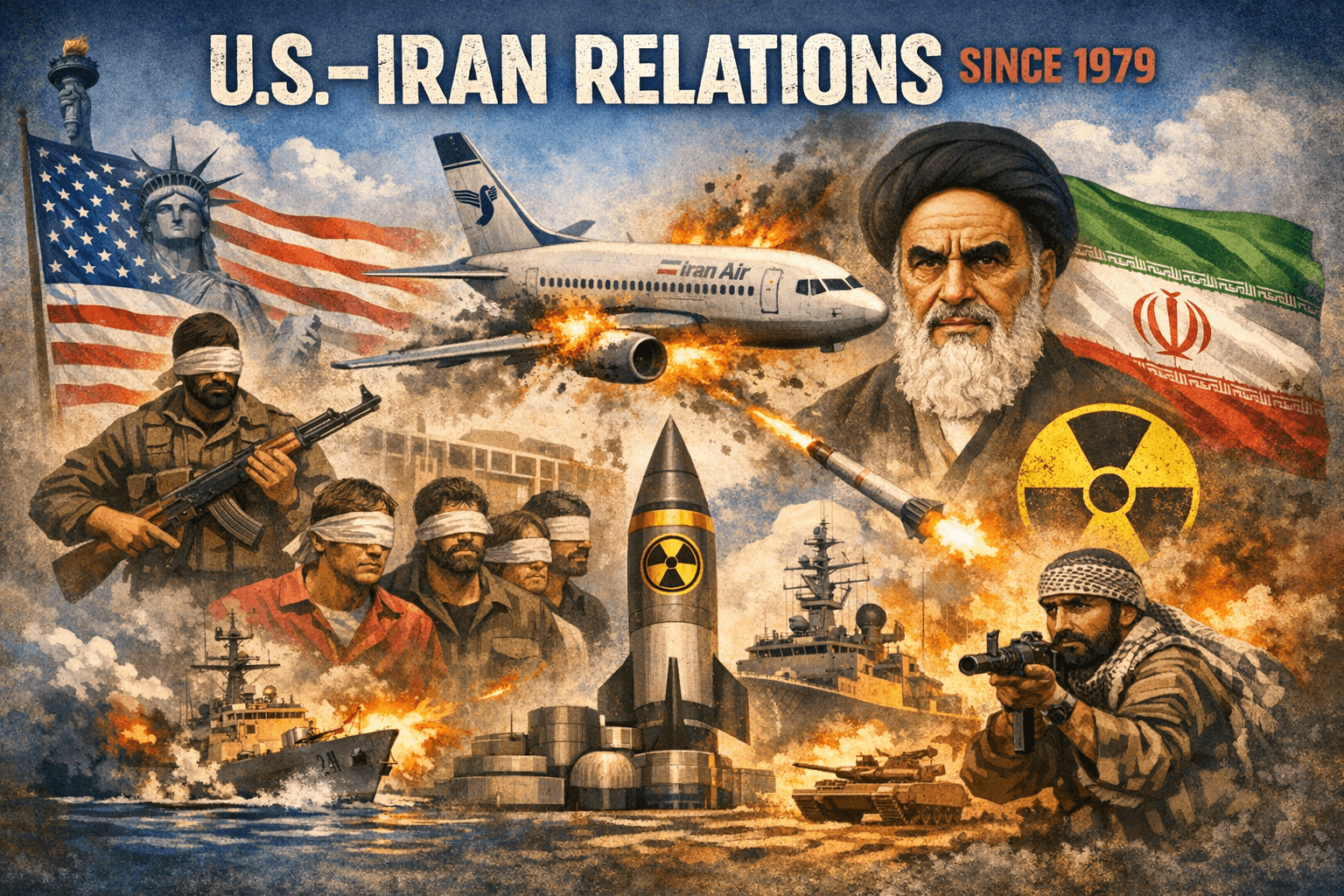
The relationship between the United States and Iran since 1979 has been one of the most complex and volatile in modern international politics. Once strategic allies during the Cold War, the two countries became adversaries after the Iranian Revolution replaced the pro-Western monarchy with an Islamic Republic deeply suspicious of American influence.
Over the following decades, tensions have been shaped by ideological rivalry, regional conflicts, economic sanctions, and disputes over Iran’s nuclear program. At times, diplomacy has produced limited cooperation, but more often the relationship has been marked by crises, military incidents, and mutual accusations.
The following chronology highlights the most significant milestones in U.S.–Iran relations from the Islamic Revolution of 1979 to the present day. The events are presented in chronological order and focus on key political, diplomatic, and military developments that have defined the bilateral relationship.
Stay ahead of global events.
Get clear geopolitical analysis in your inbox.
Chronology of Major Events
1979 – Islamic Revolution in IranThe overthrow of Shah Mohammad Reza Pahlavi, a close U.S. ally, leads to the establishment of the Islamic Republic under Ayatollah Ruhollah Khomeini. Anti-American sentiment becomes a central element of the new regime’s ideology.
November 4, 1979 – Tehran Hostage Crisis BeginsIranian students seize the U.S. Embassy in Tehran and take 52 American diplomats and citizens hostage. The crisis becomes a defining moment in the collapse of U.S.–Iran relations.
April 1980 – Operation Eagle ClawThe United States launches a failed military rescue mission to free the hostages. Mechanical failures and a deadly helicopter collision in the Iranian desert lead to the mission’s cancellation.
January 20, 1981 – End of the Hostage CrisisAfter 444 days, the hostages are released following negotiations mediated by Algeria. Diplomatic relations between the United States and Iran remain severed.
1980–1988 – Iran–Iraq War and Indirect U.S.–Iran ConfrontationDuring the war between Iran and Iraq, the United States gradually supports Iraq. Naval clashes occur in the Persian Gulf as the U.S. seeks to protect oil shipping lanes.
1985–1987 – Iran-Contra Affair (Irangate)Members of the Reagan administration secretly facilitate arms sales to Iran in exchange for assistance securing the release of American hostages held by Hezbollah in Lebanon. Profits are diverted to support anti-communist rebels in Nicaragua. The scandal becomes known as the Iran-Contra affair.
October 1987 – U.S. Attacks Iranian Oil PlatformsFollowing Iranian attacks on shipping in the Persian Gulf, U.S. forces destroy Iranian oil platforms used for military purposes during Operation Nimble Archer.
April 18, 1988 – Operation Praying MantisAfter the USS Samuel B. Roberts strikes an Iranian mine, the United States launches its largest naval engagement since World War II. Several Iranian naval vessels and facilities are destroyed, including the frigate Sahand.
July 3, 1988 – Iran Air Flight 655 Shot DownThe U.S. Navy cruiser USS Vincennes mistakenly shoots down Iran Air Flight 655 over the Persian Gulf, killing all 290 passengers and crew. Washington claims the aircraft was misidentified as a hostile military plane. The incident intensifies Iranian hostility toward the United States.
1989 – Death of Ayatollah KhomeiniIran’s revolutionary leader dies and is succeeded by Ayatollah Ali Khamenei as Supreme Leader. Relations with the United States remain tense.
1995 – U.S. Comprehensive Sanctions on IranThe United States imposes sweeping economic sanctions on Iran, accusing it of supporting terrorism and pursuing weapons of mass destruction.
1997 – Election of President Mohammad KhatamiIran elects a reform-minded president who calls for a “dialogue among civilizations.” Cultural exchanges with the United States increase slightly, though diplomatic relations are not restored.
2002 – Revelation of Secret Iranian Nuclear FacilitiesIranian opposition groups reveal undeclared nuclear facilities at Natanz and Arak. The discovery triggers international concern and begins a prolonged dispute over Iran’s nuclear program.
2003 – U.S. Invasion of Iraq and Limited Iran–U.S. ContactsAfter the fall of Saddam Hussein, U.S. and Iranian officials hold limited talks regarding stability in Iraq. Tensions persist, with Washington accusing Tehran of supporting militant groups.
2006 – UN Sanctions Over Iran’s Nuclear ProgramThe United Nations Security Council imposes sanctions on Iran after Tehran refuses to suspend uranium enrichment.
2009 – Iranian Green Movement and U.S. ResponseMass protests erupt in Iran following disputed presidential elections. The United States cautiously criticizes the crackdown but avoids direct intervention.
2013 – Election of President Hassan RouhaniRouhani, viewed as a pragmatic figure, campaigns on improving relations with the international community and resolving the nuclear dispute.
2015 – Joint Comprehensive Plan of Action (JCPOA)Iran and six world powers—led by the United States under President Barack Obama—sign the nuclear agreement known as the JCPOA. Iran agrees to limit its nuclear program and allow international inspections in exchange for sanctions relief.
January 2016 – Implementation of the Nuclear DealInternational sanctions are lifted after verification that Iran has reduced its nuclear activities in accordance with the agreement.
2018 – United States Withdraws from the JCPOAThe administration of President Donald Trump unilaterally exits the nuclear deal and reimposes severe economic sanctions under a “maximum pressure” strategy.
2019 – Escalating Tensions in the Persian GulfSeveral incidents involving oil tankers and drone attacks on Saudi oil facilities heighten regional tensions. The United States accuses Iran of orchestrating the attacks, which Tehran denies.
January 3, 2020 – Killing of Qassem SoleimaniA U.S. drone strike in Baghdad kills Iranian General Qassem Soleimani, commander of the Islamic Revolutionary Guard Corps’ Quds Force. Iran retaliates with missile strikes on U.S. bases in Iraq.
2020–2021 – Continued Sanctions and Nuclear EscalationIran gradually reduces compliance with the nuclear deal by increasing uranium enrichment levels after U.S. sanctions remain in place.
2021 – Negotiations to Revive the Nuclear AgreementIndirect talks between Iran and the United States begin in Vienna with the aim of restoring the JCPOA, though negotiations proceed slowly and face political obstacles.
2022 – Stalled Nuclear NegotiationsEfforts to revive the nuclear agreement stall amid disagreements over sanctions, verification mechanisms, and regional security concerns.
2023 – Regional Tensions and Proxy ConflictsIran and the United States remain adversaries in several regional arenas, including Syria, Iraq, and the Persian Gulf. Incidents involving drones and naval encounters continue.
2024 – Continued Nuclear Dispute and SanctionsIran expands uranium enrichment capabilities while the United States maintains sanctions and diplomatic pressure. International inspectors report growing concerns about Iran’s nuclear stockpile.
2025–Present – Persistent Strategic RivalryRelations remain characterized by economic sanctions, military deterrence, and intermittent diplomatic contacts through intermediaries. The nuclear issue continues to dominate the agenda of U.S.–Iran relations.
Conclusion
More than four decades after the Iranian Revolution, the relationship between the United States and Iran remains one of the most strained bilateral relationships in global politics. Historical grievances, ideological hostility, and competing strategic interests in the Middle East have repeatedly pushed the two countries toward confrontation.
Several moments—such as the Iran-Contra affair, the naval clashes of the late 1980s, and the downing of Iran Air Flight 655—have reinforced deep mutual mistrust. At the same time, diplomatic openings have occasionally demonstrated that limited cooperation is possible. The most significant example remains the 2015 nuclear agreement, which temporarily reduced tensions before collapsing amid renewed sanctions and political disagreement.
Today, the Iranian nuclear program continues to shape the strategic calculations of both sides. While diplomatic channels remain open through indirect negotiations, the broader relationship is still defined by rivalry, sanctions, and the risk of escalation. Whether future leaders will succeed in transforming this antagonistic relationship into a more stable form of coexistence remains an open question in international politics.
You May Also Like
A Brief History of Greenland: Key Dates and Events
Soft Power vs Hard Power: What’s the Difference and Why It Matters
What Would a NATO Without the United States Look Like?
The 10 Maritime Chokepoints That Control the Global Economy
The World’s Nuclear Powers: Capabilities, History, and Risks to Humanity