Author: Liza Dzanashvili
“I am Georgian, and therefore I am European.”
In 1999, speaking at the European Parliament, Georgia’s then Prime Minister Zurab Zhvania offered a sentence that would become on of the most recognizable expressions of Georgia’s European identity. It was more than a diplomatic declaration. For a country emerging from the collapse of the Soviet Union, it was a statement about who Georgia believed itself to be – and where it believed it belonged.
For Georgians, Europe has long been imagines as a destination – something to return to, something to join, something to become part of. But more than two decades after Zhvania’s famous words, the question may need to be asked differently.
Stay ahead of global events.
Get clear geopolitical analysis in your inbox.
What if Georgia’s relationship with Europe is no longer about whether Georgia belongs in Europe? Or what if it is also about whether Europe’s changing security order can function without taking Georgia seriously?
This question has become particularly important as the Black Sea moves from the margins of European strategic thinking toward its center. Russia’s war against Ukraine has transformed the continent’s security environment, while the European Union’s 2025 Black Sea Strategy explicitly recognizes the region’s growing importance for European security, energy and resilience. Georgia therefore find itself in an unusual position. Its political relationship with European institutions has become increasingly complicated, yet its geographical and strategic importance may be growing.
The paradox is simple – Georgia may be becoming more strategically important to Europe at the same time as its path toward European integration becomes less certain.
From Europe’s Periphery to Its Security Frontier
The Black Sea has never truly been a peripheral space. Several books present it as a crossroads of European and Eurasian history, repeatedly shaped by empires, trade networks and competing political powers. What has changed is not the strategic character of the Black Sea itself, but Europe’s understanding of it. Russia’s full-scale invasion of Ukraine has made the Black Sea impossible to separate from European security. Maritime routes, ports, energy infrastructure, food exports, military mobility and undersea infrastructure have all acquired a security dimension. In May 2025, the European Union responded with a new strategy for a “secure, prosperous and resilient” Black Sea region, bringing together security, connectivity, energy and economic interests. (King 2004)
This is significant because the EU’s approach is broader than enlargement. Brussels is increasingly treating the Black Sea not simply as a neighborhood surrounding Europe, but as a space where European strategic interests are directly at stake.
This distinction matters for Georgia.
Why Georgia Matters
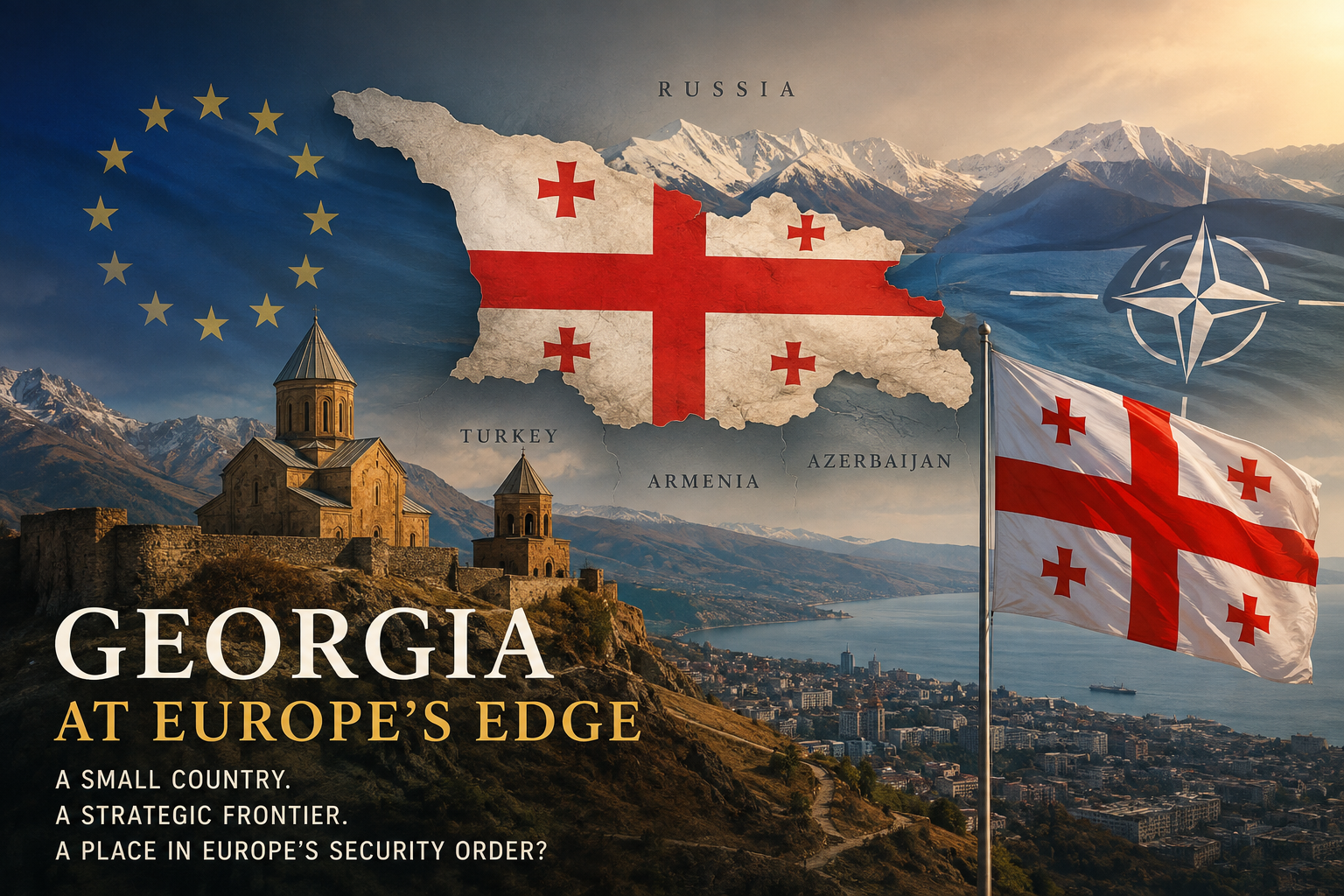
Georgia occupies a peculiar position on Europe’s map. It is not a member of either the European Union or NATO, yet its security is already connected to both institutions and to the wider European security environment. Geography is the obvious starting point. Georgia sits on the eastern shore of the Black Sea, linking the Caucasus with Europe and providing a potential corridor between Europe, the Caspian region and Central Asia. But geography alone does not make a country strategically important. What mattes is what happens because of that geography. Georgia borders Russia, while two of its regions, Abkhazia and South Ossetia, remain occupied by Russian forces. It is situated at the intersection of Russian, Turkish, European and wider Western interests. Its ports, transport routes and energy infrastructure give it significance beyond its relatively small size. This is where Barry Buzan and Ole Waever’s concept of the regional security complex becomes useful. States may be formally separate, but their security is often so interconnected that developments in one state directly affect the others – Georgia is a clear example.
A change in the Black Sea security environment, developments in Ukraine, Russian military behavior affect Georgia even when Georgia itself is not sitting at the table where those decisions are made. Georgia is therefore not simply waiting outside Europe’s security architecture. It is already located inside one of its most sensitive neighborhoods.
The European Paradox
Yet this is where the Georgian story becomes uncomfortable.
Georgia’s strategic relevance and its political relationship with Europe are no longer necessarily moving in the same direction. For years, Georgia’s foreign policy was largely understood trough Euro-Atlantic integration. Joining the EU and NATO was not simply a foreign-policy objective, it became part of the country’s broader geopolitical identity. Today, however, the political picture is considerably more complicated. The European Commission’s 2025 Georgia Report assesses the country’s progress on its EU accession path while raising serious concerns about democratic governance and political developments. At the same time, recent academic research suggests that Georgian foreign policy has moved toward a more flexible strategy of hedging and non-alignment in response to great-power rivalry. This created a striking contradiction. Georgia may be politically drifting further from some of the expectations of European institutions at precisely the moment when its surrounding region is becoming more strategically important to Europe.
These two processes should not be confused. Strategic relevance does not automatically produce political trust. Nor does political disagreement erase geography.
A Place in Europe – but Not Yet the Place Georgia Imagined
This is why Georgia’s place in the emerging European security order should not be measured only by the question of EU or NATO membership. Georgia’s importance to European security may increasingly come from what it is, rather than only from what it hopes to become.
NATO continues to describe Georgia as a longstanding partner and maintains cooperation in areas including defense capacity, interoperability and institutional development. Georgia has also contributed to NATO’s maritime security efforts. Meanwhile, the EU’s new Black Sea strategy explicitly includes Georgia within its broader regional framework. But strategic relevance should not be mistaken for a guaranteed European future. In fact, the opposite may be true.
The more strategically important Georgia becomes, the more consequential its political choices will become for both Europe and Georgia itself.
The country therefore faces a paradox. Its geography gives it strategic value, but geography cannot substitute for political credibility. Its location makes it relevant to Europe, but relevance is not the same as influence. And being part of Europe’s security environment is not the same as being part of Europe’s institutions.
For Georgia, the challenge is to turn strategic importance into strategic agency. The new European security order is unlikely to be built only around the borders of the European Union. It will also be shaped by the spaces connecting Europe to its eastern neighborhood. The Black Sea is one of those spaces, and Georgia sits directly within it.
So, does Georgia have a place in the new European security order?
Yes -but perhaps not in the way Georgians have traditionally imagined.
Zhvania’s declaration was about identity. Today, Georgia faces a different test. Its place in Europe will increasingly be determined not only by what it says it is, but by what role it can play in a changing European security environment.
Georgia may no longer simply be standing at Europe’s door, asking to be let in. The door itself is moving. As Europe’s security frontier shifts toward Black Sea, Georgia is already standing there.
The question is no longer simply whether Europe will make room for Georgia, it is whether Georgia can turn its unavoidable strategic relevance into a credible European role.
Bibliography
European Commission. 2025. Georgia Report 2025. Brussels / European Commission.
European Union. 2025. EU Black Sea Strategy 2025. Brussels / European Union.
King, Charles. 2004. The Black Sea: A History. New York: Oxford University Press.
Disclaimer
The views and opinions expressed in this article are solely those of the author and do not necessarily reflect the official position, editorial policy, or views of Geopolitical Brief, its editors, contributors, or affiliated organizations. The publication of this article does not constitute an endorsement of the arguments, analyses, or conclusions presented herein. Geopolitical Brief is committed to fostering informed discussion and the exchange of diverse perspectives on international affairs and geopolitical developments.
You May Also Like