Introduction
Russia’s full-scale invasion of Ukraine in February 2022 is one of the most consequential geopolitical events of the 21st century. Explaining it requires moving beyond single-cause narratives and examining a layered interaction of history, security concerns, regime dynamics, and competing visions of Europe’s future.
This revised analysis incorporates a critical but evidence-based perspective often underemphasized: that Russia’s own behavior—perceived as revisionist or imperial by its neighbors—helped drive NATO expansion, and that internal regime security in Moscow may have been as decisive as external threats.
1. Ukraine as a Geostrategic Pivot
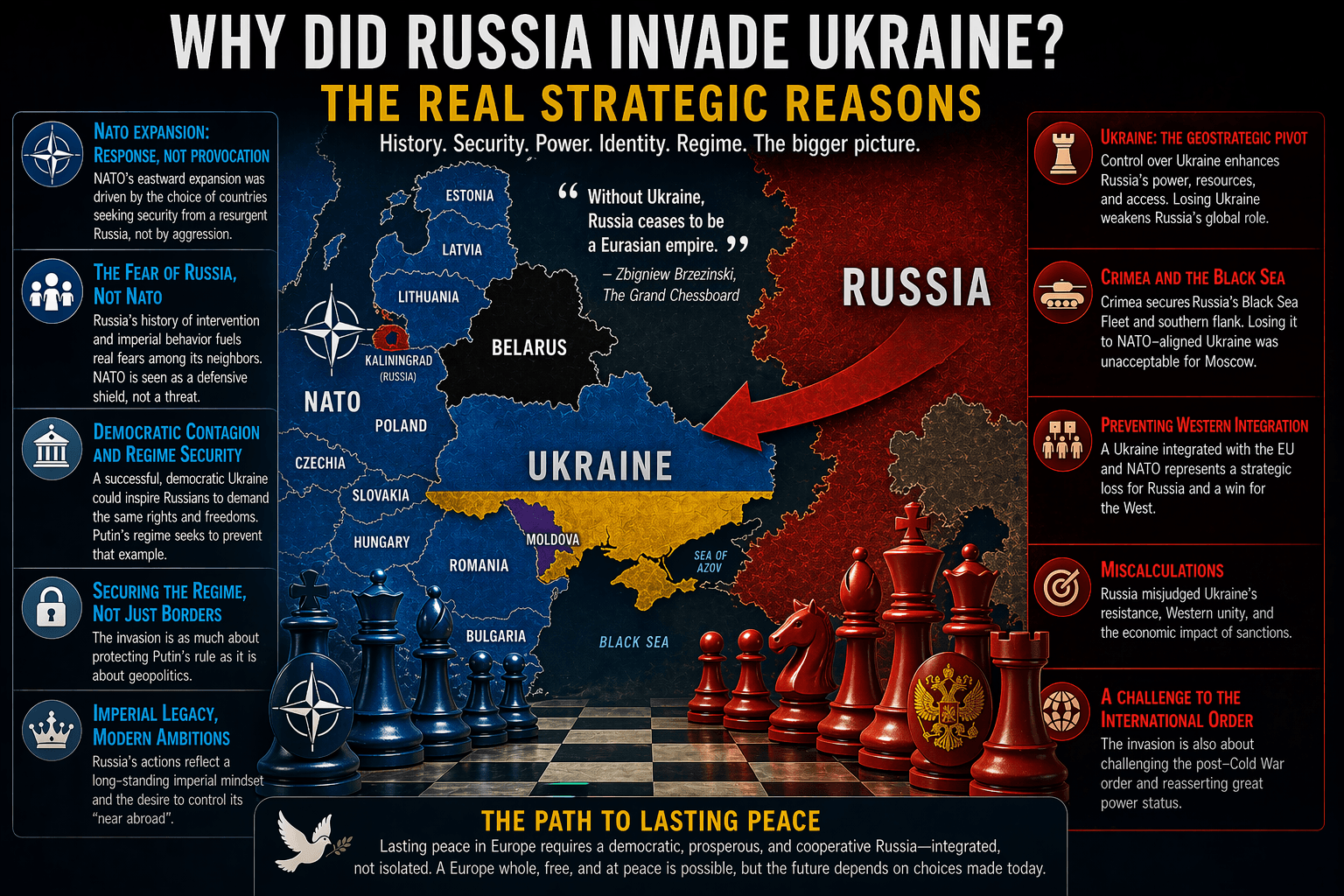
Few analysts have captured Ukraine’s importance more succinctly than Zbigniew Brzezinski in The Grand Chessboard:
“Without Ukraine, Russia ceases to be a Eurasian empire.”
This idea frames Ukraine not as a peripheral state, but as a central pillar of Eurasian power. Control—or even decisive influence—over Ukraine significantly enhances Russia’s strategic depth, population base, industrial capacity, and access to the Black Sea.
Conversely, a Ukraine firmly integrated into Western institutions represents a structural limitation on Russian power. From this perspective, Ukraine is not just another neighbor—it is a geopolitical pivot.
Stay ahead of global events.
Get clear geopolitical analysis in your inbox.
2. NATO Expansion: Cause, Effect, and Feedback Loop
A central debate concerns NATO expansion. While Russian officials consistently frame NATO’s eastward enlargement as a primary cause of insecurity, an equally important counterargument is often overlooked: NATO expansion was, in large part, a reaction to Russian behavior.
For many Central and Eastern European states, historical experience with Russian and Soviet domination shaped their strategic choices after 1991. Countries such as Poland and the Baltic states actively sought NATO membership not to threaten Russia, but to protect themselves from it.
This creates a feedback loop:
- Russian actions (historical and contemporary) generate fear among neighbors
- Those neighbors seek NATO membership for protection
- NATO expands eastward
- Russia interprets this expansion as hostile
This dynamic is a classic security dilemma—but with an important asymmetry: many of Russia’s neighbors perceive NATO not as an aggressor, but as a security guarantee against potential Russian revisionism.
The annexation of Crimea in 2014 and the invasion in 2022 reinforced precisely the fears that had driven earlier NATO enlargement. In this sense, Russian policy has been both a cause and a consequence of NATO’s growth.
3. The Fear of Encirclement vs. the Fear of Russia
From Moscow’s perspective, NATO represents encroachment.
From Eastern Europe’s perspective, Russia represents the threat.
Understanding the invasion requires holding both perceptions simultaneously, even though they lead to opposing policy conclusions.
For Russia:
- NATO near its borders reduces strategic depth
- Western military infrastructure is seen as a long-term risk
For its neighbors:
- Russia’s willingness to use force (Georgia 2008, Ukraine 2014, Ukraine 2022) validates their fears
- NATO membership is viewed as the only credible deterrent
The result is a mutually reinforcing cycle of mistrust.
4. Regime Security and the “Demonstration Effect”
Beyond geopolitics, internal regime considerations are crucial.
One of the less visible but highly significant factors is the risk of political contagion. A successful, democratic, and economically viable Ukraine aligned with the West could serve as a powerful example for Russian society.
This is sometimes referred to as the “demonstration effect”:
- If Ukrainians achieve higher living standards under a democratic system
- If corruption is reduced and institutions strengthened
- If integration with Europe produces tangible benefits
Then Russian citizens might begin to question their own political system.
From this perspective, Ukraine’s transformation posed not just a foreign policy challenge, but a domestic political risk.
The fear is not invasion—but imitation.
5. Preventing Regime Vulnerability
Closely linked to the demonstration effect is the issue of regime security.
Authoritarian systems often perceive democratic movements in neighboring countries as threats, especially when:
- They involve mass protests
- They lead to leadership change
- They are associated (rightly or wrongly) with Western support
The 2004 Orange Revolution and the 2014 Maidan movement were interpreted in Moscow not merely as Ukrainian internal events, but as precedents that could, in theory, be replicated in Russia.
From this viewpoint, limiting Ukraine’s Western integration—and even destabilizing it—can be seen as a way to reduce the risk of similar movements spreading.
This does not mean that such fears are objectively justified, but they are strategically relevant if they influence decision-making.
6. Imperial Legacy and Regional Perceptions
Russia’s neighbors often interpret its foreign policy through the lens of imperial continuity.
Key elements include:
- Historical control over Eastern Europe and the Caucasus
- The Soviet legacy of centralized dominance
- Post-1991 interventions in former Soviet space
Events such as:
- The war in Georgia (2008)
- The annexation of Crimea (2014)
- Support for separatist regions
have reinforced the perception that Russia seeks to maintain a sphere of influence.
This perception—whether fully accurate or not—has had real consequences:
- It accelerated NATO expansion
- It deepened distrust
- It reduced the space for neutrality
In this sense, NATO enlargement cannot be understood purely as Western initiative; it must also be seen as a response to regional threat perceptions.
7. Crimea, the Black Sea, and Hard Power
Strategic geography remains essential.
Crimea provides:
- Control over the Black Sea Fleet
- Power projection into the Mediterranean
- A critical military foothold
The 2014 annexation ensured that Ukraine could not easily align militarily with NATO without losing a key strategic asset.
It also demonstrated that Russia was prepared to use force to secure what it considers vital interests—further reinforcing regional fears.
8. Miscalculation and Overconfidence
Even with structural explanations, the timing and scale of the 2022 invasion suggest miscalculation.
Russia appears to have assumed:
- Rapid collapse of Ukrainian resistance
- Limited Western unity
- Manageable economic consequences
These assumptions proved incorrect.
Strategic logic may explain why conflict became possible—but misjudgment helps explain why it happened the way it did.
9. Competing Visions of Europe’s Future
At its core, the conflict reflects incompatible visions of European order.
One vision:
- Sovereign states freely choose alliances
- Integration into institutions like NATO and the EU is voluntary
Another vision:
- Great powers retain privileged interests in neighboring regions
- Security is indivisible and cannot be built at another’s expense
Ukraine sits at the intersection of these models.
10. Could a Different Russia Mean a Different Europe?
A broader structural question emerges: would European security look different if Russia itself were politically different?
Some analysts argue that long-term stability in Europe would be more achievable if Russia were:
- More politically pluralistic
- Economically integrated with Europe
- Institutionalized within cooperative frameworks
In such a scenario:
- NATO expansion might lose its urgency
- Security dilemmas could soften
- The logic of spheres of influence might weaken
The idea of Russia integrating more deeply with Europe—including, hypothetically, structures like the European Union—remains speculative, but it highlights an important point:
The nature of a state’s internal system shapes its external behavior.
Conclusion
Russia’s invasion of Ukraine cannot be reduced to a single cause.
It emerged from the interaction of:
- Ukraine’s role as a geostrategic pivot
- NATO expansion—both as cause and consequence
- Deep-seated regional fears of Russian power
- Moscow’s perception of encirclement
- The internal logic of regime security
- The risk of democratic contagion
- Historical legacies and identity narratives
- Strategic assets such as Crimea
- Miscalculations at the leadership level
- Competing visions of Europe’s future
A fully objective analysis must acknowledge that NATO expansion and Russian aggression are not mutually exclusive explanations—they are part of a dynamic system in which actions and reactions reinforce each other.
Understanding this complexity is essential not to justify the war, but to explain it—and to assess what conditions might make future peace in Europe more durable.
You May Also Like
Geography Does Not Disappear: How Maps Still Shape Global Politics
The Virtues of the Paper Tiger: NATO in a Changing World
What Would a NATO Without the United States Look Like?