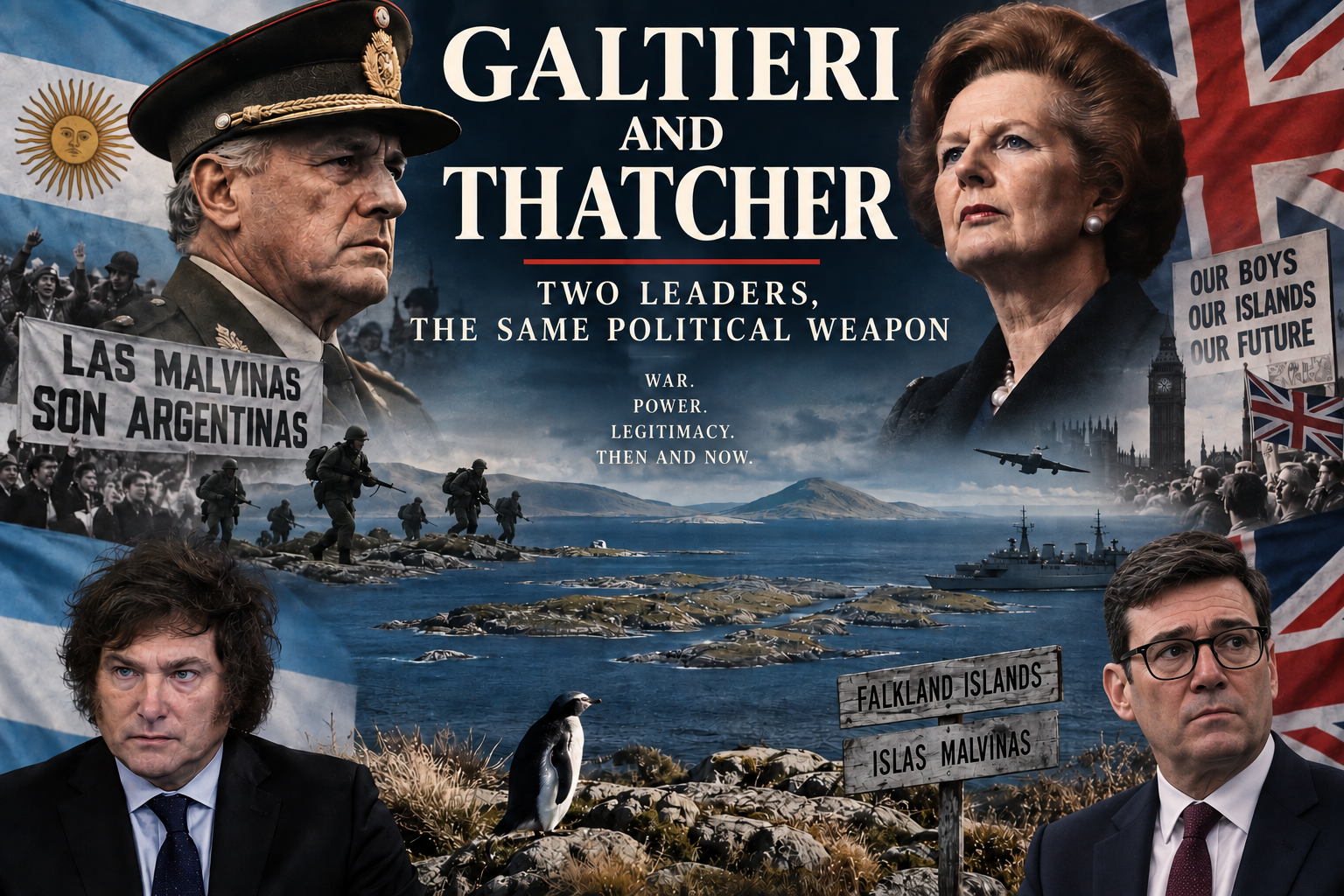
There is an old rule in politics that has survived the transition from ancient kingdoms to modern democracies: military victory creates political legitimacy.
Alexander the Great understood it. Julius Caesar understood it. Napoleon understood it. So did countless kings, emperors and presidents who discovered that a successful war can transform a weak ruler into a national hero.
The Falkland Islands, or Las Malvinas, offer one of the clearest modern examples of this ancient political logic. In 1982, Argentina’s military junta and Britain’s Margaret Thatcher government found themselves in very different political systems, facing very different domestic problems. Yet both discovered that the islands could become the source of enormous political capital.
For General Leopoldo Galtieri, the calculation was explicit. For Thatcher, it emerged after the invasion. In both cases, however, the same weapon produced political consequences: war.
And now, more than four decades later, the same political logic is returning to the South Atlantic.
Stay ahead of global events.
Get clear geopolitical analysis in your inbox.
Islands without inhabitants, claims without agreement
The history of the Falklands begins before either Argentina or modern Britain had established the political relationship that exists today.
The islands were apparently first sighted by the English navigator John Davis in 1592, while the first recorded landing was made by John Strong in 1690. Strong named the strait between the two principal islands Falkland Sound, after Viscount Falkland. The French later gave the islands another enduring name: Îles Malouines, after the sailors of Saint-Malo.
The decisive period came in the 1760s. France established a settlement at Port Louis in 1764 under Louis Antoine de Bougainville. Britain established its own presence the following year at Port Egmont. Spain subsequently took control of the French settlement, while Britain and Spain nearly went to war over their competing claims. In 1771 Spain restored Port Egmont to Britain, although Britain later withdrew its settlement in 1774 while maintaining its claim.
The dispute acquired a new dimension after the independence of the Spanish colonies in South America. Argentina, emerging as an independent state in the early nineteenth century, asserted its claim to the islands. In 1833, however, Britain re-established control after removing the Argentine military presence. Britain subsequently maintained continuous administration, apart from the Argentine occupation of 1982.
This complicated history is precisely why the Falklands dispute has survived for so long. Both sides possess a historical narrative. Neither narrative has been sufficiently persuasive to the other side.
But history alone does not explain why the islands became a battlefield.
Politics does.
Galtieri: victory as political salvation
By 1982 Argentina’s military dictatorship was in serious trouble.
The economy was deteriorating, opposition to military rule was growing, and the junta needed something capable of redirecting public attention. The Falklands were an ideal political target: geographically close to Argentina, emotionally embedded in national identity and controlled by a distant European power.
The junta calculated that Britain would not fight.
That calculation was catastrophic.
On 2 April 1982 Argentine forces invaded the islands. Britain responded by sending a task force across the Atlantic. After ten weeks of fighting, Argentina surrendered on 14 June.
Nearly 1,000 people died.
The political consequences were even more devastating for Galtieri than the military defeat. The war, intended to strengthen the junta, helped destroy it.
The lesson was ancient but brutal: a ruler can use war to create legitimacy only if the war produces victory.
Thatcher: victory as political resurrection
Margaret Thatcher’s position before the war was hardly triumphant.
Her government was unpopular. Britain was experiencing economic difficulties and unemployment was high. Her political opponents had plenty of ammunition.
Then Argentina invaded.
Thatcher did not choose the timing of the conflict. But she chose to fight.
And victory transformed her political position.
The successful campaign restored national confidence, strengthened her authority and became one of the defining achievements of her premiership. The political contrast with Galtieri could hardly have been sharper.
Galtieri had attempted to manufacture legitimacy through military victory and lost power because he failed.
Thatcher acquired legitimacy through military victory because she succeeded.
The same weapon destroyed one leader and strengthened the other.
This is what makes the Falklands War more than a territorial dispute. It was also a demonstration of one of the oldest mechanisms of political power.
Forty-four years later, the weapon has changed
Today, nobody seriously expects Argentina and Britain to repeat 1982.
The political battlefield, however, is becoming familiar again.
Javier Milei has revived the Falklands issue with increasing intensity. Argentina continues to insist that sovereignty over the islands is non-negotiable, while the British government insists that the Islanders’ right to self-determination is decisive. In June 2026, Britain reiterated that the Islanders had overwhelmingly chosen to remain a British Overseas Territory in the 2013 referendum, when 99.8% voted to do so.
Argentina’s position is equally explicit. Buenos Aires describes sovereignty over the Malvinas, South Georgia and the South Sandwich Islands as a permanent and non-renounceable national objective and continues to call for negotiations.
But something else has changed.
The islands are becoming economically and strategically more significant. Oil development around the Falklands has given the dispute a material dimension that was less prominent in 1982. Reuters reported this week that Milei’s government is moving against companies involved in oil development while proposing stronger Argentine naval capabilities near the islands.
At the same time, Washington’s traditional position has become less predictable. Donald Trump has indicated that the United States is reviewing its position on the Falklands, introducing a new uncertainty into a dispute that Britain had long considered strategically settled.
This matters because the political circumstances are beginning to resemble 1982 in one crucial respect.
Both sides have something to gain politically from the dispute.
Milei needs a diplomatic success.
Britain needs one too.
For Argentina, the Malvinas are perhaps the most powerful surviving symbol of national sovereignty. A diplomatic breakthrough would allow Milei to present himself not merely as the president who pursued economic transformation, but as the leader who restored Argentina’s international weight on an issue that has survived generations.
For Britain, the stakes are different but real. London cannot easily afford to appear weak over an overseas territory whose population overwhelmingly wishes to remain British. Nor can it easily accept a diplomatic arrangement that could be portrayed as another retreat from Britain’s global position.
The British government therefore continues to insist on sovereignty, self-determination and defence of the islands. Parliament reiterated in 2026 that Britain’s position on sovereignty and defence remains unchanged.
The battlefield has disappeared.
The political weapon has not.
The Falklands paradox
The most interesting lesson of the Falklands is therefore not military.
It is political.
Galtieri believed that a territorial victory would save his government.
Thatcher discovered that defending the territory could save hers.
Milei now hopes that diplomacy over the same territory can strengthen his political position.
And Britain faces the opposite version of the same problem: it needs to demonstrate that it can defend its interests without allowing the dispute to become another costly military confrontation.
The names have changed. The weapons have changed. The world has changed.
The political calculation has not.
For thousands of years, rulers have understood that foreign-policy success can become domestic political capital. Sometimes the currency is conquest. Sometimes it is military victory. In the twenty-first century, it may be diplomacy.
The Falklands therefore remain important not simply because of who owns two remote islands in the South Atlantic.
They matter because they demonstrate something much larger:
when political legitimacy is at stake, disputed territory can become far more valuable than the territory itself.
That is why the Falklands/Malvinas dispute refuses to disappear.
And that is why, in 2026, an argument that began centuries ago is once again becoming politically useful on both sides of the Atlantic.
You May Also Like